
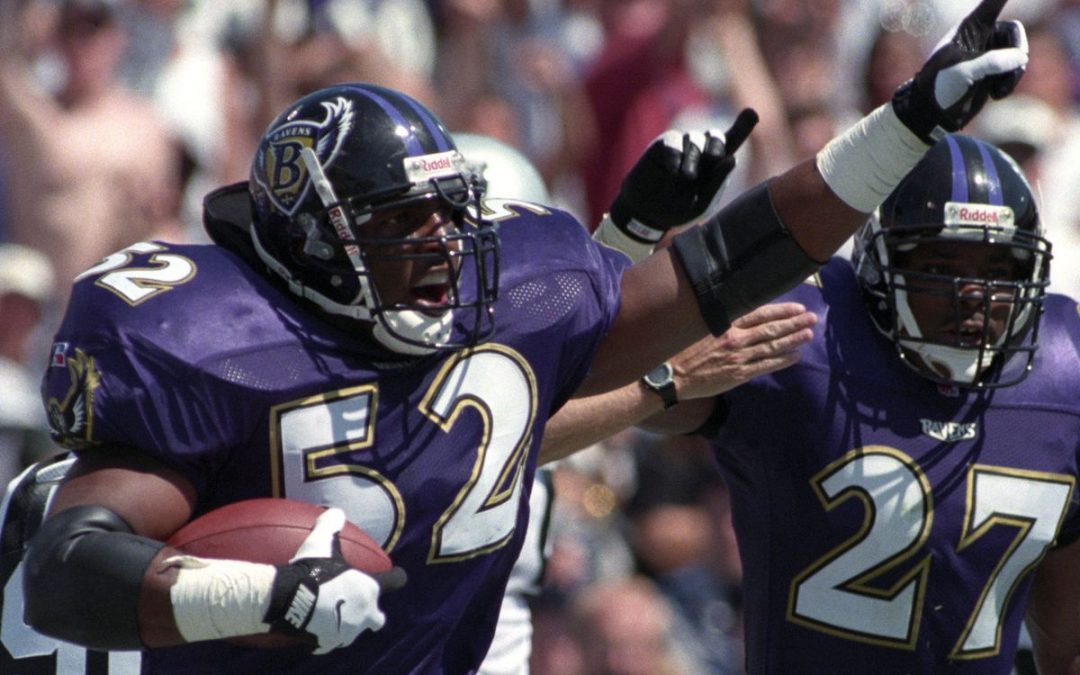
“Baltimore is Back.” That was the theme of Sunday, September 1, 1996, the first day of the rest of Baltimore football fans’ lives. That was the day the scales of justice were rebalanced, and NFL football returned to Charm City.
It was a gorgeous, warm Labor Day weekend. The kickoff temperature was 85 degrees and bright sunshine drenched “venerable” (a nice word for old) Memorial Stadium. The newly relocated and rebranded Baltimore Ravens took the field to face the Raiders, who only the previous season had themselves returned to Oakland from Los Angeles. It was the first time Al Davis’ team had played in Baltimore since winning the famous “Ghost to the Post” double overtime playoff game on Christmas Eve, 1977, the Colts’ last brush with glory before their departure for Indianapolis.
(You can discuss this on the BSL Board here.)
The coach of that Colts team, Ted Marchibroda, had returned to Baltimore to lead the Ravens after an acrimonious departure from the Indianapolis Colts, whom he had brought one play away from a shocking upset of the Steelers in the AFC Championship game the prior season. The Baltimore job was open because owner Art Modell had fired the man who had been the Browns head coach the previous five seasons. That coach had led them to an 11-5 record in 1994 before the team collapsed following the announcement in 1995 of the Browns’ move to Baltimore, and he was very unpopular with the Cleveland fans. You may have heard of him-Bill Belichick. Wonder what ever happened to him?
Marchibroda inherited a team that was 4-5 before Modell announced the move to Baltimore, then won only once the rest of the way to finish 5-11. Between the relocation, coaching change, and late-season collapse, only 11 of the 22 players who started the Browns’ 1995 season opener were in the starting lineup for the 1996 Ravens’ debut.
Crucially, one person who made the trip from Cleveland was Ozzie Newsome. The Browns’ all-time leading receiver was the organization’s Director of Pro Personnel and took on the new title of VP of Player Personnel/General Manager in Baltimore. His first draft turned out quite well-the first two picks were also in that day’s starting lineup-T Jonathan Ogden and LB Ray Lewis. I’m pretty sure you are familiar with their stories.
The Ravens’ organization has done a lot of things right, both on and off the field, since they arrived in Baltimore, but few have been better than the pre-game ceremonies that day. They gathered about 40 former Baltimore Colts to line up on the field wearing their Colts’ jerseys, then having them put on Ravens’ jackets. Then who else but John Unitas strolled out onto the field, wearing his classic number 19 blue jersey, and handed the game ball to referee Dale Hamer. Unitas flashed a huge smile to the crowd as he waved, then embraced Marchibroda before he left the field. Symbolism is important, and when it is done this well, it is glorious.
Finally, it was time for kickoff in Baltimore. I recently rewatched the NBC coverage of the game, available via YouTube to refresh my memory of the festivities and the game itself.
The crowd of 64,124 was hyped. It was the largest crowd to attend a pro football game in Baltimore at that time thanks to the additional seats added in the open end zone beyond what were used for the Colts. Memorial Stadium have received $2 million in renovations to get ready for its two-year stint hosting NFL football again. The field, not having to deal with baseball infield and pitchers’ mound cutouts, looked perfect. NBC announcer Bob Trumpy, who played TE for Cincinnati in the 1970’s, said during the broadcast that it was “the first time I’ve ever seen the field green.” Hurtful but accurate since swirls of dust at the closed end of the stadium was a standard feature of Baltimore Colts home games.
Baltimore won the toss, and rookie Jermaine Lewis received his first of many kickoffs. Lewis had returned two punts for touchdowns in the preseason but could only muster a 19-yard opening return. QB Vinny Testaverde, one of the team’s returning starters, led the offense out on the field, and it was his scramble that led to the Ravens’ initial first down. Testaverde had told Trumpy the day before that this was “the best offense I’ve ever been involved with.” It would need to be because the defense gave up the most points than any Ravens’ defense has to date, an average of 27.6 per game.
Testaverde also became the first Raven to score, rumbling in on a nine-yard run to put Baltimore ahead 7-0 with 39 seconds remaining in the first quarter. He was 4-4 passing for 68 yards at that point, a great start to a season that would end with his appearance in the Pro Bowl. The Ravens ran 18 plays in the opening quarter to just 8 for the Raiders, who came into this game with a six-game losing streak carried over from 1995.
Oakland’s touted defensive line asserted itself in the second quarter. and momentum shifted to the Raiders. QB Billy Joe Hobert, making only his third career start in place of the injured Jeff Hostettler, sliced up the Ravens’ secondary and threw two touchdown passes to future Hall of Fame WR Tim Brown to put Oakland up 14-7 at halftime. This came despite seven penalties, always a Raider trademark, most of them from false starts by the offensive line. Hobert finished 8-10 passing for 124 yards in the second quarter with the 2 TDs. Oakland outgained Baltimore 189-115 for the half.
The score could easily have been 21-7 Raiders at the break. After Oakland scored their first touchdown, the Ravens’ Earnest Hunter fumbled the kickoff, setting the Raiders up at the Ravens’ 19-yard line. Hobert threw a strike to TE Rickey Dudley in the end zone, but rookie LB Ray Lewis stole the ball away from him before Dudley could gain complete possession. Back-to-back quick scores would have been difficult for Baltimore to overcome against the Raiders’ tough defense.
The game turned around on Baltimore’s second possession of the second half. Still trailing 14-7, Marchibroda had his team go to a no-huddle offense. OT Orlando Brown (Zeus) later told the Baltimore Sun that Marchibroda had told them to “go no huddle and jump their asses.” The no-huddle attack, although not a hurry-up, did prevent Oakland from freely substituting on defense. This resulted in the Raiders visibly wilting on that warm afternoon and finally slowed up the pash rush that had effectively harassed Testaverde in the first half. I counted three penalties when Oakland tried to sub on defense, but Testaverde alertly called for the ball to be snapped and caught them with too many men on the field.
The offense did not exactly explode, but it took control of the game away from the Raiders. Testaverde started zeroing in on WR Michael Jackson and TE Brian Kinchen and moved the Ravens to two field goals, then what became the game winning score on the first three possessions running the no-huddle. Earnest Byner capped the scoring from one yard out to put Baltimore back in the lead, 19-14 after a failed two-point conversion as the third quarter ended.
The Raiders failed to get a first down on their only two possessions of the fourth quarter, and Baltimore ran out the final 6:23 of the game to seal the 19-14 victory, the first in franchise history.
The way the Ravens closed out that initial game is probably the only thing, besides #52 and #78, that would look familiar to fans who came along later. The helmets, the logos in the end zone, the huge numbers on the jerseys, the stadium, the style of play-none of it would be part of shaping the franchises’ identity. That began in earnest two years later when the new stadium opened, followed the next season by the hiring of Brian Billick and the turning over of most of the roster. The rest, as they say, is history.
Don’t misunderstand me, though; the events of September 1, 1996, were vitally important to Baltimore football history, and dare I say even the city of Baltimore itself. It didn’t really matter what it looked like.
What mattered is that it happened. The old Colts handed their legacy off to a new generation that has, for the most part, honored it and added to it.
Baltimore IS back in the NFL, and this time, it looks like it’s for good.
I’ll be taking a break next week, and coming in two weeks, I will share my thoughts on the most important athlete in Baltimore sports history, John Unitas, to honor the 19th anniversary of his passing.
In the meantime, you can follow me on Twitter and I keep up with the AFC North @jimjfootball.
Remember, it’s good to look back as long as you live forward.

Jim Johnson spent most of his life in Maryland, growing up with the Orioles, the Colts, Terps, and later Ravens. He started his sports writing career as “The Courtmaster,” covering the Terps and ACC hoops and was a frequent guest on Bob Haynie’s old WNST show and other sports talk across the region. He is currently in his second run at BSL. After previously covering Maryland and Big Ten Football, he now writes about the NFL, primarily the action in the AFC North. Jim covers both current and historic stories, seeking perspective and having fun in the process.