
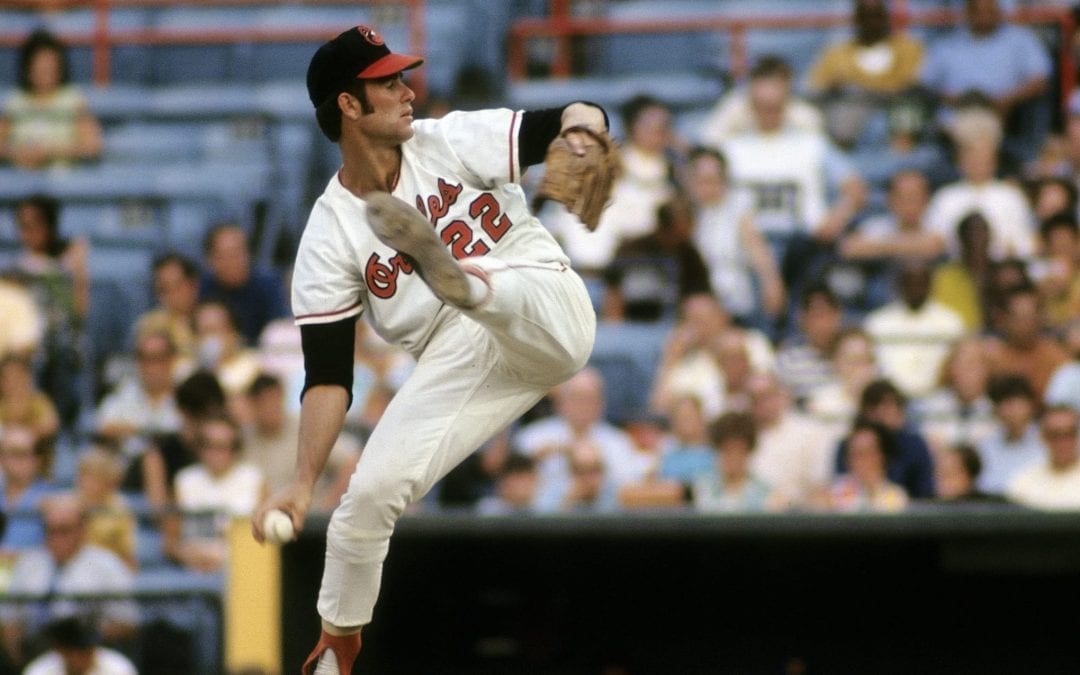
Welcome to the long delayed conclusion to the Best All Time Oriole Seasons At Every Position series! The world is moving quickly underneath our feet. Change is in the air, for the better we hope, but one thing that isn’t changing is Orioles history and that right there is called a segue, not a segway which is a totally different thing that propels you forward. Deep breath. Okay. We’ve covered the best seasons ever by Orioles infielders, outfielders, catchers, and DHs. Now it’s time to look at pitchers.
Because there are five pitchers in a rotation, I picked five pitchers’ seasons to round out the rotation. The only rule was no duplicate names, so I couldn’t pick five seasons by Jim Palmer. Just one from ol’ Cakes, thanks very much. In a related story, did you know Jim Palmer’s nickname was Cakes? Let’s collectively try our best to brush that off and move on to the best seasons ever by Orioles starting pitchers!
(You can discuss this on the BSL Board here.)
1. Jim Palmer’s 1975
Yes, ol’ “Cakes” Palmer wasn’t going away that easily. In 1975 Palmer put up a 2.09 ERA in 323 innings of work. My arm hurts just typing that sentence. The strikeout and walk numbers don’t jump off the page but that’s mostly because baseball in 1975 was completely different than it is today. Still, Palmer’s ERA+ of 169 (nice!) led baseball and he won his second Cy Young Award. It began a four year run where Palmer won two consecutive Cy’s, then finished second and third. It was probably the greatest four year run by any Orioles starting pitcher. The only question here is which Palmer season to pick? I picked 1975 because his ERA was both silly low and led baseball, but you could probably pick any one of six or so different seasons in his career and not really be wrong.
One more Palmer thing: from 1975 through the 1978 season, Palmer threw 1,253 innings of 2.49 ERA ball. That’s an ERA 42 percent above average. He started 155 games, completing 89 of them, and went 86-47. At the start of that string, Palmer was a good pitcher. At the end of it Cakes had a plaque.
2. Mike Mussina’s 1999
I’m not sure there is a more underrated pitcher in the last 40 years of baseball than Mike Mussina. Yes, he’s in the Hall of Fame, so maybe I’m full of it but the man could flat out pitch in a way that out-paced his national reputation by a good bit. O’s fans knew how good he was though. For his Orioles career, his ERA was 30 percent above average, and that’s over 2000 innings. Mussina was also incredibly consistent. Of his 18 seasons, he put up a below league average ERA in just three of them, and he put up an ERA at least 20 percent above league average 12 times. Not unlike Palmer, there are numerous candidates for this list among Mussina’s 10 excellent seasons with Baltimore. So your mileage may vary on this, but I went with Mussina’s 1999 season something you already know if you are good at reading titles. Moose didn’t lead the league in anything that season, but he did finish second in WAR, FIP, and HR/9, third in ERA+ and (unsurprisingly) ERA, and sixth in strikeouts and fewest walks. It was a very Mussina season in that he didn’t stand out in any one category, but he was really good in every category. That all said, if you went with Mussina’s 2000 season, or his 1996, or his 1995, or his 1998 or his 1997 season, I couldn’t fault you.
3. Mike Cuellar’s 1969
Justin Verlander threw 223 innings last season and that led the league by nine. The year before Max Scherzer led baseball with 220.2 innings pitched. So 290 isn’t a number of innings anyone throws anymore. Yet that’s how many Cuellar threw in 1969 and he did it with an ERA 49 percent above league average. Cullar’s signature pitch was a screwball, sort of the opposite of a curveball. While a curveball breaks to the pitchers opposite side (to the left for a right-hander), a screwball breaks, in defiance of physics, back towards a right-handed hitter from a right-handed pitcher. It’s almost anti-science and it’s definitely anti- the interior structures of your arm, which is probably why almost nobody throws screwballs anymore. Even so, that was Cuellar’s pitch. That and a pinpoint fastball were what won him the Cy Young Award in 1969 and helped the Orioles to 109 regular season wins (we won’t talk about the stupid smelly Mets), still the most wins by any Orioles team in a single season (by one over the 1970 team). Cuellar wasn’t a Hall of Famer like his rotation-mate, Palmer, but he is firmly ensconced in the Hall of Very Good, with his 1969 season (and his 1970 World Series trophy) sitting at the top of his career accomplishments.
4. Mike Flanagan’s 1979
Through 2,770 innings and 18 years in the bigs, Mike Flanagan received Cy Young votes just once, in 1979, when he won the darn thing. That year Big Mike started 38 games, going 23-9 with a 2.38 ERA, helping his Orioles to the World Series. He also won two of his three post-season starts, including Game One of the ’79 Series, throwing a complete game to get the win. Flanagan’s career, and indeed life, didn’t quite live up to the billing after that. He never again had a season worth more than three wins, but he was worth over 25 wins during his career and four years later he helped the O’s win their first World Series since 1970. Flanagan’s was the kind of career we don’t see so much anymore, the slop-throwing left who spends two decades on the back of a major league rotation. But he and the Orioles will always have that one summer of ’79 when he was better than anyone had any right to expect him to be.
5. Scott Erickson’s 1998
This is an odd one, I grant you, but if this article was a draft, you’d say it drops off markedly after the first four picks. That said, it’s not as if there have been just four great starting pitcher seasons in Orioles history, just that if you don’t count Palmer and Mussina, well, things start getting thin. That’s not to take away from Erickson’s ’98 season though. It was quite good. He didn’t get a single Cy Young vote, but he should have, as he got more WAR than all but two of the vote-getters, and threw more innings than every pitcher in baseball that season, 251.1. The tall right-hander also finished a league-leading 11 of the league-leading 36 games he started. His ERA of 4.01 doesn’t jump out at you, but recall this was the height of the steroid era, so that ERA was actually 13 percent above average that season. Ah, the days when a bad ERA was actually a good ERA because everyone was Hulk Hogan but with incredible bat speed.
Fun fact about Erickson: he was drafted four times! The Mets took him in the 36th round of the ’86 draft out of high school. The Astros grabbed him in the 34th round of the ’87 draft, the Blue Jays popped him in the 44th round of the ’88 draft, and finally, blessedly, the Twins took him in the fourth round of the ’89 draft. He signed that time.
And now to the bullpen, where I was going to pick one reliever because, well, relievers, but after looking over the list, I’m going to pick two.
1. B.J. Ryan’s 2004
You might think Ryan would be the poster boy for the argument that relievers have short careers, but in fact Ryan was extremely good for… four… seasons… *sigh* ok, ok, fine. He is that poster boy. But he was so good for those four seasons! The best though was his 2004 season where he struck out 12.62 per nine innings while walking just 3.33. That would play now, but 15 years ago strikeouts were harder to come by than they are today, so those K numbers look even better adjusted to today’s baseball. Ryan put up a 2.28 ERA that season, and was worth 3.3 wins, which is a heck of a lot for a reliever. In his entire career Mariano Rivera was worth more than 3.3 wins in a single season a grand total of once. So there you go. BJ’s ’04 was the best reliever season in O’s history.
But it wasn’t my favorite. That would be…
2. Gregg Olson’s 1989
Oh, Otter, my Otter. Remember that mustache? That curveball? Oh that curveball! If you are ever feeling bored go look up Gregg Olson’s curveball on YouTube and you shall be entertained. In ’89 the Orioles came out of nowhere to challenge for the AL East crown, and Olson’s emergence on the scene was a huge part of their success. Olson’s 9.5 K/9 was quite good, and yes he did walk a few too many, but guess how many homers Olson allowed in 85 innings of pitching in the AL East? Answer: one. One! That was the big secret to his 1.69 ERA that season. If nobody ever hits one out on you (or in this case one dude does) it makes walking a few people far less painful. There were a lot of games where Olson would come in, walk two dudes, then strike out the side. Or at least it felt that way at the time. That season was fun, far more fun that it looks like we’ll have this season or for a while, sadly. Olson won the Rookie of the Year award, finished sixth in the Cy Young, and, in a fun bit of recognition and a silly travesty of actual justice, 12th in the MVP voting. He’d never receive votes for any of those awards again.
And now for the Earl Weaver Award, which goes to the best season by a manager in Orioles history, which goes to…
Manager: Earl Weaver’s 1970
Look, it’s impossible to know how good a job of managing Earl Weaver did in 1970 compared to say, 1973, or 1979, or 1981. I wasn’t there in the locker room, I didn’t interact at the time with or interview his players then or after the fact. The only real way to judge a manager if you aren’t in the front office is on superficial stats, especially when we are talking 50 years in the past. But that very early 70s O’s team was hella good and their manager was a damn firecracker of a guy with personality to spare. With Earl at the helm the Orioles won 318 games in the three seasons from 1969 to 1971. They also won the AL all three seasons, and, of course, won the World Series in 1970. It’s tough to pick any season where the team didn’t win the World Series for this award, and so, since 1970 was somehow Weaver’s only World Series winning team, 1970 it is. What, you thought I was going to give the Earl Weaver Award to Joe Altobelli?
I hope you enjoyed this series. Let me know what I got wrong in the chat rooms and thanks for reading!

Orioles Analyst
Matthew Kory is a Orioles / MLB Analyst for BSL. He has covered baseball professionally for The Athletic, Vice Sports, Sports On Earth, FanGraphs, and Baseball Prospectus. He lives in Portland, Oregon with his wife, two boys, and his cats, Mini Squeaks and The President. Co-Host of The Warehouse.