
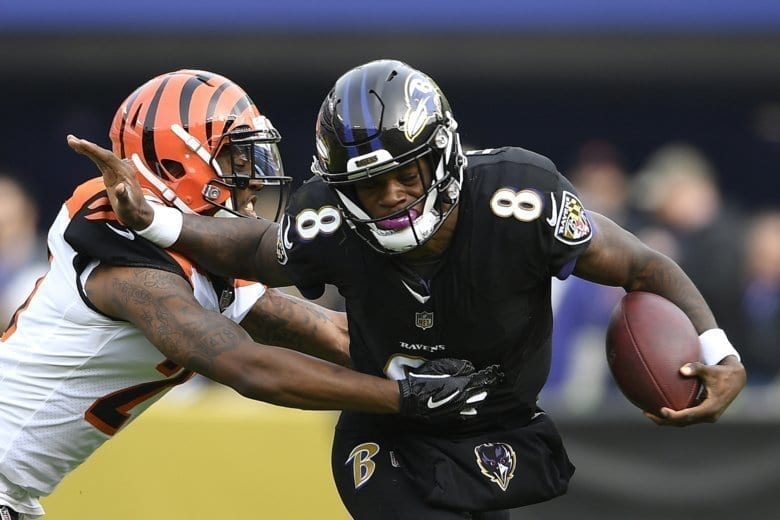
Whether or not the Lamar Jackson era has begun, Baltimore Ravens fans caught their first glimpse of the future when the rookie started in place of an injured Joe Flacco. Jackson provided some dazzling moments not seen from a Baltimore quarterback in years, helping the team to a 24-21 victory over the division-rival Cincinnati Bengals.
Jackson became the last of the 2018 NFL Draft’s five first-round quarterbacks to start a game, with his starting debut coming approximately a month and a half after the last of the other four recorded theirs. Flacco’s presence certainly played a part in keeping Jackson in a backup role, but the Ravens also deliberately avoided overloading their rookie signal-caller.
That plan changed when a hip injury forced Jackson into action, and with Flacco likely sidelined for at least another game, the question of whether the Ravens can sustain success with Jackson grows in significance.
[Discuss this article on the BSL board]
Prior to Week 11, Jackson had only seen the field as a gadget player. The Ravens had lined him up in a number of spots including under center, but in all cases they did not deploy him as a traditional quarterback. Of course, Jackson’s abundant athletic gifts make him anything but a typical drop-back passer, but the team treated him as a gimmick rather than a normal function of the offense. In that capacity, Jackson attempted just 12 passes while rushing the ball 28 times, third most on the team at the time.
Jackson’s ascent to the top of the depth chart did change the Ravens’ approach, but it didn’t mean the team planned to use him conventionally. Baltimore’s entire 11-play opening drive featured zero passes, with Jackson or one of his backfield mates running on each down. That series proved to be a reasonably fair preview of Jackson’s day, with the rookie rushing the ball an incredible 26 times for 119 yards.
Jackson’s 26 carries would seem out of place for a star running back in 2018 let alone a quarterback. Not only had no signal-caller attempted as many rushes in a single game during the Super Bowl era (1966 to present), but Jackson’s 117 yards on the ground set a Ravens franchise record for his position. Still, those facts don’t provide full context to the extensive workload. Extrapolated over a full 16-game season, Jackson’s 26 runs works out to 416 attempts, more than any player has recorded in a year since Larry Johnson reached the mark in 2006.
It seems fair to assume Jackson won’t run 26 times again this season, but that doesn’t mean the Ravens plan to completely curtail his rushing. Even if he averages half that amount the rest of the way, Jackson will eclipse 100 total attempts for the season, catching all quarterbacks save for Cam Newton (projected for 123 rushes).
Obviously, Jackson can’t reach these numbers if Baltimore reinstalls Flacco as the starter once he returns from his hip injury, but the coaching staff could ride the hot hand and leave the veteran on the bench. But even if the team sticks with Flacco, Jackson shouldn’t find himself on pace to nearly match the rushing workload of Newton, a quarterback officially listed as 33 pounds heavier (and likely much more in reality) and more capable of absorbing punishment. Instead, Jackson needs more opportunities to throw the ball and limit his exposure to hits.
But for those skeptical of Jackson’s abilities as a passer, his debut as a starter busted some myths about his throwing abilities. According to NFL Next Gen Stats, he didn’t rely on passes at or behind the line of scrimmage with only four of his 19 attempts targetted less than 3 yards down the field. Rather, the largest share of his throws — eight, all completions — attacked the middle of the field at a depth between 5 and 15 yards. Jackson’s spray chart might not draw comparisons with that of Patrick Mahomes, but the Ravens did take the restrictor plate off their rookie signal-caller.
In order for Baltimore to keep Jackson’s development on track, the team must strike a more sustainable balance between run and pass. Jackson’s legs remain his greatest asset but feeding him to 20 or more carries creates unnecessary injury risk and discounts his increasing proficiency as a thrower. Decided how often and when to lean on Jackson’s running becomes a critical concern moving forward.
The pressure falls on head coach John Harbaugh and offensive coordinator Marty Mornhinweg to not overexpose nor overload their rookie quarterback, all while preserving the Ravens’ playoff hopes. If they can’t, perhaps a different set of coaches will receive the chance to figure it out this offseason.

Jason B. Hirschhorn is an award-winning sports journalist and Pro Football Writers of America member. He has bylines at NFL.com, SB Nation, Sports Illustrated, and other outlets.