

Exactly three months after the NCAA suspended college athletics due to the coronavirus pandemic, we are starting to get a picture as to when and how college sports will start up again. Specifically, the NCAA Division-I Football Oversight Committee is set to release its plan for guidelines that programs will follow for holding workouts and practices.
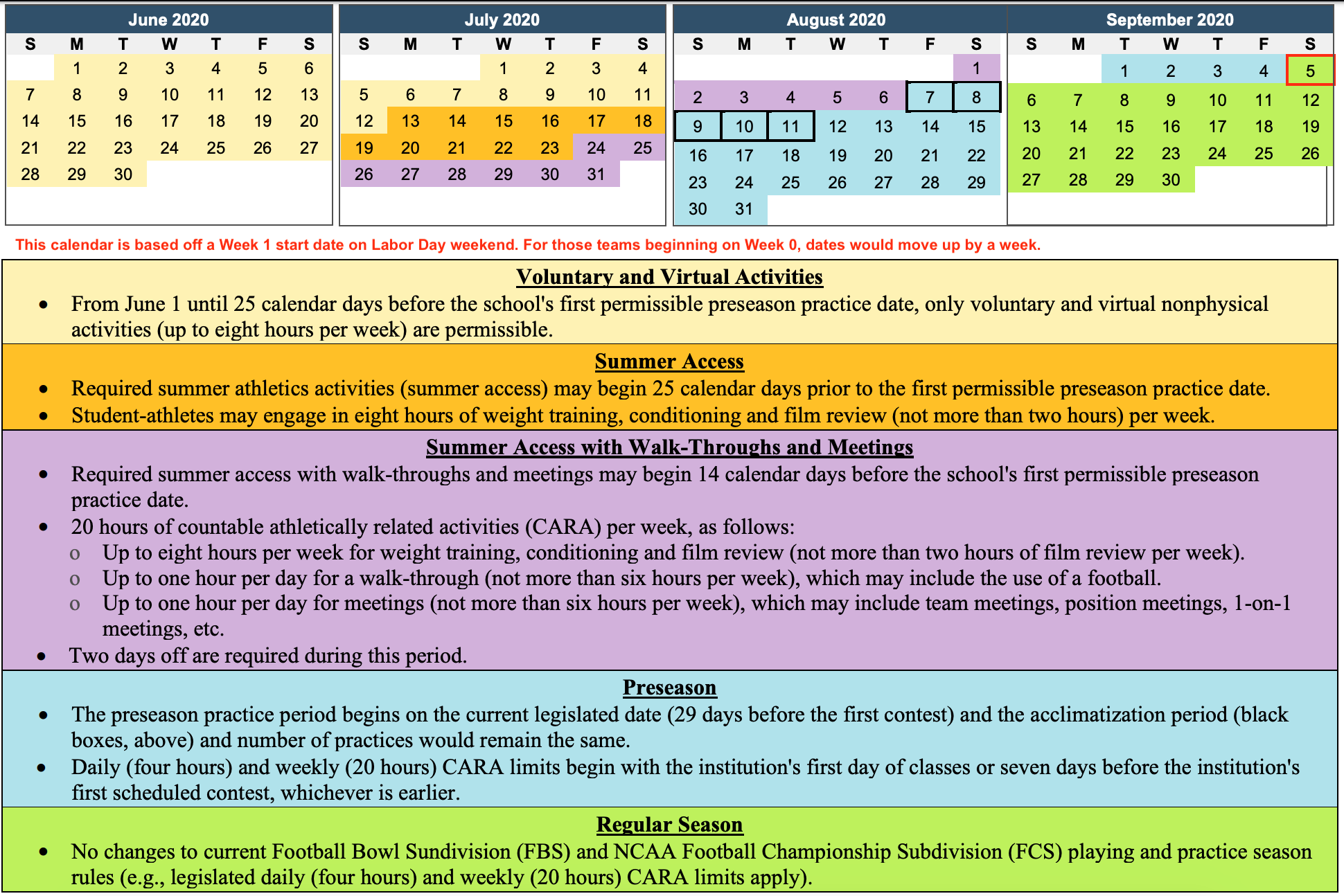
Already, some schools have opened up facilities for athletes to voluntarily return to campus and workout. The majority of schools that haven’t yet will do so by June 15th. Several schools have also reported that some of their players have tested positive for COVID-19 upon return. But while there are still a lot of details left to be determined, one thing appears all but certain….there will be some sort of a 2020 College Football season.
Honestly, that last part was likely never in doubt. FBS college football brings in around $4 billion in revenues for its 130 schools per season. Those revenues fund not only the football programs themselves, but also the lion’s share of the other intercollegiate sports for each of those 130 schools. Without college football, there are no college athletics as we know them.
Even with the likely prospect of just a modified season, one that will certainly have some negative impact on revenues, some athletics departments have already taken the red marker to their balance sheets; either by cutting programs, cutting staff, or cutting salaries/furloughs.
While there will be a college football season of some sort, there is a question as to whether several schools will be able to field a team at all. In May, the California State University system announced that it will not hold on-campus classes this fall. Schools included in that are Fresno State, San Diego State, and San Jose State….all of them members of the Mountain West Conference. One thing that all schools have appeared unified on in the wake of the pandemic is that they will not field athletics teams, including football, if there are not students on campus. Officials have offered several reasons for taking that position, but you need only read this to see why they are really drawing that line in the sand.
Will the aforementioned three schools cross the line and field football teams anyway? If not, what happens to their athletics departments without revenues from an entire football season? What does the rest of the Mountain West do if those three don’t play? Looking across the entire college landscape, what happens to departments in the likely scenario that they can’t have full stadiums, cutting into ticket sales and other gameday revenues? If they can only allow half, or maybe just a third of their seats to be filled, who gets to attend? And as I alluded earlier, what happens if one or more players on a team test positive during the season? What is the post-season going to look like? (Other than stating they intend to have the Playoff at some point, there has been little public discussion of that up to now)
The season is beginning to come into focus in the sense that we know there will be one, it will likely begin on time, and pretty much everyone intends to play a full 12-game season. But right now, just two-and-a-half months from kickoff, there are still more questions than answers.

College Football Analyst
Mike is a Baltimore native living in Portland, OR since 2007. He currently runs his own business specializing in video production and online marketing. Prior to that he was a legal technology consultant, worked for 9 years at Johns Hopkins University and served 6 years in the Air Force. He also enjoys travel, food, beer, and is a volunteer at the Oregon Humane Society.