
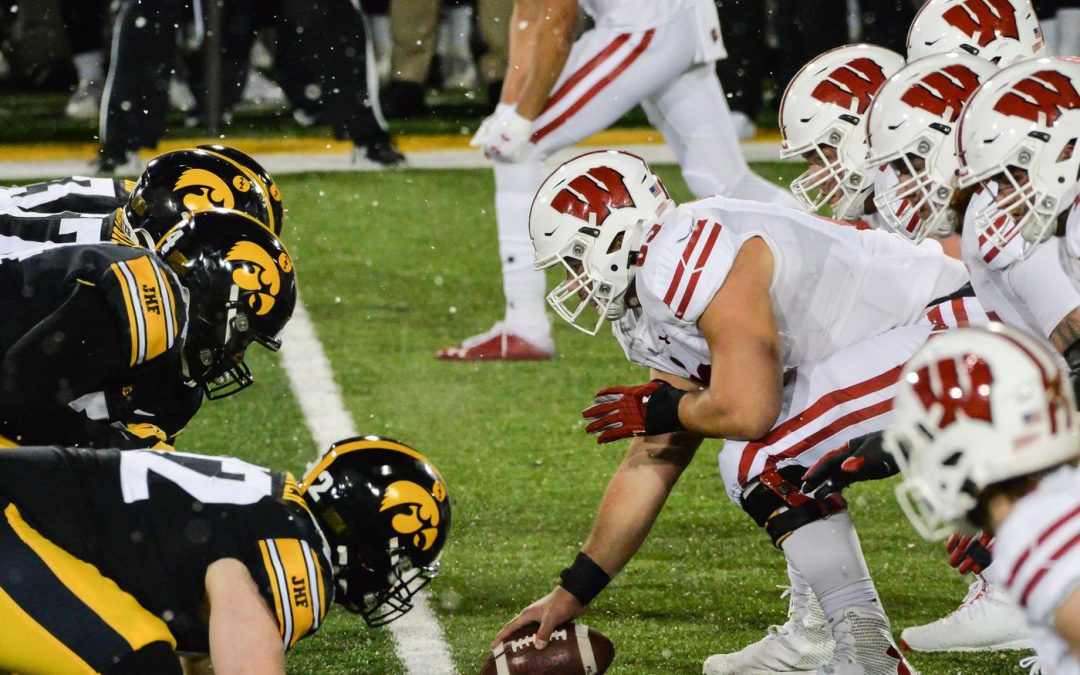
Jim Johnson and I broke down our thoughts on how the Big Ten West shapes up on our weekly Sports Tonight podcast. Here’s my written summary, with teams listed in order of my predicted finish.
In the East-West divisional era of the Big Ten, the West has been a little more competitive versus the East in the regular season than some may believe, winning 70 head-to-head matchups against 77 defeats. But in conference title games the West is 0-for-8. Could 2022 be the year they end the drought?
Last season four teams entered the final week with a chance at the division title. This season the field appears just as wide open. Here is a preview of each team, listed in my expected order of finish.
Purdue – Surprise!
2021 ended up being a strong season for the Boilermakers that they hope will be the springboard to an even better 2022. They went 9-4, tied for 2nd in the West, with wins at Iowa and at home against Michigan State, who were ranked #2 and #3 at the time, respectively. They are an anomaly among their West peers; a pass-first offense in perhaps the most run-heavy division in the sport. While head coach Jeff Brohm will stick to their offensive style, one of his primary goals for 2022 must be bringing more balance to their offense; they averaged just 2.79 yards per rush in ’21, dead last in the country.
After shuffling signal-callers for the first part of the season, QB Aidan O’Connell settled in as the starter and threw for 28 TDs against 11 INTs with a 71% completion percentage. As a unit, Purdue QB’s broke the school record for completions in a season (407) set in 1998 by the team featuring Drew Brees. O’Connell returns for a 6th season and has a talented pool of receivers to target, though they will certainly miss David Bell who is now in the NFL. A pair of Iowa transfers, Charlie Jones and Tyrone Tracy, will help fill the gap. They lose 3 starting offensive linemen from 2021, though that might be a good thing given the poor rushing numbers and a high sack-surrendered rate (4.5%). If this year’s unit can open enough holes, 2021 leading rusher RB King Doerue should be able to boost their ground game.
The defense has seen marked improvement over the past several years, going from allowing 436 ypg in 2019 (100th) to 365 ypg last year (46th). While a significant amount of production returns, missing will be their leader and 1st Round NFL draft pick George Karlaftis (5 sacks, 11.5 TFL). While the stats will be hard to replace, the attention Karlaftis drew in the form of double-teams that allowed others to thrive might be the bigger loss. Sophomore Kydran Jenkins, who equaled Karlaftis’ 5 sacks last season, will be the one primarily tasked with filling his shoes. All in all, the defense returns 8 players who have started games for them. With their steady offensive output during the Brohm era, the defense living up to, or exceeding, their 2021 standard will determine just how far the Boilermakers go in 2022.
Wisconsin – While Georgia’s defense received the well-deserved accolades, when it came to total yards per game and rushing yards per game allowed in ’21 the Badgers had the best defense in the nation. It was only good enough to go 9-4 and tied for 2nd in the West division. For many schools results like that would still be an unquestioned success (see: Purdue above). But Wisconsin holds itself to a higher standard, and thus some changes were made with the expectation of improving an offense that was the team’s anchor last season.
Head coach Paul Chryst had taken over the play calling in 2021, but the Badgers only scored 25.4 points per game, and averaged just 12.5 in their four losses. He brought in Bobby Engram from the Baltimore Ravens to be the new offensive coordinator and QB coach, with hopes that a fresh set of eyes and ideas would elevate a passing game that was 120th in the country. But ultimately any progress in that area will come down to QB Graham Mertz, who in his second season as starter struggled with consistency and accuracy (just 10 TDs versus 11 INTs). The personnel around Mertz are promising entering the season. RB Braelon Allen had an excellent freshman season (over 1,100 yards rushing, 12 TDs, and All-American honors). The offensive line should be solid as always. There is talent, albeit inexperience, at WR with Chimere Dike leading the pack. Can Mertz get them the ball often enough? That will likely define Wisconsin’s season.
Defensively there are a lot of losses to fill in, with 8 of 11 starters gone. But defensive coordinator Jim Leonhard seems to be able to plug-and-play with the best of them. The biggest holes are at LB, where Jack Sanborn and Leo Chenal leave huge shoes to fill. The defensive line brings back two starters and should be the strength of the defense. The transfer portal infused both talent and experience among the CBs, adding Jay Shaw (UCLA) and Justin Clark (Toledo). They’re very thin at safety, but if there’s any position Leonhard can coach up, a 10-year NFL safety himself, that would be it.
Iowa – 2021 was a nice year for Iowa, as they won 10 games and at one point were ranked #2 in the country. Though as is usually the case for Kirk Ferentz’s Hawkeyes, the conclusion ended up falling flat, as they were blown out by Michigan in the conference championship game followed by a 3-point loss to Kentucky in the Citrus Bowl. Much like their rival Wisconsin, Iowa was fueled by an excellent defense and held back by an anemic offense. Based on the number of experienced returnees, the defense could be even better in 2022. Meanwhile, it is unclear where the badly needed offensive improvement might come from.
Not to overuse the Wisconsin references, but Iowa in 2022 will go as far as their quarterback will take them. For now it appears the job will again fall to primary 2021 starter Spencer Petras. Petras put up pedestrian numbers in ’21; 57% completions, 10 TDs, 9 INTs. His backup, Alex Padilla, who started three games when Petras was injured, was no better (47% comp., 2 TDs, 2 INTs). Both will compete with redshirt freshman Joey Labas for QB1. One area where Iowa did differ from Wisconsin is that they did not run the ball efficiently either. While RB Tyler Goodson, since departed for the NFL, ran for over 1,100 yards last season, he also had negative yardage on 47 carries, 39 of those on first down. The onus on improving that rests mostly with the offensive line which must replace two All-Conference starters; C Tyler Linderbaum (#25 overall draft pick) and G Kyler Schott. The Hawkeyes do return a lot of overall experience within the unit, and the expectation is former DT Logan Jones will switch sides and replace Linderbaum. Iowa is known for its long, distinguished line of TEs, and Sam LaPorta continues that tradition. Arland Bruce and Keagan Johnson give them a pair of game-breaking wide receivers. The hope is that whoever plays QB can get the ball to those weapons.
The foundation of Iowa’s great defense are All-American LB Jack Campbell and CB Riley Moss. They are two of seven returnees who logged at least 200 snaps last season. Last year’s Iowa defense finished 13th nationally in scoring (19.2), eighth in yards per rush (3.15), 14th in yards per pass attempt (6.4), seventh in yards per play (4.72) and 16th in total defense (328.9). The Hawkeyes intercepted 25 passes, the most by a Power 5 defense since 2014. The strength of the defense is the front, which doesn’t generate a lot of tackles-for-loss, but is extremely effective and allows them to position their secondary to make plays and force turnovers. The defense should, and must, be stellar again if Iowa is to finally break through and win a Big Ten championship.
Minnesota – Head coach PJ Fleck has his boat moving through the water pretty well these days. The Gophers have won a total of 20 games the past two full seasons of football. That’s an accomplishment for a program that hasn’t won a conference title in over 50 years and went through 5 head coaches in the 10 seasons prior to Fleck’s arrival. Still, they have yet to capture a division title, which only pushes Fleck to row even harder. Last season they leaned very heavily on a senior-laden offensive line. They’ll need to lean on someone else in 2022, as the OL unit lost a combined 197 career starts.
To say the Gophers were a run-first offense last year would be an understatement. They attempted fewer passes all season (257) than every FBS school except the three military academies. While the running game was effective, it was not efficient, as the Gophers averaged only 25.5 points per game, just 83rd in the country. In an effort to bring more balance, Fleck reunited with Kirk Ciarracca, his offensive coordinator at Western Michigan and at Minnesota during their 11-win campaign in 2019. Ciarracca also reunites with 5th-year QB Tanner Morgan, who in 2019 threw for 3,253 yards and 30 TDs while completing 66% of his passes; all school records. Also back is RB Mohamed Ibrahim, who gained 163 yards in the opener against Ohio State in 3 quarters, but was then lost for the season with a ruptured Achilles tendon. Also back is leading WR Chris Autman-Bell. So the skill players are there, but replacing four offensive lineman will be a challenge. The lone returnee on the line, C John Michael Schmitz, will probably be playing in the NFL in 2023, so there is at least a good foundation in the middle. Grad transfers from O-line factory programs like Michigan (Chuck Filiaga) and Notre Dame (Quinn Carroll) should help as well.
After the offensive line, the defense is easily the biggest question mark due to turnover. Like on offense, the heaviest losses are up front, a unit that last season held 10 of their 12 opponents to fewer rushing yards than their per-game average, and was 9th in the nation in rush defense. They do return a lot of experience in their secondary (3 of 4 starters) and the unit is augmented by CB Beanie Bishop, an All-Conference USA transfer from Western Kentucky.
Illinois – In their first season under Bret Bielema, the Illini showed that the path to competitiveness may not be a long one. They went 5-7 after a disappointing 2-6 season in 2020, defeated two ranked teams on the road, and four of their losses were by one-score margins. Bielema knows how to win in the Big Ten, having won a conference title as a player at Iowa and compiling a 68-24 record (with 3 conference titles) as the head coach at Wisconsin. He’s always done it with a throwback style; run the ball, play great defense. However, changes made during the offseason would seem to indicate Bielema wants to introduce more present-day aspects into their offensive scheme.
After ranking just 115th in scoring (20.2 ppg) and 112th in yardage (330 ypg) last year, they brought in former UTSA offensive coordinator Barry Lunney. Bielema got an up-close look at Lunney’s work when the Roadrunners came to Champaign last season, as a 4-point underdog, and left with a 37-30 victory. Lunney’s job will be to introduce more tempo, and attack defenses on the edges and vertically more, all while maintaining the principles of the pro-style offense Bielema prefers. The Illini also added former Syracuse QB Tommy DeVito, who went 16 of 20 for 248 yards and 3 TDs in the spring game. 5-game starter Arthur Sitowski also returns after an injury-laden season, though DeVito would appear to have the edge. RB Chase Brown (1,005 yards, 5.9 ypc, 5TDs in ’21) returns as the top weapon in the running game. Despite losing two starting offensive lineman to the NFL, the Illini return plenty of experience and should have solid depth thanks to 3 returning starters, plus a projected starter who was lost in ’21 due to a broken ankle in camp, and two JuCo transfers. Their two top receivers return in Isaiah Williams and Casey Washington, but they will need to establish some depth in order to get more out of what was a very pedestrian passing game in 2021. TE Luke Ford, who started all 12 games, will also contribute.
Johnny Newton and Keith Randolph Jr return to anchor a defensive line that played a big role in them surrendering 10 fewer points per game in 2021 than the year prior. The linebacking corps will have to replace its top pass rusher in Owen Carney Jr along with stalwarts Isaiah Gay and Jake Hansen. Last season’s leading tackler, Tarique Barnes, is back and will be leaned on heavily. The return of LB Calvin Hart, who tore an ACL in the season opener, will help. The secondary loses two starters and three backups from last season. That will make it difficult for them to replicate how well they played last season, especially in the red zone, where they allowed only 46.5% of possessions to be converted to TDs (12th in FBS) and ranked 9th in red zone defensive pass efficiency.
Northwestern – Northwestern appears to be settling into a consistently inconsistent trend in year-over-year results. In 2018 and 2020 they won the West division. In both 2019 and 2021 they went 3-9. Whether they can continue their trend of even-year bounce-backs could possibly come down to just a few basic factors; consistent QB play, staying on the positive side of the turnover battle, and better tackling on defense. All three of those dipped notably in 2021. The roller coaster seems a bit surprising for a program that has been pretty consistent; head coach Pat Fitzgerald has been on the job since 2006, the fifth longest current tenure in FBS. All but one member of his staff return for 2022. A tough schedule, including the loss of a true home game (they will open the season Week Zero in Dublin, Ireland against Nebraska) could make a rebound more challenging.
The inconsistency at QB could be largely due to Northwestern’s reliance on transfers each of the previous three seasons; from Hunter Johnson (Clemson) in 2019, to Peyton Ramsey (Indiana) in 2020, then Tyler Hilinski (South Carolina) last season. Hilinski does return, though he could have competition from an internal option in second-year man Brendan Sullivan, who looked good in the spring. The running game should be the strength of the offense, led by returning yardage leader Evan Hull (1,009 yards) and Cam Porter, who was the lead back headed into fall camp last year when an injury cost him the entire season. All five offensive line positions are expected to be filled by someone who started at least two games last season. The unit is led by perhaps the best lineman in college football, and likely 2023 NFL 1st Round pick, LT Peter Skoronski. The receiving and tight end groups don’t lack experience, returning four different players who are in their 4th or 5th year, but someone needs to emerge as a playmaker; something that was lacking last season.
The defense was probably the most glaring issue in 2021. The numbers tell the story for how big a problem missed tackles were; they allowed 3.4 yards after first contact on rushing plays, 111th in the country. They also have to replace five of their front seven on defense, though perhaps that is a good thing given 2021’s results. They do return their best pass rusher in DE Adetomiwa Adebawore. MLB Bryce Gallagher is the leading tackler among returnees. The secondary is by far the deepest and most experienced unit on defense.
Nebraska – By now everyone is aware of what a weird season 2021 was for Nebraska. 9 losses, 8 of them by one score. And these weren’t lightweights they were losing against: Oklahoma (7 points), Michigan State (3 points in OT), Michigan (3 points), Ohio State, (9 points, their largest margin of defeat), Wisconsin (7 points) and Iowa (7 points). So how do you evaluate a team that was truly in every game they played, against some of the toughest competition in the sport, and yet always found a way to lose? Considering the result followed seasons of 4-8, 5-7 and 3-5, most would say it’s time to clean house with a new head coach. Nebraska chose to run it back with Scott Frost at the helm. Consider it the inevitable downside of hiring the native son who led your program to a national title as the star QB; it becomes painful when you have to fire him. Too late now. Frost gets one last shot at redemption, and he did make wholesale changes prior to attempting one last Hail Mary.
Frost has an entire new offensive staff, led by veteran coordinator Mark Whipple who came from Pitt. The Huskers will hope Whipple can replicate his success with Kenny Pickett and Jordan Addison. His signal caller will be Casey Thompson, the Texas transfer who threw for over 2,100 yards and 24 TDs in 2021, despite battling a thumb injury. He’ll have a relatively inexperienced group of targets, as the Huskers return just 36% of last year’s receiving yards. The running backs are solid, if not special, led by Rahmir Johnson (495 yards in ’21). The offensive line, led by returnees Trent Hixon (who will shift from G to C) and Nouredin Nouili, will need to do better at protecting the QB than last year; as Thompson’s numbers at Texas indicate he is much less adept under pressure than last year’s QB, Adrien Martinez, who is now at Kansas State.
If the Huskers are to make progress on defense, they will be doing it with an interior line that is very thin on experience. The unit’s veteran, by default, is tackle Ty Robinson (4 starts, 27 tackles in ’21). Expect Alabama transfer Stephon Wynne, Jr to start next to Robinson. The edges are in much better shape, led by Garrett Nelson (5 sacks, 11.5 TFL in ’21). Nick Heinrich and Luke Reimer form a solid linebacking tandem. Despite losing three starters, the secondary returns a good bit of experience thanks to its depth, providing solid competition.
Finally, Nebraska’s special teams were abysmal last season. The best metric available, the Fremeau Efficiency Index, ranked them 129th out of 130 last year (and they weren’t much better in Frost’s previous seasons). There were costly gaffes that really hurt them, something a team that finds itself in so many close games can ill afford. They hope the promotion of Billy Busch, a stickler for detail, from analyst to special teams coordinator helps.

College Football Analyst
Mike is a Baltimore native living in Portland, OR since 2007. He currently runs his own business specializing in video production and online marketing. Prior to that he was a legal technology consultant, worked for 9 years at Johns Hopkins University and served 6 years in the Air Force. He also enjoys travel, food, beer, and is a volunteer at the Oregon Humane Society.