
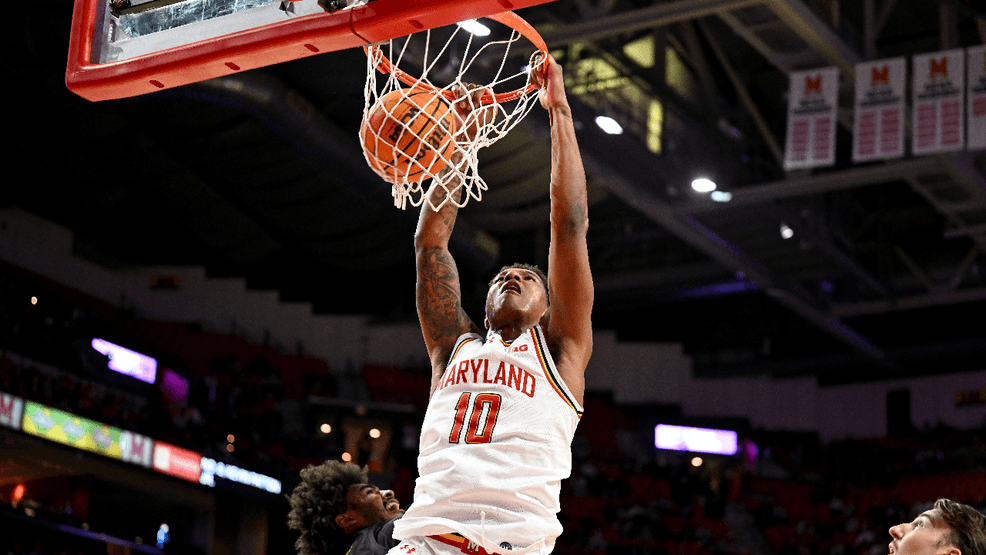
Maryland’s success on the hardwood has been a sneaky but welcomed revelation this season. After two relatively ho-hum seasons with Kevin Willard at the helm, it was fair to question the Terps’ outlook entering the 2024-25 season. This was despite the addition of five-star center Derik Queen in the most recent recruiting cycle.
But even after a respectable 11-2 start to the season that only included close losses to ranked Marquette and Purdue teams, it seemed a West Coast lull in which the Terps lost at Oregon and Washington had tempered the expectations of Maryland fans. Even though both of those losses were also narrow defeats and the Terps clearly gave full effort in those games, Maryland was on no one’s radar as a Big Ten or National Title contender at the time.
My how things have changed.
Skip ahead about six weeks and the Terps are 10-2 since their West Coast swing, including three wins against nationally ranked Big Ten opponents. Maryland has looked extremely formidable during this stretch and all five starters appear to be playing their best ball of the season simultaneously.
Currently ranked in the top 20 in offensive and defensive efficiency, per KenPom, the Terps have proven to be one of the most balanced and well-rounded teams not just in the Big Ten but in the entire country. It has certainly shown in back-to-back double-digit victories over Iowa and USC.
After a slow start in the first half against Iowa, Willard rallied his troops at halftime and the Terps exploded in the second half, outsourcing the Hawkeyes 54-24 the rest of the way. As an encore to a 26-point win, Maryland welcomed USC to Xfinity Center and took care of the Trojans by 17.
But it’s the way the Terps are winning these games that causes optimism and concern for the rest of the season.
Maryland is fortunate enough to have all five of its starters averaging double figures this season, which has also been the case in the Terps’ last three games. While this five-man attack has led to some offensive explosions such as in the second half against Iowa, it’s also leaving a lot of responsibility on the plates of the starters and is hurting Maryland a bit on the defensive end.
Despite beating Nebraska, Iowa, and USC with impressive offensive showings, the Terps allowed more points in each of those games than their season average and as the season deepens the amount of minutes the starters are being asked to play and the offensive contributions they must make in order for Maryland to win could catch up to Willard’s team if he doesn’t find a way to implement some depth into his game plan.
While shortening the rotation and keeping the best talent on the floor for most of the game is a strategy often deployed by coaches in the postseason, having just five offensive contributors is too short and leaves Maryland with no room for injury or foul trouble.
After the starters, the Terps have just three players averaging more than 10 minutes per game, but none are averaging more than 4.2 points. It’s not the easiest place on the schedule to start implementing new approaches — with four Big Ten games remaining in the regular season, including two ranked teams from Michigan and scrappy Northwestern and Penn State teams. But Willard is running out of time before a crucial postseason to figure something out.
He has to find a way to get one or two more players into the rotation and let them get comfortable playing with the starters. This clearly isn’t a Maryland team that is going to be able to do “line changes” where four or five new players come in at once, but if one starter goes down or gets into foul trouble there’s no reason why this team should fall apart. Having four double-digit scorers still available with a player that can hold their own on defense and move the ball on offense should be enough to still compete.
So which players on Maryland’s bench fit that mold?
If recent games are any indication, it’s sophomore Deshawn Harris-Smith and seniors Jay Young and Jordan Geronimo who are being asked to step up, and each has shown some flashes over the last few games.
Harris-Smith had a ton of promise coming to College Park as a freshman, but last year he struggled mightly playing starter minutes. However, he did average 7.3 points per game for the Terps last season, as opposed to 2.8 this year, so there is room to grow for his offensive output. Harris is also a big guard who tends to contribute on the glass, which is never a bad thing in hoops, so perhaps working him into these last few games a bit more would be wise.
Young came to Maryland this offseason as a transfer who had previous stops at Central Florida and Memphis, and while transitioning to the Big Ten this year has been a challenge, he shows good energy off the bench and can spell Maryland’s guards for a few minutes if needed. He’s much smaller than Harris-Smith and isn’t going to take over a game athletically, but he’s averaging nearly a steal per game and can hold his own as a scrappy defender when needed.
Geronimo was a spark plug off the bench for Maryland last year and has taken a step back this season, but still shows flashes of how he can contribute when given the call. He picked up a block and two steals in just nine minutes of action against USC, and he’s the athletic presence off the bench that can provide a spark when the Terps need it.
Two more members of Maryland’s bench to keep an eye on are junior forward Tafara Gapare and freshman guard Malachi Palmer. Both give the Terps the most size coming off the bench, particularly Gapare at 6-foot-9. And while neither can exactly fill the role of Julian Reese or Queen if either were to miss significant time, it’s a scenario Willard has to be prepared for. If anything were to happen to either member of Maryland’s starting frontcourt, the Terps would be forced to play much smaller lineups overall, but it would certainly force Gapare and Palmer into more action.
Gapare has consistently flashed his athleticism as a Terp, and he is making 37.5% of his 3 point attempts (1.3 attempts per). I think where MD needs him the most, is with consistent rebounding and shot-blocking off the bench. While he has shown an ability to hit a shot, I’d prefer to see him using his athleticism regularly going to the basket.
Palmer has been lauded by Willard several times in recent weeks, with MD’s Head Coach being glowingly enthusiastic about the Freshman’s potential.
Still, Palmer has struggled to find anytime or crack the regular rotation.
Given Harris-Smith’s struggles shooting, one wonders if Palmer should be getting some of those minutes.
Maryland starting 5 is fantastic, but it feels necessary for Willard to get some regular production from at-least 2-3 of these bench options going forward.
Now, is tinkering during a home game next Wednesday against No. 14 Michigan State the best idea? Probably not, but if that game were to get out of hand in either direction, it has to be seen as an opportunity to prepare for bigger and better things. However, ideally, the two non-ranked opponents Maryland will face down the stretch will prevent better opportunities to explore roster depth. Of course, securing wins and improving postseason seeding takes priority, but there doesn’t seem to be many things that could hold this Terps team back from postseason success, so identifying depth as a weakness and improving in that area could go a long way in how the postseason pans out for Maryland.

Terps Analyst
Pat has been covering sports in the DMV area since 2012. He is a former Washington Redskins beat reporter for PressBoxDC.com and has been covering University of Maryland football and basketball recruiting and daily beats for Rivals.com’s Terrapin Sports Report since 2013. Pat graduated from College Park with his master’s degree in journalism and has received bylines in publications such as USA TODAY Sports, The Philadelphia Inquirer, SB Nation, and Yahoo! Sports. A Philadelphia native, Pat enjoys fishing, golfing, and playing fantasy sports when he’s not covering or watching a game.