

Over the past decade a number of new analytics and/or grading tools have come available in order for fans to digest the game in different ways. Football Outsiders for example does a great job of evaluating individual player, offense/defense, and entire team performance by statistical analysis. Pro Football Focus took a different approach and grades individual player performance on an objective scale. Both of these companies provide unique perspectives that have helped advance our understanding of the game beyond just stat compilations.
One of the newest, and in my opinion coolest, analytical approaches comes from NFL.com in their Next Generation Stats. You can go to their website and find any number of cool stats such as who was the fastest ball-carrier on the field or who was able to sack the QB the fastest. They also chart WR routes and outcomes as well as every pass the QBs throw. Passing charts for each NFL QB can be found that gives unique insight into where different QBs struggled and succeeded. I wanted to take a look at Joe Flacco’s 2017 season as well as the Ravens WRs from 2017 and the new WRs for 2018 to get an idea of how they may be used in Marty Mornhinweg’s offense.
You can discuss Joe Flacco and the Ravens revamped WR corps on our message board.
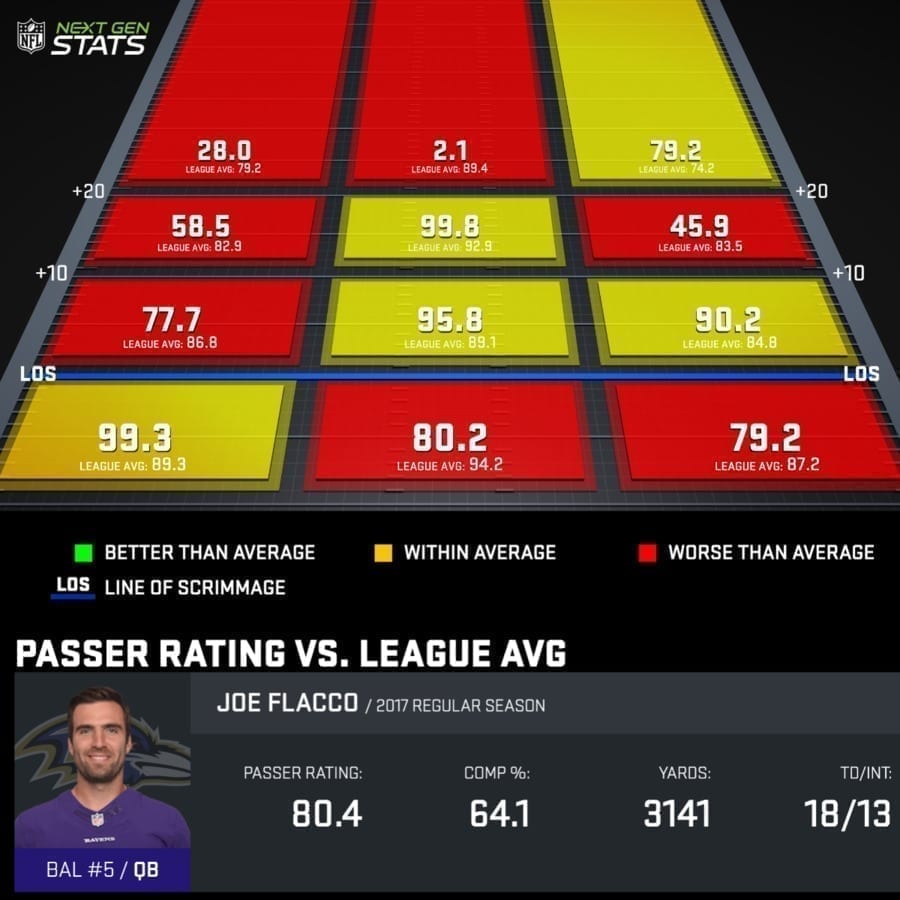
If we take a look at Joe Flacco’s passing chart (pictured above), we will see that there are some areas of the field in which he had much greater success throwing the ball to than others in 2017. We can see that he was a solid passer throwing the ball 0-10 yards from the LOS, but as he threw deeper, his performance fell off fairly drastically. One sector in particular stood out, on throws to the middle of the filed 20+ yards beyond the LOS, Flacco posted a 2.1 passer rating. That’s not a typo, and from the data that is available from Next Gen Stats we can see why his passer rating is so poor; Flacco only attempted 6 passes to this part of the field and completed 1 of them while throwing 2 INTs.
Now, part of this is due to Flacco’s health in 2017 and part of it is scheme driven, but Flacco’s numbers throwing deep have not always been this poor. When Torrey Smith and Jacoby Jones were in Baltimore, Flacco excelled at throwing the deep ball so who Flacco was throwing the ball to, I’m looking at you Breshad Perriman, played a major factor in his deep ball efficiency. At least 2 of Flaco’s INTs bounced off Perriman’s hands, and Breshad’s stat line from last season is a sight to behold: 10 receptions on 35 targets for 77 yards, and 4-6 drops (depending on where you look). His passer rating when targeted: 11.3. In order to improve this aspect of their offense, the Ravens brought in John Brown from Arizona to fill the deep threat role that Perriman was supposed to have in 2017.
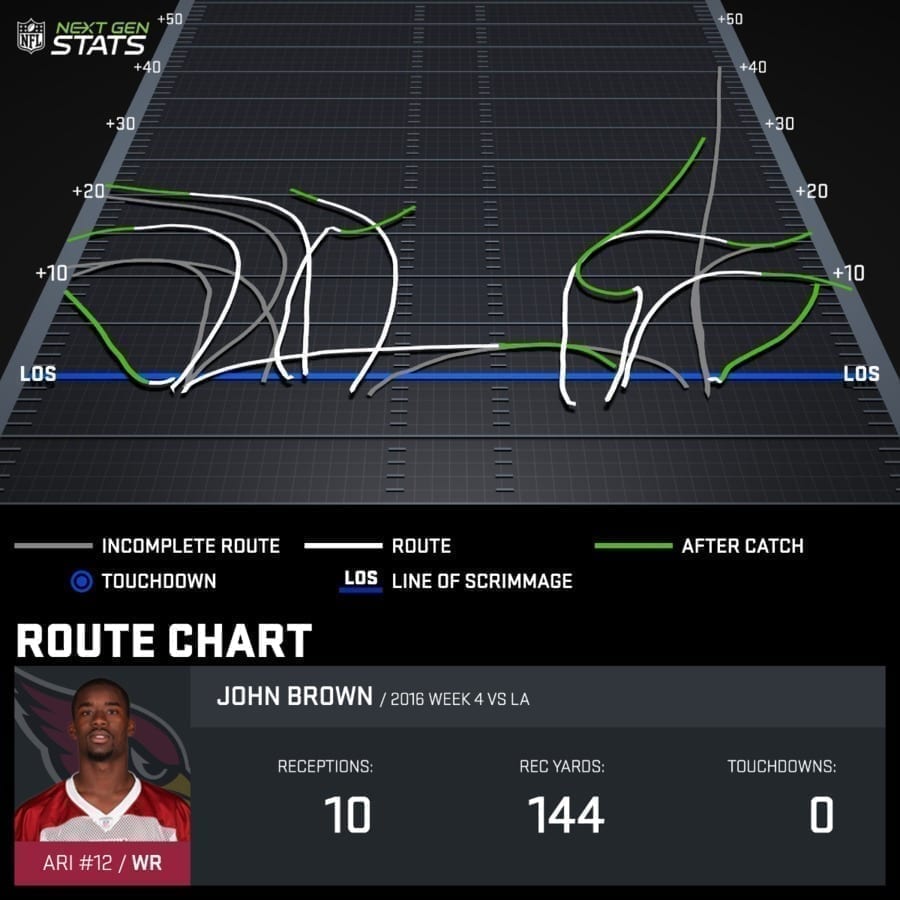
Over his career, Brown owns a 14.5 yards per reception mark, which isn’t elite but is certainly above average. Over the past 2 seasons in which Brown was not 100% healthy, he was targeted 128 times and while his catch rate wasn’t great (47%), he only dropped 3 balls. He also managed to produce 5 TDs on those 128 targets, which taken into context of his best season in 2015 when he caught 65 balls for 1,003 and 7 TDs on just 101 targets suggests a player who can get open deep and find the endzone even in a limited role. If we look at Brown’s limited 2016 profile by Next Gen Stats (week 4 shown above), we see a very different skill-set than what the Ravens WRs possessed last year. Almost all of his work came outside the hashmarks and beyond 10 yards from the LOS in this game vs the Rams. These are the parts of the field in which Joe Flacco struggled the most in 2017 so bringing in a WR who does his best work on the outside and downfield could be a huge boon to the offense.
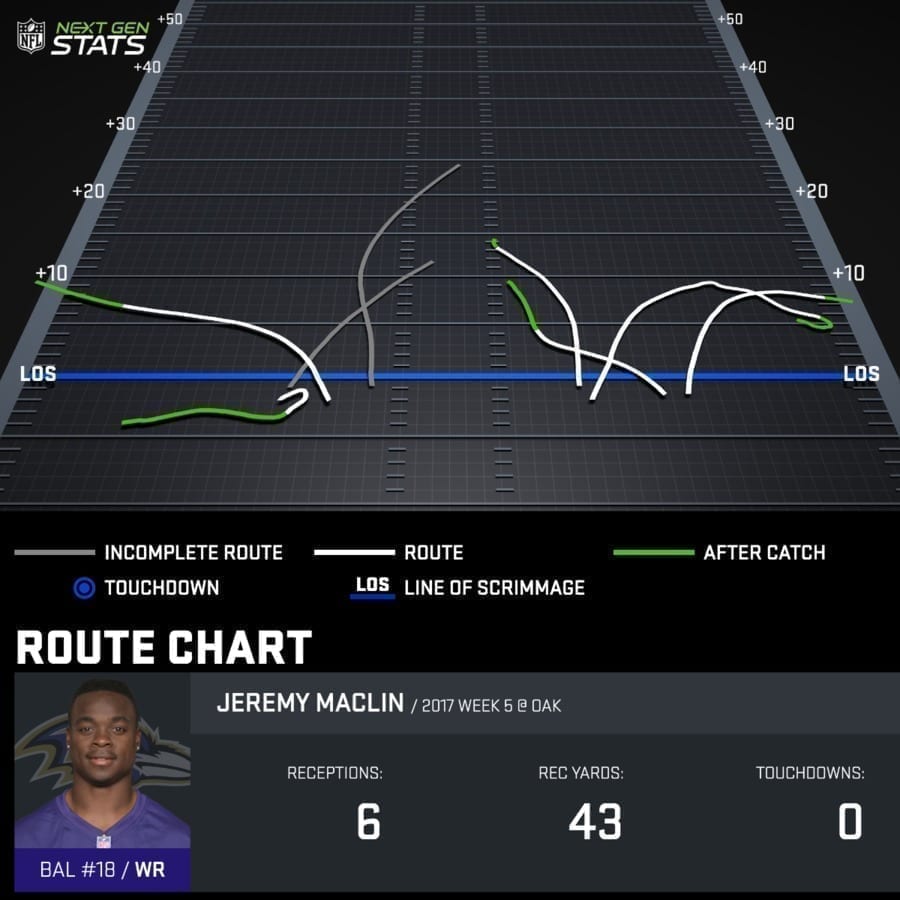
Jeremy Maclin was supposed to be the savior of the Ravens passing game in 2017, but he struggled to stay on the field and even when he was available he rarely proved to be a difference maker. He did a lot of his work from the slot in 2017, and while he did have a few games where he made an impact he didn’t crack 100 yds once and only had 2 games with 5+ catches. If we look at his games charted by Next Gen Stats (week 5 shown below), we see he mostly ran quick slants, hitches and out routes within the 10 yards of the LOS.
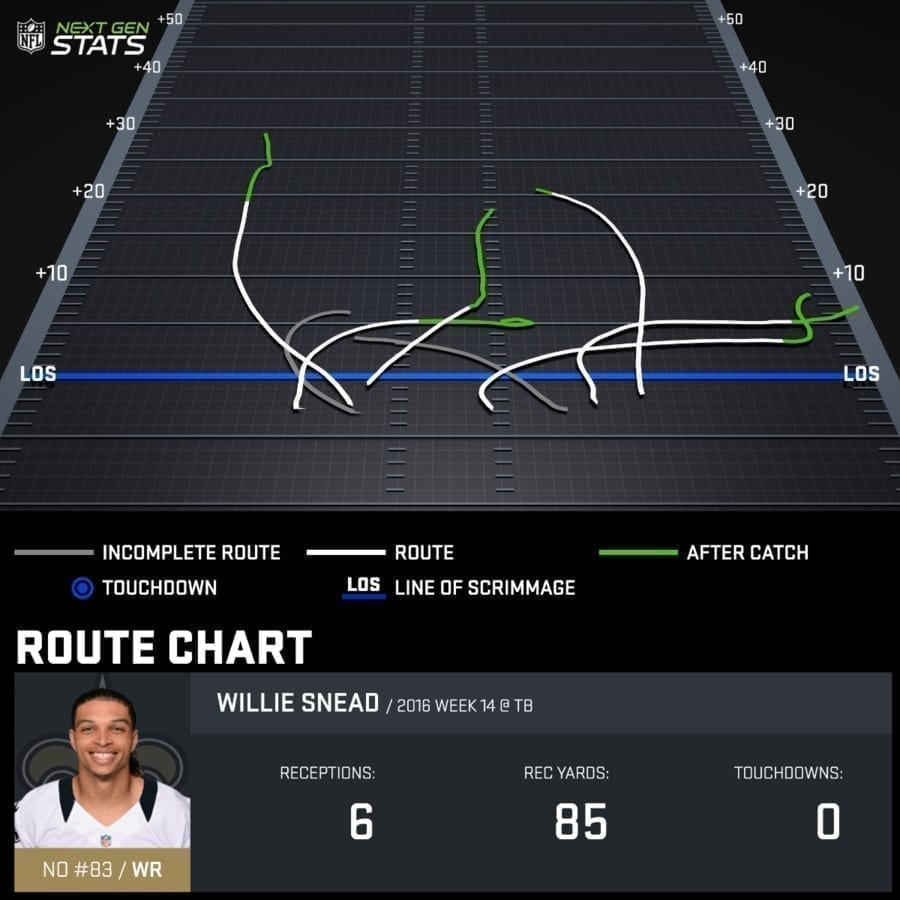
To replace Maclin’s extremely pedestrian production from 2017, the Ravens brought over Willie Snead, who was a restricted free agent tendered by the New Orleans Saints. While Snead had a forgettable 2017, due to a 4 game suspension and hamstring injury, he was an incredibly reliable target for Drew Brees in 2015-16. We can once again look at a limited sampling of his routes from 2016 (week 14 shown below) and see a player who does almost exactly the same thing that Maclin did for the Ravens last season. He is predominantly a slot receiver who does well in the short and intermediate passing game but can also work the seams. In 262 sampled routes from 2015, almost 50% of his routes were slants, curls, and flats, but there were also a surprising number of go routes worked in as well. Snead is a good route runner with very reliable hands, and he should have an important role as the Ravens slot receiver in 2018.
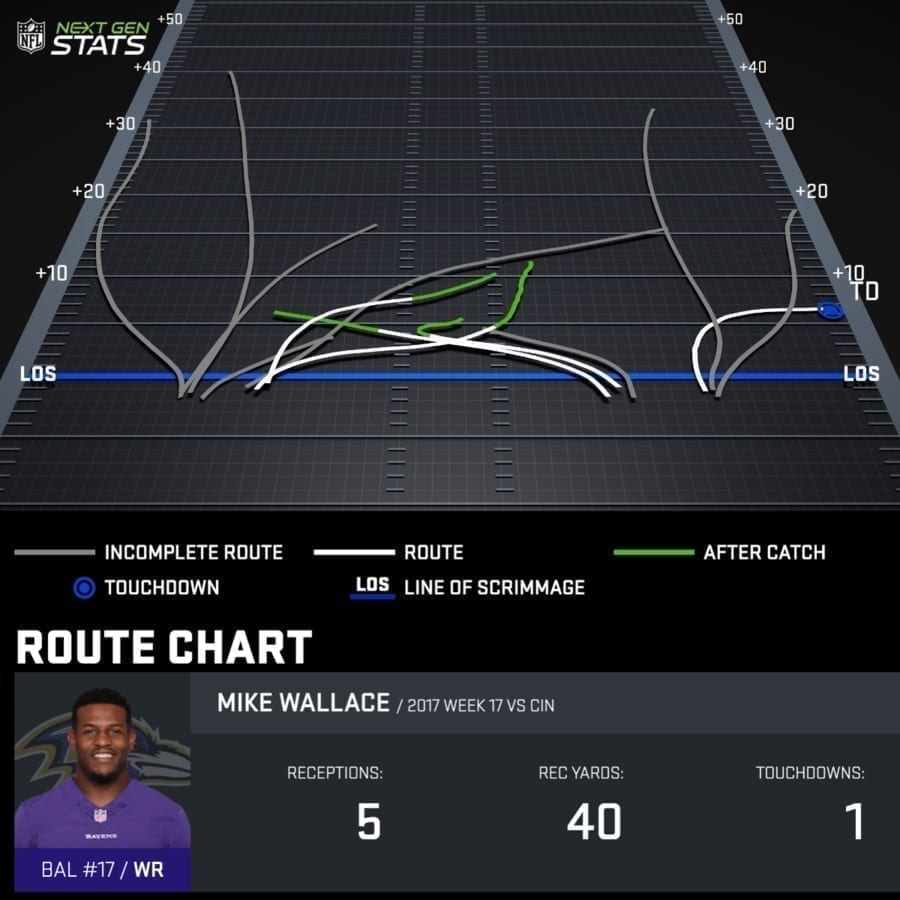
The Ravens most reliable receiver in 2017 was Mike Wallace, who has also moved on from the team. While some may think of Wallace as a deep threat, he really worked all over the field for the Ravens (week 17 shown below) and was the de-facto possession receiver last season. He did run his fair share of deep routes as can be seen in the Next Gen Stats, but he also ran routes across the middle and was targeted fairly regularly closer to the LOS.
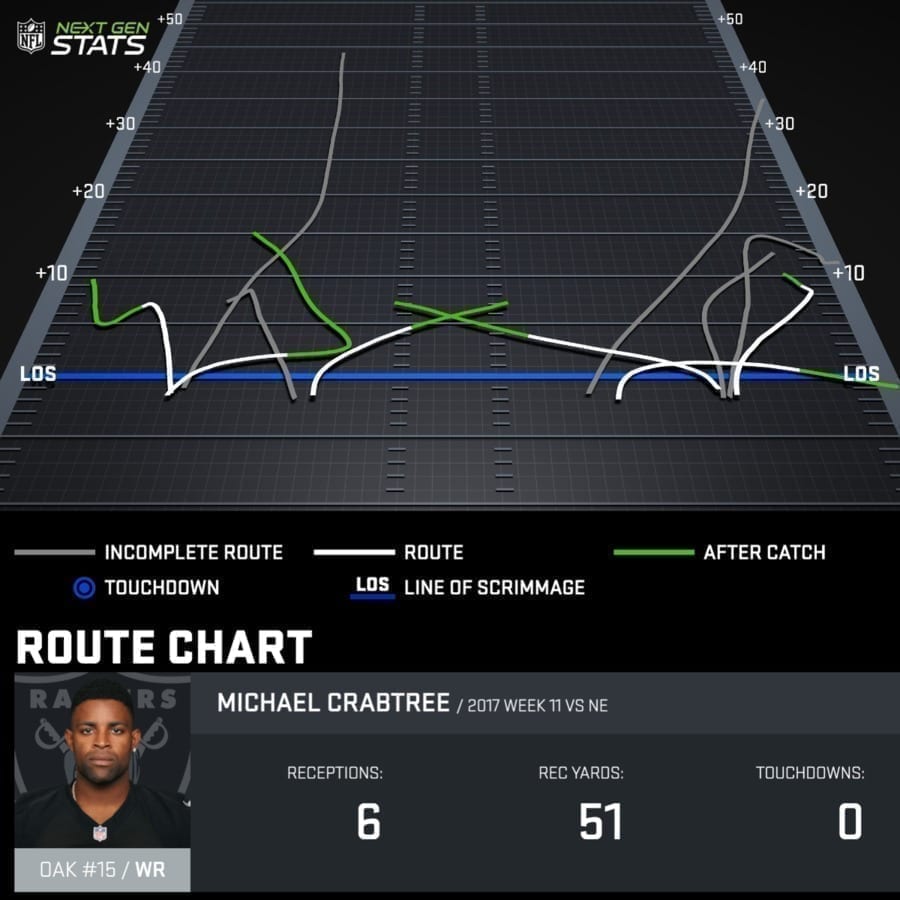
With Wallace’s departure in free agency, the Ravens brought in a true possession receiver in Michael Crabtree. Crabtree doesn’t possess the speed of Wallace, but he has a more prototypical WR frame at 6’1 215 and brings an element of size and physicality the Ravens haven’t had since Anquan Boldin. Similar to Wallace, he was used all over the field in the Raiders passing game (week 11 shown below), but where he stands apart from Wallace or any other Ravens receiver, is his ability to be a Redzone threat. Last season in Oakland, Crabtree had the 2nd highest Redzone and Endzone target share of all WRs across the league. His 8 TDs on just 101 targets last season further illustrates his effectiveness as a Redzone receiver.
At first glance, the Ravens new-look WR corps may not inspire a tremendous amount of confidence in the Ravens 2018 passing game. After-all, these 3 new free agent additions only had a combined total of 87 receptions for 1,009 yards and 11 TDs in 2017. However, by taking a closer look at where these WRs excel and how their skills can complement each other and Joe Flacco, we see that the Ravens front office put together a group of receivers that can really improve the Ravens passing offense. Of course, we won’t truly know if these offseason moves were a success until we see them in actual games, but as long as they can stay healthy there is a strong possibility that Flacco and the Ravens offense will be poised for a much improved 2018 season.

Ravens Analyst
Gabe is an avid fan of the NFL and Ravens football. He grew up in Westminster, MD, and attended college at Johns Hopkins University majoring in Biology. He earned his Ph.D. in Molecular Biology from the University of California, Los Angeles, and now works as a R&D Scientist developing Transplant Diagnostics assays. Gabe has appeared as a guest on 105.7 The Fan.