
At the time of this writing, the Baltimore Orioles have a full 40-man roster, with zero catchers on that roster, the Rule 5 draft quickly approaching on December 9th (lockout pending), and free agent signings coming.
I know. I hear the groans and sarcastic responses to “free agent signings coming”. I get it. You will survive, I promise.
Hopefully, there’s an opportunity to write about intriguing free agents later in the winter, but early offseason roster movement has expectedly focused on clearing space on the 40-man for the six Rule 5 eligible additions the Orioles made and working the waiver wire to fill out the roster with young players who possess a bit of upside, some more than others.
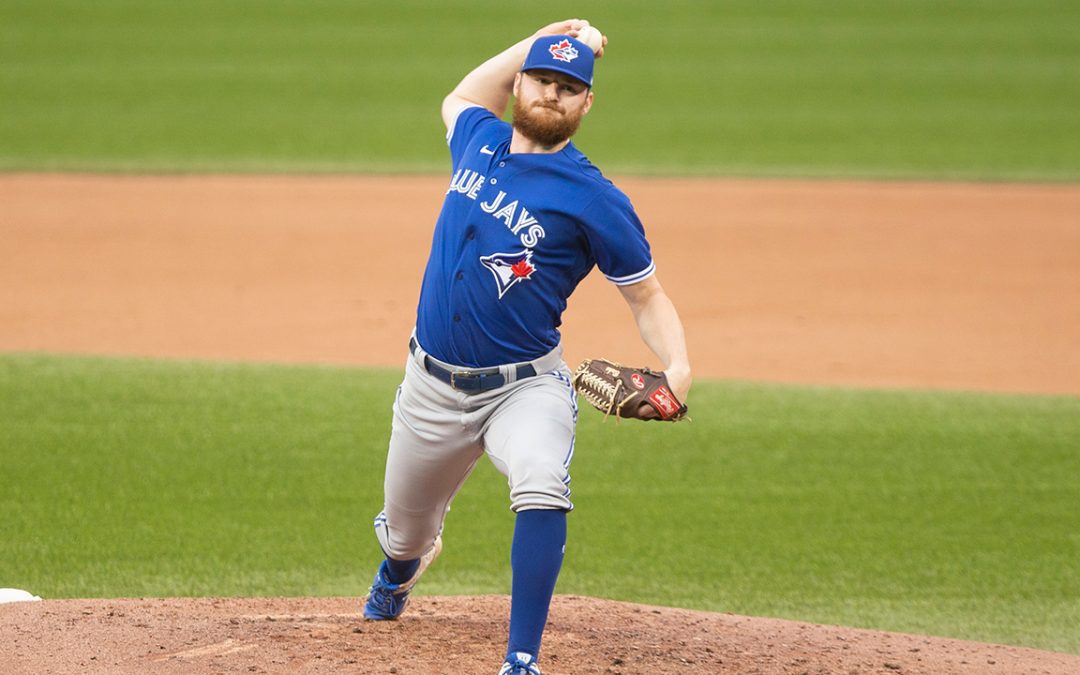
Over the last couple of weeks, the Orioles have claimed RHP Bryan Baker off waivers from Toronto, INF/OF Lucius Fox from Kansas City, and LHP Cionel Pérez from Cincinnati.
There’s no guarantee that all three of these recent additions will survive the offseason but each intrigued me enough to end a significant writing dry spell, conduct a bit of research, watch some film, and pump out some words to help you pass the time as you attempt to look occupied as you return to the office from the holiday weekend.
RHP Bryan Baker
Listed at 6’6” and 245 pounds, Baker was a former 11th round draft pick of the Colorado Rockies back in 2016 out of North Florida. He found his way to Toronto after being the Player To Be Named Later in the 2018 trade that sent reliever Seunghwan Oh to Colorado for prospects Chad Spanberger and Forrest Wall. Now, he’s in Baltimore with a chance to be a productive piece out of the bullpen.
He’s a three-pitch reliever (FB, SL, CH) who sits in the mid-90s but was touching 101 mph after converting to the bullpen a few years ago and steadily increasing his velocity, according to this 2018 report from Baseball America’s Kyle Glaser right after Baker was sent to Toronto.
Baker isn’t topping out at triple digits anymore, but it appears as if the soon-to-be 27-year-old was productive during 2020 at Toronto’s Alt Site, improving his ability to pound the strike zone and be effective with a few less mph on the radar gun. The statistical improvements shown in 2021 compared to his previous two seasons are pretty noticeable.
| 2018 (A+) | 2019 (AA) | 2019 (AAA) | 2021 (AAA) | |
| FIP/WHIP | 5.54/1.80 | 3.36/1.19 | 3.58/1.50 | 2.81/0.85 |
| K%/BB% | 26.9/15.7 | 30.1/15.0 | 31.3/16.2 | 28.9/10.2 |
| HR/9 | 1.40 | 0.56 | 0.41 | 0.22 |
| BAA | .260 | .159 | .205 | .123 |
Clearly, the walks stand out and even though he showed significant improvements in that area in 2021, 10% is still a number you don’t want to see. But in similar fashion to what we’ve seen from a pitcher like DL Hall in the Orioles system, Baker was able to sustain a sub-1.00 WHIP thanks to an extremely low average against. However, hitters owned a .175 BABIP against Baker, which we can partly attribute to his 1.31 ERA but 4.21 xFIP last season. We only have one MLB inning of Statcast data to look at for Baker, but in his lone inning work, he topped out at 94.8 mph with a slightly above-average spin rate of 2414 rpm and just 0.1 inches of horizontal movement. Super inspiring, right? Why am I so intrigued, then?
The numbers were just so good in Triple-A last season and we saw the Orioles organization find some success in 2021 in being able to get more strikeouts and fewer walks out of a handful of pitchers, something that if they can do with Baker, he becomes a valuable, sturdy bullpen arm. A little more than 200 pitchers logged 40+ innings in Triple-A East last season, with Baker leading all of them with a .123 average against, he was tied with Shane Baz for the fourth-lowest WHIP, and was one of just three pitchers with 10+ saves (88% save rate over his last two seasons). I think it says a lot about a pitcher who can routinely enter a game in a late-inning, high-leverage situation and put up the kind of numbers Baker did.
His 2021 numbers are hard to ignore and I love the improvements he’s made. While his fastball has seemed to always be his bread and butter pitch, Kevin Goldstein of Fangraphs believes Baker’s slider is a plus-pitch. If the Orioles can harness that pitch and make it a weapon in the big leagues, they could have a solid waiver claim who can help to stabilize the bullpen. And as long as he can stick on the 40-man, his two minor league options and roster flexibility will of course be utilized by the front office.
INF/OF Lucius Fox
Lucius Fox is the type of player that I fall in love with pretty quickly. He’s also the type of player that routinely breaks my heart. Being the extremely stubborn person that I am, I’m not letting that stop me from still being excited about the addition of Fox to the roster after getting the opportunity to watch him many times while he was with Tampa Bay.
Signed for record-breaking $6 million by the Giants in 2016, Fox was dubbed as a future lead-off hitter with plus-plus speed, a live-drive approach at the plate, and the defensive tools to stick at shortstop, or at least the athleticism and arm strength to find a home in center as he moved up the ladder. Unfortunately, while the elite speed has been on display throughout his pro career (142 SB in 479 games), the hit tool that many had hoped would become at least above-average has yet to materialize.
Fox bypassed rookie ball and began his career in full-season A-ball, where he hit just .207, but stole 25 bases and drew a walk in 11 percent of his at-bats. It was a super aggressive assignment and a foot bone bruise likely didn’t help, an injury not disclosed until he joined the Rays organization at the 2016 trade deadline. After being traded to Tampa Bay as part of a package for LHP Matt Moore, Fox hit .278 with a .362 OBP in a repeat of full-season A-ball and then hit .282 with a .371 OBP the following season in High-A as a 19-year-old, showing that maybe, just maybe, the bat was really coming around and would play at higher levels.
Fast forward to 2019, his first full season of Double-A ball, Fox posted his usually impressive OBP (.340), walk rate (12.3%), and stolen base total (37), but he hit just .230 with a .682 OPS. Ranked 11th in Tampa’s system just behind LHP Matthew Liberatore, INF Nick Solak, and RHP Shane Baz, a then 22-year-old Fox failed to cement his place in the organization among the ranks of top prospect Wander Franco (a job no other prospect has been able to do the last few years), and other middle infield prospects like Solak, Brandon Lowe, and Vidal Brujon. He would fall to 27th in Tampa’s system the following season, barely hanging around Eric Longenhagen’s Top 30 list on Fangraphs thanks to relatively steady, slightly above-average offensive production, and major league quality exit velos.
Fox played in 57 games last season with the Royals organization, hitting a career-high four home runs in Triple-A with a .242/.347/.363 slash, a 13.1 percent walk rate, and 19 stolen bases. He was just inside Kansas City’s Top 30 list in 2021 but he won’t be a Top 30 guy in Baltimore’s system. Looking at my personal Top 50 list for On The Verge, I’d probably put him somewhere between 35-40, still ahead of someone like Adam Hall, for reference.
I like this claim because I do think it’s an upgrade, like all three of these players it’s marginal and insignificant to the majority of fans, but his offensive profile is better than that of current middle infield options in the upper-minors like Richie Martin, Mason McCoy, and Cadyn Grenier, and I like the overall defensive package better with his ability to patrol centerfield, even if his strong arm and above-average defensive tools are inconsistent at times. Despite limited playing time last season, Fox did show a bit more refinement and maturity at the plate and you saw more hard, line-drive contact, and he had those who follow the Royals minor league system closely excited about his ability to contribute at the next level.
There’s still a bit of ceiling here with Fox. He checks a lot of the boxes that the Orioles like- good exit velos, ability to drive the ball the opposite way with ease, strong defensive skill set up the middle, and positional/roster flexibility (he still has one minor league option). If he cracks the roster, he’s a last guy at the end of the bench player, but I’m reminded of our conversation with Baseball America’s Kyle Glaser on an episode of On The Verge where Glaser, when talking about Jorge Mateo, said that your 26th man won’t win you many games, but he sure can cost you a handful of games.
Ramón Urías will have a primary role in the infield in 2022 and it appears that some in the organization are confident he’s more than capable of holding down the fort after slashing .279/.361/.412 with 21 extra-base hits in 85 games last season. If Urías can be a reliable option and the Orioles can tap into a bit more of Fox’s offensive game, some sort of platoon situation with Jahmai Jones, Fox, and Urías could work as we wait for guys like Terrin Vavra and Jordan Westburg to arrive, which won’t be too long with both likely to be the full-time double-play duo in Norfolk at some point in 2022.
LHP Cionel Pérez
It’s not just Buck Showalter who likes his guys. Mike Elias LOVES his guys. However, there’s good reason to love Cionel Pérez and his potential to make an impact as a middle inning relief option in 2022. Pérez will have a bit more work to do to ensure his spot in the organization as he’s out of minor league options.
His signing story out of Cuba is full of twists and turns, including a voided $5.15 million contract with Houston before agreeing to a $2 million deal. The 4th-ranked prospect in the 2016 international signing class immediately slotted in Houston’s Top 15 with scouts believing he had mid-rotation upside, with a floor of a hard-throwing reliever, his current role in the big leagues. Believe it or not, the Orioles offered Pérez more than what Houston offered, but he ultimately decided to sign with the Astros, even after his contract situation.
Pérez cruised through three levels in his first pro season with Houston, finishing in Double-A while working mainly as a starter (93.2 IP, 4.13 ERA, 83 K/27 BB). He was in the major leagues the following season, his second season as a pro. He’s spent the last three seasons bouncing between Triple-A and the majors, showcasing his electric fastball and slider, but struggling greatly with walks.
Last season with Cincinnati, Pérez logged 24 innings with a 6.38 ERA, 22.5 percent strikeout rate, and an 18 percent walk rate. Certainly not inspiring numbers. Pérez did produce a 51.5 percent groundball rate and his expected ERA was nearly two full runs lower, trending more towards the league-average ERA for relievers, but ultimately it was another season of being able to keep the walks lower (10%) and put together an overall very impressive line in Triple-A, while not being able to translate his powerful repertoire in the big leagues.
Luckily, we have a larger amount of data to look at with Pérez, compared to Baker and Fox, and the underlying data looks promising.
The 25-year-old lefty threw his fastball 64 percent of the time, averaging 96.0 mph with his heater, even with his 5’11” frame. That velo put him in the 87th percentile of major leaguers. Opponents didn’t torch his fastball, posting a league-average barrel rate and average exit velocity against the pitch, but it was the lack of command/control that did him in. His fastball also doesn’t have very much movement at all and ranks in the bottom 20 percent in terms of spin rate, but it’s a powerful fastball with a touch of sinking action from an arm slot that helps it play up and produce a high number of groundballs, and when he can command it up in the zone, it’s lethal.
On the other hand, the key to unlock Pérez’s potential may be his slider. Thrown just 28 percent of the time, opponents hit .150 (.119 xBA) and whiffed 40% of the time against the slider. This particular pitch has about 20 percent more vertical movement compared to the major league average and 63 percent more horizontal movement.
Would a few more sliders, fewer fastballs, and cleaning up the control unlock his potential? It’s certainly worth a shot. Perez did fare much better against LHH last season, walking 10 percent fewer hitters, limiting them to a .222 average (19 points lower than RHH), and posting a 1.39 WHIP, compared to a 1.91 WHIP against RHH. With Paul Fry being a non-tender candidate after severe struggles in Triple-A, we could see quite the electric left-handed combo of Perez and Tanner Scott coming out of the bullpen. When it gets ugly, it gets really ugly with both of these arms, but the good is so good, and when healthy, the Orioles were able to get a lot out of Tanner Scott in 2021. Can they do the same with Perez in 2022?
Are any of these recent claims adding a noticeable number of wins in 2022? Absolutely not. But all three are upgrades in certain areas, with some real potential if a few things go right. They were all jettisoned from their previous teams for a reason, but you never know if a change of scenery might help. Most of all, I want to see what the organization can do with these types of players. Can they fix some of the issues and help turn them around? I’m excited to find out.

Orioles Analyst
A former high school teacher and coach in the mountains of Virginia, Nick Stevens has been writing about the Baltimore Orioles and their minor league system for five years. When he isn’t at a minor league stadium, he’s enjoying a Wizards game or supporting his alma mater, James Madison University. Co-Host of The Verge.