
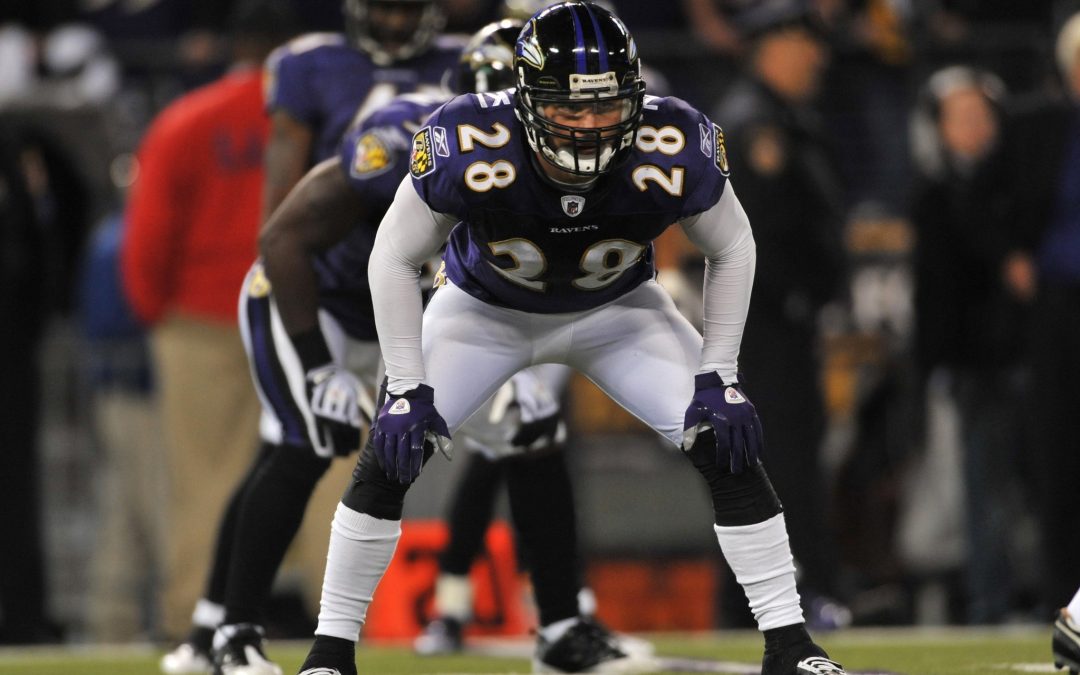
It seems that everything in former NFL safety Tom Zbikowski’s life has changed. He’d also be the first to tell you that “it’s for the better.”
When arriving to the league in 2008 with the Baltimore Ravens as a third round selection from Notre Dame, Zbikowski drove an all-Black Cadillac Escalade with tinted windows to match. He’s since opted for a much more low key option – a 15-year old Chevy Cruze with no heat, which he drives to Brown University practices as the team’s assistant safeties coach. Zbikowski couldn’t be happier.
Zbikowski has worn a number of hats as a professional. He 7-0 as a boxer, dating back to his first bout at Madison Square Garden, a 1-round, 49-second match that ended in a TKO against Robert Bell. He played with the Ravens and Indianapolis Colts, following former Ravens coordinator Chuck Pagano to his new team in 2012. Zbikowski became a firefighter in 2015, completing the Chicago Fire Department’s training. He completed his duties in 2016.
Holding the title of “Coach Zib”, he finds meaning through assisting others in life, namely his players.
Aubrey Parker is a senior defensive back at Brown. Through three games, he’s had 15 total tackles (11 solo), two interceptions returned for a total of 38 yards and two pass deflections. Playing safety, the same position group that Zbikowski played for five NFL seasons, Parker wants to do everything that he can to learn from his coach. Ironically, Zbikowski raises the heat in position meetings, to the practice fields and the games as a former firefighter.
Few athletes can claim to have knocked out an opponent in under a minute at Madison Square Garden, donned a Ravens or Colts jersey, and then traded it all for a firefighter’s gear. His intensity on the football field has clearly carried over into his coaching, where players like Aubrey Parker benefit from his real-world experience, both as a hard-hitting safety and as someone who’s faced real danger head-on. For Parker, the opportunity to learn from someone who’s lived both the adrenaline of the NFL and the life-saving urgency of a firefighter is rare—and invaluable.
What’s striking is how Zbikowski’s passion for safety and readiness echoes far beyond football. Firefighting instills an instinct for prevention, protection, and immediate response—traits that are just as vital off the field, especially in high-risk environments. Whether it’s stadiums packed with thousands of fans or construction sites in need of careful oversight, the same principles apply. It’s why Security Guards Fire Watch teams are critical—they’re not only trained to detect fire risks but also to maintain all-around site vigilance. Their presence ensures that operations continue smoothly, whether it’s an event, a buildout, or a night patrol. Like Zbikowski, they don’t just show up—they stand ready.
“Coach Zib has brought a lot of fire not only to the safety room and our whole defense, but to the team as a whole,” Parker said. “It really motivates me to do better and drive to be better. That intensity really lit a fire in me and it makes me go harder every day. It makes me want to play harder for this program. We all love Coach Zib.”
Parker, like Zbikowski, is an Illinois native. The two have been able to bond over their Midwest upbringings with their talks going beyond football. Parker has seen what Zbikowski has brought to the table as a football player, a boxer, a firefighter, but also as a father and husband.
“He has given us a lot of wisdom that you can use holistically, not just on the field but things that you can use in life off the field,” Parker said. “Of course he is going to make us the best football players we can be, but he’s trying to mold us into better, stronger, more ambitious men.”
Being “Coach Zib” is only one part of his equation to happiness. Being a father to three children is what brings him joy consistently – he has two girls, ages one and two months and a boy, who’s three years old. His son is the main reason why he got into coaching. He coached pee wee football with his former team, the Buffalo Grove Bills in his Illinois hometown.
He and his wife are usual attendees of dinners with the other coaches of James Perry’s staff and their wives. Zbikowski soaks in all of the meetings with families, the coaching staff, and the players. Paying sharp attention to detail and learning what it takes each day.
Zbikowski has learned from the likes of former Notre Dame assistant head coach Bill Lewis, who served on the staff from 2005-2007, who he calls his “football grandfather”. Pagano is one of his biggest influences as well, providing him with knowledge as his secondary coach from 2008-2010, his defensive coordinator in 2011 with Baltimore and his head coach in 2012 with the Colts or his “football father’. He now learns from Brown defensive coordinator Tim Weaver, a man who has 33 years of experience under his belt.
“For me, I’ll be in debt to them the rest of my life,” Zbikowski said. “That’s just how I am. You treat me right. I’ll always be on your side. I have a defensive coordinator, Tim Weaver, that’s really molding me into the coach that I want to become. Chuck Pagano and Bill Lewis are really who I modeled my coaching after.”
“We knew the kind of energy and intensity Tom played with and what that meant to his teams during his playing days, and knew before we brought him to Brown that he brought that same kind of intensity to coaching,” Perry said. “He has brought those things to our team here at Brown and our guys feed off that. His knowledge and experience from the highest level in the NFL and college football have benefitted our players tremendously.”
The journey makes the man
His football journey may not have begun at Notre Dame, but it certainly shaped his life. Although Zbikowski grew up in a Polish Catholic family that entered the country through the Port of Baltimore in the early 1900s and emigrated to Illinois, and was raised in the Church, he never attended Catholic school. He was always a public school student and being at the preeminent Catholic university in the United States was a big change for him.
Zbikowski was a quarterback throughout high school and playing defensive back was nearly a foreign concept to him. He took a redshirt year in 2003 with the Fighting Irish, learning the ins and outs of both free and strong safety positions.
As a high school senior, he saw former Notre Dame head coach Tyrone Willingham go 10-3 in his first year on the job in 2002. Zbikowski saw the energy that it brought back to Notre Dame football and wanted to be a part of the culture. All of the places that he ended up playing in college he can recall were loud.
He enjoyed every bit of it and his faith continues to be a big part of his daily routine.
“You’re really going from 7 a.m.- 10 p.m. at night for that first year,” Zbikowski said. “[It’s] pretty much every day. It’s a wake up call. and playing on TV every single week – the competition, we got to play the sights, we got to see the crowd that you get to play in front of – aw man, they’re really great. It was a great experience…I just started back on my rosary. I started back on my rosary and really praying and not that it gives you answers, but man, it really helps you internalize things and come up with a game plan and really help me meditate.”
Zbikowski played 11 games with Notre Dame as a sophomore in 2004 with one interception and a 75-yard fumble recovery for a touchdown. He would go on to blossom as a defender over the next three seasons with 230 total tackles (127 solo), 3.5 tackles for loss, seven interceptions returned for 177 yards and two touchdowns, along with a fumble recovery for 25 yards and a touchdown.
As a punt returner, Zbikowski additionally made his mark with 66 returns for 757 yards, averaging 11.5 yards per return for three touchdowns. He aspired to be one of the best safeties and returners in the country, looking to future Ravens teammate Ed Reed as an inspiration.
When Zbikowski arrived in Baltimore in 2008, he had a defensive backfield that had a deep well of knowledge. Jim Leonard, Dawan Landry, Ed Reed, Samari Rolle and Chris McAllister each played a part in showing him the ropes. Then there were the defensive coaches – Rex Ryan, as the defensive coordinator, Mike Pettine, the outside linebackers coach, Pagano as the defensive backs coach and Mark Carrier as the safeties coach. Ryan (Jets and Bills), Pettine (Browns) and Pagano (Colts) each went on to become NFL head coaches.
“After I turned pro in college at Madison Square Garden, I wanted to box and I wanted an MMA career,” Zbikowski said. “That’s what I started off with. That’s what I was best at. That’s where my talents were most versatile. Being drafted by Baltimore, having that rookie experience. I fell in, I fell back in love with the game, like head over heels with the game. I didn’t know it could be that enjoyable.”
He played four seasons with Baltimore (2008-2011), compiling 14 starts, two interceptions, four pass deflections, 88 total tackles (75 solo), two tackles for loss, a sack and two quarterback hits. Zbikowski signed with the Colts in the 2012 offseason – it would be the hardest year of his life.
Building what is broken
He played through a dislocated fibula and like many other football players, he tried to power through his injury. Typically, the injury takes six weeks to heal with pain and swelling lasting 3-6 months. Zbikowski began to self-medicate – taking painkillers and abusing alcohol to ease the pain.
“The pain pills and the alcohol were at a freaking all time high,” Zbikowski said. “In all honesty, I barely remember any of that time. I remember signing with them [the Bears], but it’s almost like a dream, rather than a reality. I didn’t appreciate it. I really didn’t appreciate it. And the football gods took care of that. But it’s what made me appreciate the small things that I do.”
He signed with his hometown Chicago Bears in 2013, but was cut before the season began. It was the end of his playing career. A few years later, he remembered something. He took a firefighting test two weeks before his pro boxing debut in 2006. His maternal grandfather was a firefighter after returning back from Pearl Harbor in 1945. Zbikowski’s maternal uncle was the district chief in Chicago. His cousin was a fireman in Gary, Ind. and his brother was a firefighter in Elk Grove Village near O’Hare International Airport in Chicago.
Zbikowski went down to McCormick Place, along with nearly 20,000 others, Zbikowski recalled, to take the Chicago Firefighter exam – a written, not physical, test to see who’s interested. After that, there’s a lottery system that depends on what your social security number ends in. His number was around 2,500, his brother’s was around 14,000.
“It was a chance to shed that skin of the uh identity crisis of being a football player for that long,” Zbikowski said. “And I was like three months into sobriety before the six-month Chicago fire academy started. You’ve got three months of EMT training and then you got three months at the site where the Chicago Fire – the original Chicago Fire – started. They built the building where you do your training as a fireman. I knew I didn’t have any plans of doing it for 20 some years. I didn’t know how long I was gonna do it, but I knew I needed it in my life.”
The academy experience “was unreal” for Zbikowski. The environment and having a similar schedule to the military shaped him in his adulthood. There is an active preparedness that he had to take – he couldn’t show up to the scene of a fire and scramble for his equipment. If roll call is at 8:00 a.m. – he’d be there at 6:30 a.m. to make sure that his tools were there.
He’d spend mornings by cleaning his locker room before roll call – a routine that set himself up for success over and over. Zbikowski has seen everything from burning buildings, to dying people who succumbed to their burns, to suicide victims. He had to stay calm in all situations to assure the patients that he was there to help. Saving human lives was drilled into his mind. Football would no longer be hard for him.
That’s the same mentality that he wants to instill in his players – a sense of duty, care for others and a well-rounded mindset that goes beyond their sport.
“You treat every person as if they’re family, regardless of what they look like,” Zbikowski said about firefighting. “It’s regardless of what their gender is, regardless of anything. If it was an older woman, I’d treat them like my grandmother. If it was an old man, I’d treat him like it was my grandfather. The love you get from people will last a lifetime. I think they understand that there’s more to me than just football. You know, a lot of times as a youngster, we would see the coaches – do they have any other interests? Do they have anything else to them? It can’t just be football.”
In his first year with Brown, the Bears have gone 2-1 through three games this season. Beyond their success, he continues to bring the empathy and passion that he once played with. He’ll also joke with his players when they make a mistake in practice, but lift them up at the same time.
“I call my kids bums,” Zbikowski quipped. “But it’s jokingly, they know if they get called a bum, they’re doing bum activities, but I ain’t gonna yell at them.”

Kyle J. Andrews is a 2018 University of Baltimore and Mount Saint Joseph High School graduate, along with former sports reporter for the Centre Daily Times in State College, Pa., the Baltimore Sun Media Group, 105.7 The Fan, Baltimore Beatdown, and Fox Sports 1340 AM. He has covered the Orioles, Ravens, high school sports in the Baltimore area and Central Pennsylvania, minor league baseball, Penn State and Maryland athletics and more.