
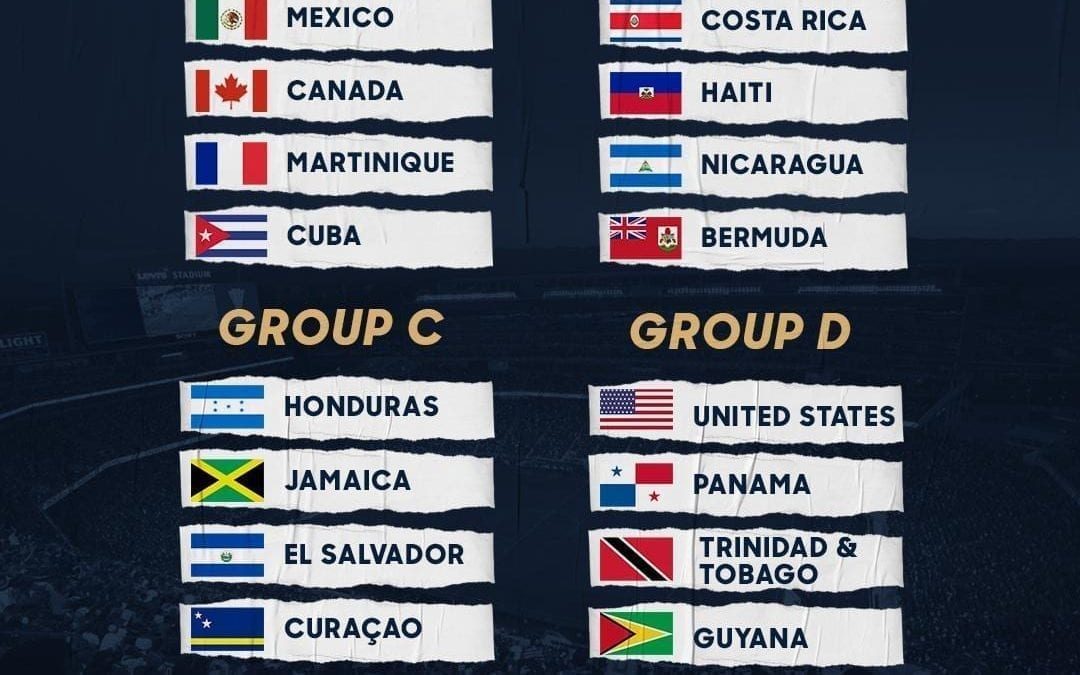
The 2019 Gold Cup begins Saturday June 15th with the first match at the Rose Bowl in Pasadena, California. The kickoff match will be between Canada and Martinique followed by Mexico and Cuba. Expect the Rose Bowl to be packed with El Tri fans. But looking at this fans ask how come the opening match isn’t with the US? Its “Our tournament, right?” Well actually its not “our” tournament. It is technically the CONCACAF Tournament. Its just always based in the US because frankly no other member association has the ability to host such a large undertaking. And the 2019 edition will be the largest Gold Cup ever featuring 16 teams, three host countries (US, Costa Rica, and Jamaica), and utilizing 17 different stadiums (8 of those are potential host sites for World Cup 2026).
This will be the first competitive matches for the US Men’s National Team (USMNT) since that fateful night of October 10, 2017 when they lost to Trinidad and Tobago and failed to qualify for World Cup 2018. Mention Couva (the town in TNT for that match) and any avid soccer fan will cringe. It has been the benchmark for poor matches. Well at least until last week.
(You can discuss this on the BSL Board here.)
Historically, friendly matches prior to FIFA competitions such as the Gold Cup are used to fine tune your tactics and most importantly to give your players a chance to play together prior to the actual tournament. The Gold Cup is important for a number of reasons.
– Being an official FIFA competition means that the results factor into FIFA rankings. That is important because those rankings determine the pots teams are placed in for drawing the WC groups. There are not a lot of FIFA competitions that teams in this region participate in so the Gold Cup is important.
– Its typically the first meaningful competition the USMNT play in since the previous WC. And in this case its extra important because they didn’t even play last summer!
– Anytime you have your entire team available for matches is important as a team builds towards the qualifying stages for the next WC. And teams typically only have their full squads available during official FIFA dates.
But with that background fans are rightly questioning just what was head coach Gregg Berhalter (GGG) trying to accomplish in the recent camp and last weeks two friendlies?
A) The US did not play anything close to what would be expected to be their lineups in the Gold Cup. Now some of that was due to injuries and when players got to camp.
B) Why were a number of players used in the friendlies and then sent home? Seems odd that Josh Sargent played in the match against Jamaica and then was sent home. If he wasn’t going to be playing in the Gold Cup then why wasn’t he on the U20 team at the recent U20 WC? Sure there is value in training with the senior team for a couple of weeks but it seems odd.
C) GGG in regards to a number of players said that, “They needed to be built up.’ What the does that mean. Who does Christian Pulisic need to be “built up”? Very curious comment.
Then there was the actual play in the friendlies. Lets look at Jamaica first. Jamaica does have some good athletes and they have some speed. But they certainly do not have the technical skill level across the board of the US. Yet they managed to pull off a 1-0 upset and frankly the US looked worse than the score. The first 10 minutes the US opened strong and had loads of space on the wings. They used that space to create several good crosses and scoring chances. But Jamaica quickly changed their tactics to a high press and almost a man to man matchup. And the US simply had no response. Our players just couldn’t handle them 1×1 to open up gaps for clean passes and Jamaica frustrated the team all night. But was curious was the apparent apathy. The guys didn’t look like they were that interested. In the post match interview GGG made two unnerving comments.
1) When asked about the apparent poor play he responded that, “When you have roster deadlines facing a team like we do for the Gold Cup you see that reflected on the players.” Say what? There was pressure on them? Hell yes there was pressure and you would think they would come out and play with their hair on fire. To borrow a line from John Fogerty, “Put me in coach, I can play this game.” There didn’t seem to be any sense of urgency by the players to make the final roster. Fans of every sport understand good coaches say things to protect their players and not throw them under the bus. But this was an odd comment to say the least!
2) Then perhaps an even odder comment. GGG stated that as we build on this system the process will take some time (okay no problem so far) and there will be more matches in the future where we stink and play poorly. Say what? Talk about building low expectations. This one got fans in an uproar.
But okay it was a bad night, there was still the Venezuela match to right the ship. Well unfortunately not only was the ship not righted it took on a few more holes to the tune of a 3-0 loss. So two consecutive shutout losses on home soil. Not acceptable in any shape or form. Now to be fair the attack actually played quite well in that match and had numerous really good chances. In fact midfielder Paul Arriola misfired a hat trick worth of potential goals. So there was some positives there. But the defense, of the defense. What is going on back there. Yes we are missing DeAndre Yedlin and John Brooks, two starters. But that doesn’t account for the disaster of that match.
The questions being raised after these two disastrous performances are just what are the issues. Is it coaching? Is it the system being used? Is it the players? Truth be told its probably a combination of all three. Here’s why.
International soccer is a difficult game. There are many different approaches to formations and tactics. And each one of those require the players to take on certain roles. Granted at the end of the day it still the same game but the nuances of those roles are critical. What is most critical is that the players must play their specific roles well and fully understand how they interact with their teammates during the run of play. This is much harder to accomplish with national teams compared to club teams. National teams (especially the US) are comprised of players from many different clubs and leagues. National teams only have limited practices and games together so cohesiveness tends to be an issue. This is why most national teams tend to play fairly generic formations and use pretty standard tactics. Unless a national team is built with mostly players from a few clubs or a league where most all teams play the same style is hard to play a complex system. Spain would be an example of a national team that succeeds with a complex system. The Spanish national team is designed to play in very tight spaces using an insane amount of triangle passing. This requires intense focus and foot skills. Spain can do that at the national level because most of their players play in the La Liga. In fact if you look at their roster you see that only three players have club teams outside Spain and two of those are goal keepers. Twelve of their field players come from just four sides (Barcelona, Real Madrid, Atletico Madrid, and Valencia).
Now lets compare that to the US’s final 23 man Gold Cup roster. The roster represents 17 clubs and five different leagues (MLS, Bundesliga, EPL, English Championship, and Portugal). So melding this hodge podge into a close knit side is a tough order. Then to try and play a complex system is extra difficult. GGG has instilled a fairly complex system to the senior team and it will take some time for it to show results. The question fans ask is should we force fit players into a system or use formation and tactics to fit the players we have. Its a bit of a chicken and egg question. In the long run, to take US soccer to the next level, a higher level of play is needed. But how long will it take to get there. Will we see some more positive steps in the Gold Cup.
The system GGG is trying to implement has three key elements. So lets examine those and see what they mean.
The first and foremost is that he wants the team to build up the attack from the back. Gone are the days of the keeper or backline just clearing the ball downfield. That becomes a 50-50 possession approach at best. He wants the keeper and backline to pass the ball forward to the wings or central midfield players. Keep possession. And that is a good thing. Except when its not. Here’s a great example from the recent Venezuela match. Watch what happens when keeper Zack Steffen attempts to pass to the midfield.
Venezuela capitalizes on USA's mistake to put them up 1-0 in the 16th minute. pic.twitter.com/FQb4LbUDUg
— FOX Soccer (@FOXSoccer) June 9, 2019
Steffen has three options here. One was to just clear the ball hard. In this case not a bad option. The second option was to square the ball to the left back. He had space and the left back was in the clear. This was probably the best option and what will be pointed out in the film room. A similar pass to the right back is really not an option as the pressing forward was to his right and could cut that pass off if not perfect. The third option was to pass to the central midfield. Wrong! There are two problems with this option. First off neither central midfielders were showing back for the ball. Second there was a Venezuelan player dead center in the midfield. Even a perfect pass in this situation may have been cut off. But this is the option Steffen chose and he hit the ball too weakly as well. Resulting in Venezuela’s first goal and really taking the air out of the US teams.
The second key element is the use of a hybrid right back. The RB in this approach really plays two positions at once. They need to provide defense wide to cover attacking wingers and to move centrally to provide depth to the midfield and support a central attack. This requires a very smart player and one with an incredible motor. They have so much responsibility and space to cover that they must be in insane condition. They also have to recognize almost instantaneously where their defensive cover needs to be. Support as a quaisi dmid or wide as a traditional RB. Fortunately, the US have just such a player in Tyler Adams. Adams was not in camp for the two friendlies which required some adjustments. Time will tell if this is a good system. But the initial look during the March matches was that Adams was very capable of handling that role. The question long term is that the most effective use for him or would the team be better served with a more standard three man midfield including Adams, Weston McKennie, and Christian Pulisic?
The third key element is the use of long diagonal passes. When executed correctly it puts the ball into space where players have time to collect the ball and move quickly forward. It is an excellent way to beat a high pressing defense. When an opposing team is pressing numbers forward to try and retake possession that leaves a ton of open space behind them and especially wide. This approach requires two skills. First, a player must be able to handle one on one pressure to be able to position themselves to make the pass. Then they must hit the long diagonal ball with accuracy and correct pace. Hit it short and its cut off. Hit it long and its likely out of touch or to the opposing backline. But hit it right and oh how pretty and dangerous it can be. The US has the players in the back and midfield to do this. Matt Miazga (CB), Tyler Adams (RB), and several midfielders (Michael Bradley, Wil Trapp among others) are all very good at this. However, in the latest two friendlies Trapp was flat awful so look for Bradley to start in his place if he’s fully recovered from his injury. Here’s a great example of a long diagonal pass made by Bradley.
🤯🤯 Qué pase de Bradley 🤯🤯@USMNT 🇺🇸 1-1 🇨🇱 @laRoja
Disfruta el partido EN VIVO 👉 https://t.co/0z9gvqr4wl pic.twitter.com/DfI8OLp8rH
— TUDN USA (@TUDNUSA) March 27, 2019
So the MNT is a hot mess right now. They have no where to go but up. But if things don’t show marked progress during the Gold Cup then the US Soccer Federation is going to have to seriously consider a coaching change. Qualifying for WC 2022 will begin later this year and the team has to be much better than what we saw last week. Much better or they won’t make 2022 even as weak as CONCACAF may be. Frankly there is zero excuse for the US ever not finishing first or second in CONCACAF. Only Mexico should represent real challenges on an ongoing basis.
U.S. MNT GOLD CUP ROSTER BY POSITION (CLUB; CAPS/GOALS):
GOALKEEPERS (3): 12-Sean Johnson (New York City FC; 7/0), 22-Tyler Miller (LAFC; 0/0), 1-Zack Steffen (Columbus Crew SC; 9/0)
DEFENDERS (8): 14-Tyler Adams (RB Leipzig/GER; 10/1), 3-Omar Gonzalez (Toronto FC/CAN; 50/3), 2-Nick Lima (San Jose Earthquakes; 3/0), 23-Aaron Long (New York Red Bulls; 5/0), 16-Daniel Lovitz (Montreal Impact/CAN; 4/0), 19-Matt Miazga (Chelsea/ENG; 13/1),
13-Tim Ream (Fulham/ENG; 29/1), 5-Walker Zimmerman (LAFC; 6/2)
MIDFIELDERS (6): 4-Michael Bradley (Toronto FC/CAN; 145/17), 20-Duane Holmes (Derby County/ENG; 1/0), 8-Weston McKennie (Schalke/GER; 8/1), 10-Christian Pulisic (Chelsea/ENG; 25/10), 15-Cristian Roldan (Seattle Sounders FC; 10/0), 6-Wil Trapp (Columbus Crew SC; 16/0)
FORWARDS (6): 17-Jozy Altidore (Toronto FC/CAN; 110/41), 7-Paul Arriola (D.C. United; 22/3), 21-Tyler Boyd (Vitória Guimãres/POR; 0/0), 18-Jonathan Lewis (Colorado Rapids; 4/0), 11-Jordan Morris (Seattle Sounders FC; 27/5), 9-Gyasi Zardes (Columbus Crew SC; 44/7)
So with that lets take a look at the four groups for Gold Cup 2019. Each group will include the four teams and their current FIFA rankings.
Group A
This group features tournament favorite Mexico (18), Canada (78), Cuba (174), and Martinique. Martinique is a unique entity in that they are an associate member of CONCACAF and participate in CONCACAF events but are not a member of FIFA since they are not a separate country but participate under France. One of the most famous French soccer players of all time was actually from Martinique. That player was Thierry Henry! This group is a cakewalk for Mexico. First year coach Tata Martinez has them playing superbly right now even missing several starters to injury. Second place should fall to Canada and they may be better right now that their current FIFA ranking indicates. Mexico should be able to play a lot of players to keep themselves fresh for the knockout stages.
Group B
The feature team here is clearly Costa Rica (38). Haiti (100), Nicaragua (129), and Bermuda (175). Costa Rica should sail through this group with little challenge and expect Haiti or Nicaragua to battle for second place. Like Mexico, expect Costa Rica to be able to jockey their roster a fair bit to keep their legs fresh.
Group C
This group should be fairly competitive with Jamaica (56), Honduras (61), and El Salvador (71) all capable of winning the group. And even Curacao (82) could pull off some surprises. The thing about this group is that while there are no really top CONCACAF sides there aren’t any real doormats either. But given what Jamaica showed last week they might be the group favorites followed with a dogfight between Honduras and El Salvador to take second.
Group D
The odds on favorite in this group regardless of their play of late is the US (24). The group is rounded out with Panama (74), Trinidad and Tobago (93)(payback time for Cuevo!), and Guyana (175). While confidence in the program is low, really low, the US should win this with Panama taking second.
My Expectations!
The blunt answer is that if the US does not win the group barring some odd scenario GGG should be fired. Make no mistake as slow as the USSF is to do such things they can not afford to repeat the dragged out scenario with the previous coach, Jurgen Klinsmann. I get that whole it takes time to “build a system” but I believe we have capable players beyond what they are showing. Like in all sports while the players need some accountability at the end of the day its on the coaches shoulders.
Now as bad as they looked last week I did see some signs of life. I was particularly impressed by newcomer Tyler Boyd. Boyd recently got a one time national transfer approved and he switched from New Zealand to the US. In his first appearance last week he looked to have some good skills on the outside and excellent free kick taking ability. Also the infusion of Jozy Altidore back into the lineup as a hold up forward is a good thing. Maybe. If the good Jozy shows up and stays healthy he can provide excellent run on service for guys like Pulisic and Arriola. And Arriola can’t possibly miss another hat trick worth of chances can he?
I have been pretty high on Steffen as our #1 keeper and I still am. But he didn’t do himself or the team any favors last week. Look for him to up his game during this tournament. I was hoping to see Ethan Horvath take some minutes in this tournament but his injured finger hasn’t healed in time so he’s out.
In the back …..boy I don’t know. Looks like GGG will use Tyler Adams at RB as the only real set player. I’d like to see Miazga and Zimmerman at the CBs and I guess Ream at LB. But I sure wish we could find an solid option at LB. Shoot at CB for that matter. John Brooks is clearly our best CB but he’s oft hurt. But I like what I saw from the U20 CB Chris Richards and I won’t be surprised to see him during qualifying.
In the midfield I believe we will see a combination of Bradley, McKennie, Trapp, Roldan, and Holmes. You can include Pulisic here as well but expect to see him floating the field between central midfield, wing, and forward.
Up to I think we are likely to see Atlidore as the main guy with some minutes from Boyd and Zardes.
Hopefully the team plays well enough to enable some more liberal substitutions to give other players some experience and to keep our legs fresh.
The good news is we got a cupcake in our first match and should dispatch them handily.If for whatever reason Guyana gives any trouble then turn up the worry meter.
Given the competition in the group we US should do no worse than two wins and a draw. Anything less than that is unacceptable. And even running the table, while clearly a good sign, will hardly be cause for celebration. This team should make the final. That is the expectation.
So it begins this Saturday but just like the Women’s WC play will occur for several days before we get to see the Stars and Stripe. Our first match isn’t until next Tuesday at 10pm edt.

Soccer Analyst
Steve is an avid fan of all things soccer and the O’s. Originally from the west, he grew up in the Baltimore area. He returned to the west for college where he earned a BS degree in Chemical Engineering from Montana State University and spent 36 years working at the Idaho National Laboratory prior to retiring in 2013. It was during his school years in Baltimore where he learned to play soccer and that developed into a life long passion. He played competitively for over 40 years and was a four year starting goalkeeper at MSU. He also coached and refereed in the Idaho premier soccer and High School programs for many years.