
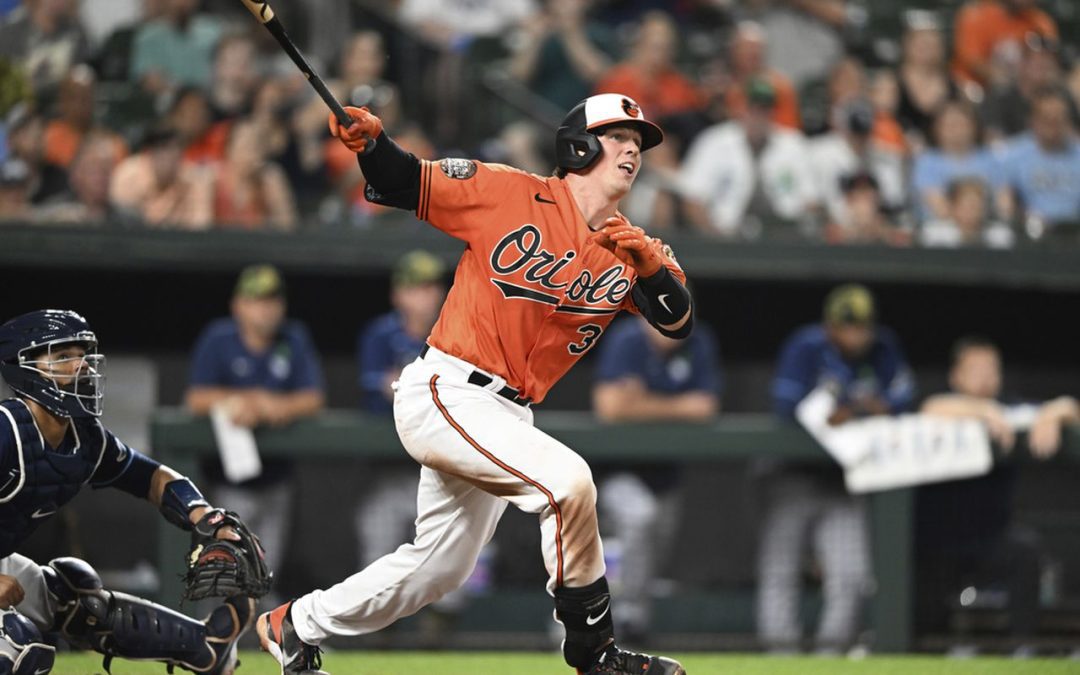
With the Baltimore Orioles coming remarkably close to the playoffs this year, it’s a perfect time to explore the similarities and differences between their roster and the rosters of playoff teams.
One way to do this is by comparing positional production between the Orioles and the eight remaining teams to see where the O’s are in good shape and where they could use an upgrade.
Catcher
Adley Rutschman ended his spectacular rookie year with an .806 OPS that ranked fourth among catchers with at least 400 plate appearances this year. However, the combination of his days at DH and not arriving until May 21 meant that the Orioles did not end the year in the top ten for OPS from their catchers, ranking 13th with a .675 figure.
Rutschman’s 367 PAs in the lineup at catcher led the team, but it was weighed down by another 276 PAs shared between Robinson Chirinos (.545 OPS) and Anthony Bemboom (.434 OPS). Rutschman provided the Orioles with excellent production at catcher but still ended up with under 60 percent of the total PAs at the position for the Orioles this year.

As for the playoff teams, the Philadelphia Phillies-Atlanta Braves NLDS will feature two of the top three teams for catcher OPS, with the Braves leading the league while the Phillies rank third. The Braves and Phillies achieved this level of production in two different ways, with Atlanta opting for a more balanced approach than the Phillies.
The Braves had Travis d’Arnaud provide a team-leading 402 PAs but also gave 240 PAs to William Contreras, with each providing an OPS above .800 to give the Braves a total OPS of .869 from the catcher’s spot.
Meanwhile, the Phillies started JT Realmuto as much as they could, wanting to make the most of their catcher making over 20 million dollars this year. He had 547 PAs at catcher, while backup Garrett Stubbs didn’t even reach 150 PAs. Realmuto was a workhorse for the Phillies and led all of baseball in innings at catcher with 1131.2.
Given that the Orioles are hoping to copy the success of the Houston Astros, it feels noteworthy that Rutschman could give them a leg up on Houston when it comes to reliably solid production at catcher. This year the Astros ranked 27th in OPS from their catchers, with Martin Maldonado’s .600 OPS being the main culprit. Meanwhile, 2021 saw a similarly underwhelming 25th-ranked OPS from Houston’s catchers.
With Rutschman on the Opening Day roster and a backup catcher more competent at the plate than Chirinos, it feels like a lock that next year the Orioles should at least be in the top ten for OPS and perhaps the top five.
Third base
When comparing positional OPS with the eight remaining playoff teams, there’s only one spot where the Orioles are in dead last and it’s certainly not a position I was expecting.
Baltimore ended 2022 with an OPS from third base ranked 21st, producing a .675 figure. Ramon Urias had a .731 OPS as the primary starter at the position and Gunnar Henderson’s promotion included 81 PAs of a .781 OPS at the hot corner. However, the number is mainly weighed down by 138 PAs with a .580 OPS from rookie Tyler Nevin.
In contrast to the Orioles, several playoff teams had outstanding production coming from third base and six playoff teams ranked in the top ten for OPS from third basemen.

The Braves led the pack with an .876 OPS that came almost entirely from Austin Riley’s 38-homer season and Manny Machado’s San Diego Padres and Jose Ramirez’s Cleveland Guardians also found themselves in the top five.
In fact, if the St. Louis Cardinals were able to beat the Philadelphia Phillies in their series there would have been seven playoff teams in the top ten for third base OPS, due to Nolan Arenado’s excellent season.
Third base is somewhat of a question mark heading into next year because we’re not certain if they’ll choose to start Henderson at the hot corner or shortstop. Either way, this year’s playoff teams demonstrate that an offensive upgrade at the position could certainly be beneficial.
Center field
Cedric Mullins failed to hit 30 homers again this year, but his production was still good enough to give the Orioles the #7 OPS among center fielders this year.
In addition to a top-ten OPS, Mullins also gave Baltimore more stolen bases from its centerfielders than any other team, picking up 33 steals. That’s not surprising given that Mullins was third in baseball for steals, but it provides another reminder that Mullins can still provide plenty of value without hitting 30 homers.
In contrast to the strength of production at third, half of the remaining teams have an OPS ranked 20th or lower from center field this year.
The worst offender is the Guardians, who finished dead last with a .558 OPS from the position. Myles Straw was the primary offender, providing 593 PAs of a ghastly .567 OPS.
The Astros, meanwhile, had a more balanced group of center fielders who all failed to produce offensively. Four different players had between 100 and 250 PAs in center and none of them had an OPS higher than .640.
Based on this year’s playoff teams, an offensive standout in center is hardly a requirement, but that also means the Orioles have a leg up on most of the league with a productive hitter who can swipe bases like Mullins.

BSL Analyst
Rose Katz is a recent graduate of the University of Maryland’s journalism school, where she worked for The Diamondback as the online managing editor and a sports blogger. As a student, she spent almost all of her time on campus in The Diamondback’s newsroom or at Xfinity Center, Ludwig Field and Maryland Stadium. Rose gained intern experience with the Mid-Atlantic Sports Network (MASN).