
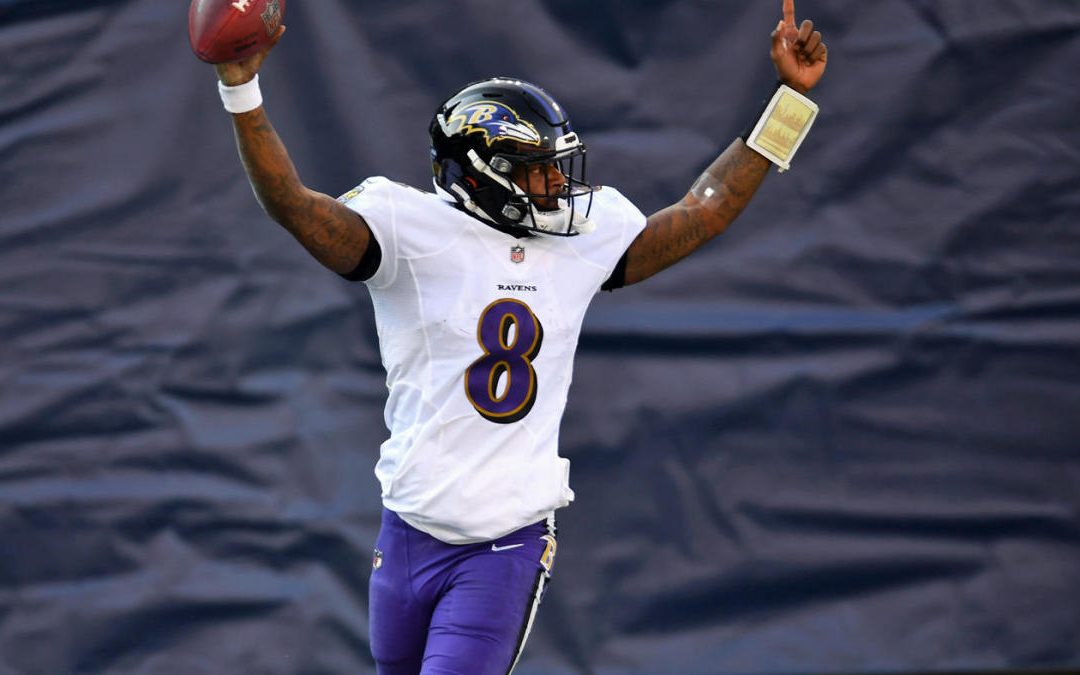
From the moment Lamar Jackson entered the NFL, he became the focus of countless bad-faith arguments. As a former Heisman Trophy winner and a transcendently gifted athlete, Jackson saw a certain segment of the football industrial complex treat him less like a potential superstar quarterback and more like a hazardous gamble that only the most cavalier general manager would take.
Questions about Jackson’s viability as a signal-caller continued into his rookie season. The Baltimore Ravens, still rolling with longtime starter Joe Flacco under center, used Jackson as a gadget player and rarely for more than a few snaps a game. That approach furthered the perception that he couldn’t play the position and even his late-season efforts after taking over for Flacco didn’t silence those concerns.
[Discuss this article on the BSL message board]
Jackson finally dealt a blow to the misconceptions surrounding him in 2019 as he tore up the NFL en route to the MVP trophy, becoming just the second to win the award by a unanimous vote and the youngest recipient in league history. The campaign flipped the narrative on Jackson — sometimes in a disingenuous manner — and made him of the faces of the league despite his limited time in the pros.
But criticism of Jackson poured out as soon as the Ravens surprisingly fell in the divisional round of that season’s playoffs. Jackson had a poor outing, tossing multiple interceptions and struggling to connect with his receivers in the passing game. In marked the second time in two years Baltimore went one and done in the postseason, and the team’s young quarterback bore the brunt of the blame.
However, Jackson has squashed that narrative this season. Despite playing in just two playoff games in his young career, Jackson had somehow earned the dubious status as a quarterback who can’t win in the playoffs. The reigning MVP put that notion to rest last Sunday, memorably dicing up the Tennessee Titans on one of the all-time great touchdown runs from a quarterback.
Jackson finished the game with 136 yards on the ground while providing a quietly efficient 17-for-24, 179-yard day as a passer (albeit with an early interception). By any reasonable measure, the superstar quarterback delivered for the Ravens to help secure a 20-13 playoff victory on the road.
With the notion of postseason futility now in the rearview mirror, Jackson can turn his attention to a more significant challenge: building the foundation of his legacy.
At present, the NFL features six active quarterbacks with an MVP award in their trophy case. Five of those players — Tom Brady, Patrick Mahomes, Cam Newton, Aaron Rodgers, and Matt Ryan — have reached the Super Bowl and three have helped their team win a championship. The other MVP signal-caller, Jackson, has yet to appear in a conference title game let alone the game’s grandest stage.
Jackson’s accomplishments tower over all but a select few at the same point in their careers, but the standards for him and his team have changed. While his age suggests placing him alongside the likes of Justin Herbert, Kyler Murray, and Deshaun Watson, the five other active MVP-winning quarterbacks represent Jackson’s true peers.
Jackson doesn’t necessarily have to carry the Ravens to Super Bowl LV to make the 2020 season a meaningful stride in his career. Recent NFL history is littered with star signal-callers who didn’t reach that stage until several years deeper into their careers, including multiple members of the aforementioned list of active MVP quarterbacks. While Jackson will receive undue criticism should Baltimore fall this weekend regardless of his individual play, his story will outlast such short-term narratives.

Jason B. Hirschhorn is an award-winning sports journalist and Pro Football Writers of America member. He has bylines at NFL.com, SB Nation, Sports Illustrated, and other outlets.