
The transfer portal window for college basketball closed on April 21st, and for Maryland, the real story is less about who came and went and more about the kind of team taking shape under Buzz Williams heading into 2026–27 after a down season in College Park this past year.
The Terps offseason has been less about patchwork and more about identity building. What’s emerging is a roster that looks dramatically different from last year’s group: older, bigger, and far more aligned with Williams’ preferred style, which is physical and defensive.
A frontcourt built around size and toughness
Let’s start with the frontcourt because that’s where the most obvious philosophical shift has taken place.
The additions of Croatian forward Tomislav Buljan and Queens transfer Maban Jabriel signal exactly what Williams wants the Terps to be. Buljan arrives after averaging a double-double (13.1 points, 10.3 rebounds) at New Mexico, bringing proven production and a physical presence at 6-foot-9, 250 pounds. Jabriel adds more size and experience to a frontcourt that is also awaiting the pending medical redshirt of Pharrel Payne. Robert Jennings comes to College Park after 99 games, and 52 starts in the Big 12 with Texas Tech and Oklahoma State.
This isn’t accidental roster construction. Williams is clearly prioritizing rebounding, interior defense, and lineup versatility in the frontcourt. Expect Maryland to look far more comfortable playing through the paint—both offensively and defensively—than it did a year ago.
Big Ten games are often won with physicality and depth rather than pace and finesse. Maryland’s frontcourt now looks capable of matching up with the league’s more bruising teams instead of getting pushed around.
A high-upside backcourt anchored by a potential star
While the frontcourt sets the tone, the backcourt may determine how far next year’s Terps team will go.
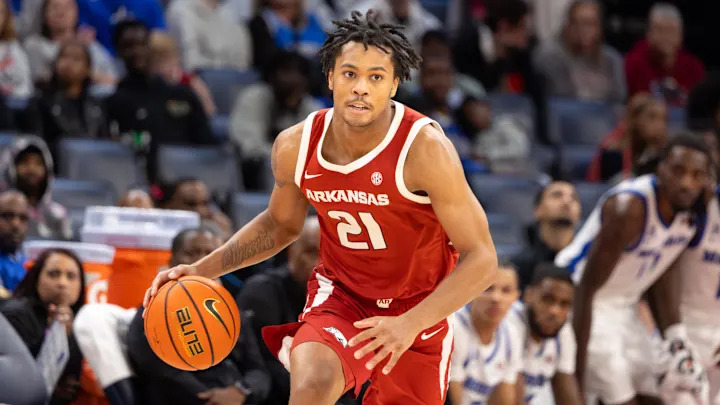
The most notable transfer portal addition is former five-star guard DJ Wagner, who arrives from Arkansas with significant pedigree and something to prove. Wagner has long been viewed as a dynamic scorer and playmaker, and Maryland is betting that a change of scenery along with a system that will give him the ball can unlock his full potential.
While the upside is there, Wagner will certainly have a lot riding on his shoulders next season. This roster doesn’t project as elite offensively unless Wagner becomes a true lead guard who can create advantages.
If Wagner becomes the leader Maryland needs him to be, the Terps suddenly have a go-to option late in games, which is something that has been inconsistent in recent seasons. If he doesn’t, the offense could again become overly reliant on half-court execution without a true shot creator or a strong stable of shooters.
Joining Wagner in the backcourt will be Tennessee transfer Bishop Boswell, who averaged 6.2 points, 4.4 rebounds, and 3.1 assists per game for the Volunteers last season. Having started 33 games for Rick Barnes in Knoxville last season, experience might be the biggest asset he brings with him to College Park. A work in progress as a shooter, Boswell is known as a lockdown defender.
The combo of Wagner and Boswell give Maryland a set of experienced guards who could create one of the country’s best duos if they’re able to run halfcourt sets successfully and up their consistency as shooters.
The return of guards Andre Mills and Rakease Passmore, as well as last-minute transfer portal addition Michael McNair (Boston) and incoming freshman Kaden House, gives the Terps some backcourt depth.
The freshman class raises the ceiling
Speaking of incoming freshmen, one of the more intriguing aspects of Maryland’s offseason isn’t from the portal at all—it’s the incoming recruiting class.
Headlined by five-star wing Baba Oladotun and supported by players like House and Adama Tambedou, the freshman group adds athleticism and long-term upside.
This creates an interesting dynamic. The portal additions provide immediate stability and experience, while the freshmen inject talent and potential star power.
That balance is exactly what modern roster building demands. Too many veterans, and your ceiling is capped. Too many freshmen, and your floor collapses. Maryland appears to be finding the balance.
What the rotation could look like
Guards: Wagner, Boswell, Mills, McNair, House, Del Pino, Passmore, Sotell
Wings: Oladotun, Turkson Jr., Brown, Jabriel
Bigs: Payne*, Buljan, Jennings II, Tambedou
* = pending medical redshirt
Projecting a rotation in April is always risky, but things are starting to take shape.
Guards: Wagner likely runs the show with a mix of returning players and freshmen filling out the perimeter rotation. Boswell likely becomes his running mate in the starting backcourt and his defense could take some of the load off of Wagner at that end of the floor. ’25-’26 was a lost year for MD, but Andre Mills took advantage of the minutes available, and had a very promising RS Freshman season. Passmore missed the year with an ACL injury, but both he and House are Top 50 National recruits, which give MD good depth. We will see if McNair can find minutes, but he averaged 16.9 games for Boston University, making 44% of his 3’s on 7.3 attempts per game. If MD has trouble spacing the floor, he could earn more time than currently expected.
Wings: Oladotun and others provide length and athleticism, but it remains to be seen where the shooting will come from. Maybe it’s Mills over Oladotun in more 3 guard alignments? Could be incoming freshman Austin Brown, who showed some range in high school. Clearly Oladotun is going to play a lot. Turkson didn’t play a lot this year as a RS Freshman, but he’ll be going into his 3 year in Williams’ system, and was a former Top 100 recruit.
Frontcourt: Payne (pending medical redshirt), Buljan, Jennings, and Jabriel headline a deep, physical group that should anchor the defense and rebounding. Jabriel might be more of a 3 overall, but I see him getting time as a spot-up 4.
The biggest change fans will notice is stylistic. This should be a more deliberate, defense-first team that tries to control games rather than outscore opponents.
What fans should realistically expect
Here’s where it’s time to be blunt. This roster is better constructed than last year’s, but that doesn’t automatically make it great.
There are still real questions: Can Wagner be an efficient, high-level lead guard? Will the offense generate enough spacing and shooting? How quickly will the freshmen adjust to Big Ten play?
At the same time, there are reasons for optimism. Maryland’s incoming class—transfers plus freshmen—has been rated among the most impactful in the country, a sign that the overall talent level is rising. More importantly, the pieces actually fit together in a coherent way. That wasn’t always the case in recent years, particularly last year.
The bigger picture: Year 2 of the Buzz Williams era
Ultimately, this roster is less about chasing a championship immediately and more about establishing a foundation. Williams’ first year exposed gaps in toughness, consistency, and identity. This portal cycle looks like a direct response to those issues.
The 2026–27 team should be harder to play against, more consistent defensively, and better equipped for Big Ten physicality. Whether that translates to a top-tier finish or just incremental improvement depends largely on guard play and offensive development.
But the direction is clear: Maryland is no longer trying to piece together a roster. It’s building a program identity and this portal cycle might be the first real glimpse of what that identity will look like. We’ve seen Williams have success with this type of roster in the past. Can he recreate the magic in College Park? Time will tell.

Terps Analyst
Pat has been covering sports in the DMV area since 2012. He is a former Washington Redskins beat reporter for PressBoxDC.com and has been covering University of Maryland football and basketball recruiting and daily beats for Rivals.com’s Terrapin Sports Report since 2013. Pat graduated from College Park with his master’s degree in journalism and has received bylines in publications such as USA TODAY Sports, The Philadelphia Inquirer, SB Nation, and Yahoo! Sports. A Philadelphia native, Pat enjoys fishing, golfing, and playing fantasy sports when he’s not covering or watching a game.