
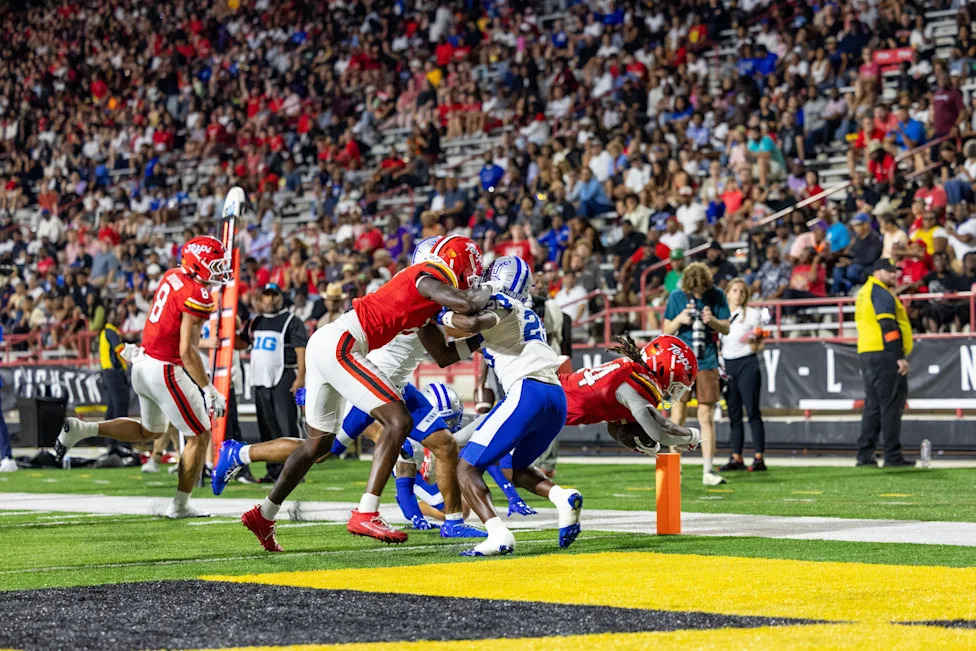
Maryland beat Hampton 62-0 on Saturday night, which tells you almost nothing and a few things. The trick with an FCS opener is separating the two.
Our season preview listed eight things to watch in September. The expected result vs. Hampton answered several of them, left others open, and raised one nobody had on the list.
Maryland next heads to East Hartford to face UConn in Week 2.
After that, the Terps will host James Franklin and the Virginia Tech Hokies in Week 3.
What the Terps answered
The run game showed up, as Maryland had 40 carries for 365 yards. Zack Kiesel noted in his preview that Maryland had not rushed for more than 175 yards in its previous three games against FCS opponents. The Terps more than doubled that. They scored six rushing touchdowns, the program’s most since 2001, after managing nine in all of 2025.
The volume matters as much as the yardage. Maryland averaged 25.4 rushing attempts a game last season, the fewest of any offense in Division I. Saturday the split was 40 runs and 38 passes. Even if you throw out DeJuan Williams’ 94-yard touchdown, the second-longest run in program history, it is still 39 carries for 276 at 7.1 a clip.
Locksley did not hedge about why it matters. He has said Maryland’s chance to be successful each week will start with the ability to run the football, and called Saturday a good start.
The defensive front showed up. Hampton ran 31 times for 10 yards. The Terps had five sacks, two apiece from Eyan Thomas and DD Holmes, and Holmes did it lining up on both the edge and inside after making a single start in his career. Maryland forced three interceptions, posted its first shutout since 2022, and allowed Hampton past midfield twice all night.
Messiah Delhomme had two of those picks. He was the player we singled out as most likely to make a leap, and he opened by making one. Jayden Shipps had the third.
And the return game, which was genuinely bad last season at 7.0 yards per punt return and 92nd nationally, produced two returns for 58 yards. New special teams coordinator Matt Barnes had a good first night.
What the Terps did not answer
The passing game was the worst part of a 62-point win, and it was worse than the box score suggests.
Malik Washington went 19-of-31 for 186 yards, the second-lowest total of his career. He completed four passes in the first quarter for 15 yards. Locksley said Washington forced some things and was pressing early, and named the quarterback’s reads as the specific fix. Washington said he needed to watch the tape before evaluating himself, which is the right answer and also not a rebuttal. The telecast relayed that Washington had shared he wanted to hit more singles this year vs. always looking for the big play. He missed a number of each opportunities last night.
We argued Maryland had removed the nation-leading 39 drops and the receiving production in the same transaction, and that the room was a coin flip rather than an upgrade. Week 1 came down on the unhappy side. Maryland’s receivers dropped four passes with Washington in the game, starting with Chris Durr dropping the first throw of the season. Locksley volunteered that Kaleb Webb had two in the first half and that dropping the ball has not been like him. Webb, who reportedly rose to the top of the depth chart in camp, finished with one catch for nine yards on five targets.
The tight end plan did not show up either, at least not in the passing game. Maryland was reported to be planning significant two-tight-end personnel as a way to manufacture throws around a thin receiver room, and Clint Trickett developed a Mackey Award winner at Florida Atlantic. Saturday, Dorian Fleming, AJ Szymanski and Preston Howard combined for five targets out of 38 attempts, about 13 percent, against roughly 18 percent of completions a year ago. The TE blocking was strong, and helped the running game. There was less production in the passing game than you’d hope for, even if they weren’t needed to produce vs. Hampton.
Maryland scored touchdowns on roughly eight of ten trips inside the 20, which is a large improvement on last year’s 37.8 percent, worst in FBS. That’s good, but there is still room for improvement. Both failures were goal-to-go, and both looked exactly like 2025. First-and-goal at the Hampton 7 in the first quarter produced a run for minus-one and two incompletions, and a 26-yard field goal. Against an FCS defense.
What UConn actually is now
Kiesel covered the background in his two-game preview, so the short version: Jim Mora left for Colorado State, Jason Candle arrived from Toledo with a nearly new staff, and the roster turned over with close to 60 portal additions. The 9-4 UConn team people remember does not exist.
What replaced it looked good. UConn beat Lafayette 56-7 for 671 yards, a program record, and led 21-0 after one quarter. The quarterback competition resolved in favor of Kalieb Osborne, the Toledo transfer who followed Candle east, and he went 19-of-26 for 265 with two touchdowns and an interception while leading the team with 92 rushing yards. He threw for 124 and ran for 45 in the first quarter alone.
A dual-threat quarterback already fluent in his head coach’s system is a different assignment than a first-year starter learning one, and Osborne scrambled for two touchdowns when the pocket collapsed rather than throwing the ball away. Defensive Coordinator Ted Monachino’s preference is man coverage on the outside with pressure behind it. Man coverage against a quarterback who runs when nothing is open is how explosive plays happen.
The Huskies gave two things away, though. They were penalized for 134 yards, and Candle said afterward there is no appetite for the pre-snap operation problems, which is a first-year staff talking.
The UConn Defense had two sacks, four tackles for loss, and 209 yards allowed to a Patriot League team that threw 42 times.
Is Maryland an improved team on the ground? Ground success vs. the Huskies would certainly tell you more than anything we saw against Hampton.
What we are watching Saturday
- DeJuan Williams’ health. This is the top item and it was not in anybody’s preseason plan. Williams picked up a knock (Minor knee tweak) early in the second quarter, which is why the leading rusher finished with three carries for 116 yards. Iverson Howard handled the rest of the night and scored twice, and Harry Dalton averaged 5.6 a carry, so the depth held up against Hampton. Williams is assumed to be available vs. the Huskies. If he’s not, that could impact the expected result.
- Whether the run commitment survives adversity. Forty carries against an FCS team that allowed 233 rushing yards a game last season is easy. The test is what Trickett calls on second-and-8 in the second quarter of a one-score road game. Last season Maryland ran it more than 30 times in exactly two games all year.
- The drops. Four in Week 1. If that number stays in the same neighborhood against an FBS defense, the receiver rebuild has not fixed the problem it was supposed to fix, and the preview’s coin-flip framing lands on the wrong side.
- Washington’s first quarter. He completed four passes for 15 yards in the opening period and settled in later. If MD is going to surprise this year, Washington has to be consistently excellent. Will be looking for a rebound performance vs. UConn.
- Tight end usage. Target share was down in Week 1. If it is down again, the two-tight-end plan is a talking point rather than a scheme.
- Whether Zion Elee shows up. One tackle in the opener. The five-star was supposed to help replace Zahir Mathis, and Maryland’s pass rush was excellent Saturday without much from him. Both of those things can be true and only one of them is sustainable.
- The interior of the defensive line against real linemen. Thomas and Holmes were dominant against FCS blocking. UConn just rushed for 301 yards on 40 carries. This is a better test of the group for the MD lineman.
- Field position. Sean O’Haire and Bryce McFerson are plausibly the best specialist tandem in the Big Ten, and the coverage and return units were bottom-third in the conference last year. Week 1 was encouraging on both counts. A road game decided by a possession is exactly where that shows up.
Where the numbers sit
ESPN gives Maryland a 73.6 percent chance to win, down from 77.7 before the season. Maryland won 62-0 and the model likes them slightly less, which is not a criticism of the Hampton performance so much as an acknowledgment that UConn also looked good and the two updates did not cancel out.
The betting market is more bullish. Maryland is favored by 13.5, which converts to something in the neighborhood of 79 or 80 percent using a normal model and a typical college scoring-margin spread. When a predictor sits below the spread, it is usually seeing something in the efficiency numbers, and Maryland’s passing efficiency is the obvious candidate.
Rerunning our full-season math with Hampton banked and UConn at 73.6 gives 5.27 expected wins against a preseason 5.30, with bowl probability at 43.2 percent against 44.0. One week in, nothing has moved. Our projection stays 5-7 with 6-6 live.
Maryland did what it was supposed to do to a FCS opponent. Not a lot to take from a game when you have physical mismatches everywhere, particularly on the lines.
Next Saturday at UConn we will start to find out more about the Terps.

Owner
Chris Stoner founded Baltimore Sports and Life in 2009. He has appeared as a radio guest with 1090 WBAL, 105.7 The Fan, CBS 1300, Q1370, WOYK 1350, WKAV 1400, and WNST 1570. He has also been interviewed by The Baltimore Sun, Baltimore Business Journal, and PressBox (TV). As Owner, his responsibilities include serving as the Managing Editor, Publicist, & Sales Director.