
The Baltimore Ravens shouldn’t panic, certainly not after a Week 1 victory over a fellow AFC opponent. However, the first game of the season appeared to reveal a major weakness for the team: the inability to keep franchise quarterback Joe Flacco off the ground.
The numbers alone paint a dreary picture for the Ravens’ pass protection. The lowly Buffalo Bills sacked Flacco four times last Sunday and knocked him down a total of nine times. In truth, however, Flacco could have absorbed far more hits if not for some clever footwork to step out of pressure. All quarterbacks work to avoid defenders within and outside the pocket. However, Flacco had do dodge rushers too often, especially for a player less than 10 months removed from surgical knee reconstruction.
Still, the quality of the line play stymied Baltimore’s offense throughout its first regular-season game. The team produced few trips to the red zone, and produced just 13 points in regulation. If not for Flacco keenly audibling out of a run play for a deep pass when the Bills left no safety deep, the Ravens may not have scored a touchdown in their first tilt of 2016.
(Discuss this article on the BSL board)
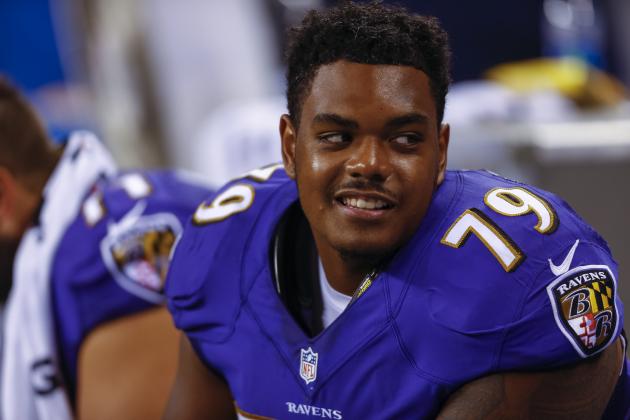
Most of the damage came from the offensive line’s left side, where No. 6 overall pick Ronnie Stanley and fourth-round selection Alex Lewis man the tackle and guard spots respectively. Like most rookie linemen, the duo struggled. Though they remain promising, each needs more time with position coach Juan Castillo along with more live reps before Baltimore can expect a significant improvement in their play.
Many of the NFL’s best quarterbacks have operated success offenses despite multiple weak links along their offensive lines. For most of his career, Peyton Manning made do with protection pieced together with share parts and duct tape. Drew Brees continues to produce video-game numbers behind a line with one of the weaker guard tandems in the league. Though both outrank Flacco in the eyes of most observers, the Baltimore should still expect its signal-caller to elevate the play of his linemen.
But Flacco’s situation differs from those of the aforementioned examples in one important way: the location of the weak links. Manning, Brees and many others deal with subpar blockers in front of them, but rarely multiple on the same side of the line. Flacco’s entire blindside combines for just two regular-season starts between them, not to mention Lewis now plays a different position than he did for the final 26 games of his college career. Most teams hide the deficiencies of their rookie linemen by placing them adjacent to reliable veterans. The Ravens did not have such a luxury.
Of course, one game like the Ravens’ season opener doesn’t provide an adequate sample size to identify a trend, even in a sport with an extremely short schedule such as football.
Examples of misleading small samples abound. In 2015, Adrian Peterson looked over the hill during the Minnesota Vikings’ season opener, producing just 31 yards on the ground over 10 carries. Yet by the end of the year, he amassed a league-leading 1,485 rushing yards. A season earlier, the New England Patriots dynasty seemed all but dead after a 41-14 drubbing at the hands of the Kansas City Chiefs. Head coach Bill Belichick even fielded questions about whether he might bench future Hall of Fame quarterback Tom Brady. Those narratives quickly disappeared after the Patriots upended the Cincinnati Bengals on Sunday Night Football, beginning a hot streak that pushed the team into the playoffs and ultimately to a Super Bowl victory.
But history doesn’t suggest such a turnaround for an all-rookie blindside, at least not until late in the season. None of the first-round offensive tackles selected over the previous three drafts performed at a high level as rookies, nor have many fourth-round linemen of any stripe provided starting-caliber play right out of the box.
Perhaps the last left tackle to hold his own as a rookie is the Green Bay Packers’ David Bakhtiari. Interestingly, Bakhtiari also probably rates as the best fourth-round offensive linemen of recent vintage. While the possibility exists that Stanley and Lewis could enjoy similar success, Bakhtiari seems more the exception rather than a reasonable standard for rookie performance. He spent the first three years of his career working alongside one league’s best guards in Josh Sitton, and blocked for a quarterback gifted with one of the quickest releases in NFL history. Neither of those advantages apply to Baltimore’s first-year blindside blockers.
Which likely means that Stanley and Lewis will continue to endure rookie struggles for most of the 2016 season. Not every game will result in four sacks, but Flacco should anticipate plenty of pressure coming from his left and adjust accordingly. On certain days against weaker opponents, the offense might rise above its pass protection. But in other instances, the Ravens may not score much more than 20 points. How the team deals with those shortcomings and inconsistencies will ultimately define their season.

Jason B. Hirschhorn is an award-winning sports journalist and Pro Football Writers of America member. He has bylines at NFL.com, SB Nation, Sports Illustrated, and other outlets.