
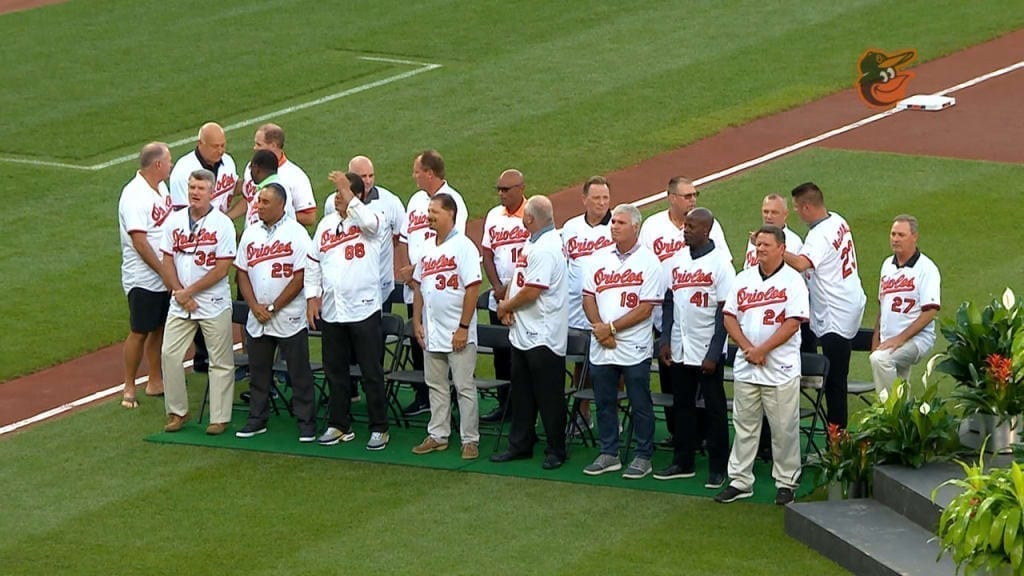
The favorite season of my Orioles fandom was 1989.
It was 30 years ago, and a simpler time. At-least a different time.
I was 9 years old most of that year, and maybe because of that age, and how information was consumed; that year holds magical elements for me three decades later.
The ’88 season is the first year I remember in detail.
The 0-21 start, and 107 total losses. Ripken Sr. being fired in the first week of that season. My favorite player Eddie Murray being traded to the Dodgers that December.
That backdrop set the stage for ’89, when then Orioles GM Roland Hemond, and Manager Frank Robinson put together a roster and a mentality which allowed the O’s to compete until the final weekend of that season.
They committed to giving their best internal talent opportunities.
They committed to defense, and team speed.
They did some things seemingly ahead of their time. Such as targeting on-base percentage (9 year old me noted Randy ‘Moose’ Milligan’s walks at the MiL level), being willing to have ‘bullpen’ games, when necessity called for it and they lacked starters, and utilizing options to have an effective AAA shuttle which basically extended their roster.
(You can discuss this on the BSL Board here.)
The year is revered by myself and others not just because they exceeded expectations, but because their playing style allowed them to do so. You had a group of guys looking to take advantage of available playing time. They played hard, and were fundamentally sound.
There are lessons which can be found in sports, which relate to life in-general.
As an impressionable kid, the ’89 Orioles certainly taught me things. The uniform changed that year, and literally it signified a clean start. That you can start anew. The on-field production showed you don’t have to be beholden to the minimal expectations of others.
The economic realities of MLB in 2020, makes it difficult to replicate what Hemond and Robinson were attempting to accomplish with their ’89 team.
The highest team salary of ’89 was the LA Dodgers, at $21M. Adjusted for inflation, that would be $43.5M today. The O’s team salary in ’89 was $11M. The White Sox had the lowest team salary at $8.5M. All of the team salaries were closely bunched.
In 2020, teams are making more money then ever before. The Cubs led the way in ’19, with a team salary of $211M. The Rays were 30th overall at $53.5.
With the revenue being generated today, and the money teams are spending – it’s not a surprise that every Front Office is comprised of Ivy League Executives.
Also, when the gap increases from the top spenders to the bottom; that also forces changes in how teams operate.
Note I said change, and that I’m not saying baseball’s lowest spenders can’t compete. The ’19 Rays were last overall in team spending, but they also won 96 games. The Rays operate by being sound. They build through Scouting and Player Development. They graduate talent. They cut ties when players get too expensive, and they trade the players they can’t keep for young, cheap talent they can control.
Luckily, there are multiple ways to build teams. Each Front Office of today has to be cognizant of the different issues they face individually. Each job is a bit different.
That’s just reality, and you adjust.
That means the ’20 Orioles can’t think about going to Spring Training and giving Ryan Mountcastle a chance to make the roster. They will send him back to AAA for at-least the first 6-8 weeks, and make sure they gain an additional year of team control.
It’s the prudent move, that ultimately benefits Orioles fans down the road (you’d rather have that additional year of control down the road when you are hopefully contending, vs. having Mountcastle on the field Opening Day ’20 when you have a roster which can’t compete). Still, while you can rationalize the decision, that doesn’t make it any more fun to watch now.
I’d have a lot more anticipation and excitement for this coming year, if Elias and Hyde were able (and committed) to putting their best internal talent on the field.
Let’s take Rutschman, Rodriguez, and Hall off the table, and not include them here; but what if we could build a roster with everyone else?
For example, if you told me that after Means and Cobb*, the O’s would allow Akin, Kremer, Lowther**, Baumann**, Wells**, Zimmerman**, and Bailey to compete for spots 3, 4, and 5 – I’d be looking forward to that.
That doesn’t mean I think they’d be ‘good’, just that there is some upside in those arms, and watching how they perform would be more enjoyable vs. ’19 where the O’s gave 76 starts to Brooks, Hess, Ynoa, Straily, Yacabonis, Eshelman, Blach, and Wojciechowski. The enjoyment tied to the idea that you’d be giving starts to guys who possibly could become pieces vs. guys you know are not.
*Wojciechowski obviously has an inside track on a rotation spot, but I wish it wasn’t going to just be handed to him.
**These guys aren’t on the 40 man, so would require adjustments there. Wanting to delay adding them to the 40, is another reality of the current economics of the game.
Ahh well, I digress.
As I’ve said previously, I still maintain the Orioles could improve the 2020 product, without jeopardizing the larger plan – and in-fact might increase the chances of the rebuild ultimately proving successful, by making the 2020 team better.
Since the Orioles are seemingly not interested in that path, I’d happily accept the next best thing which would be watching more of the players who could potentially be part of the O’s future get extended opportunities.
We will see parts of that.
Hays will patrol CF.
Santander will get plenty of time.
When Stewart gets healthy, he will find ab’s.
The bullpen will have a lot of young, talented arms.
At some point this year Mountcastle will join the roster, and Diaz could also force his way.
Akin & Kremer (at the minimum) will get starts, even if they don’t begin the year in Baltimore.
Even if the ’20 Orioles lose 100 games again for the third consecutive year, there are going to be a lot of things I enjoy watching. But that’s me, and my level of fandom. The Orioles and baseball have me as a fan.
What baseball should be thinking about are the fans they want to grow, and getting kids today to fall in love with the game.
I recognize things change, and we can’t always turn back the clock – but I don’t think it helps the game as a whole, that Front Offices have to be consumed with economic realities vs. focusing on putting the best products they can on the field.

Owner
Chris Stoner founded Baltimore Sports and Life in 2009. He has appeared as a radio guest with 1090 WBAL, 105.7 The Fan, CBS 1300, Q1370, WOYK 1350, WKAV 1400, and WNST 1570. He has also been interviewed by The Baltimore Sun, Baltimore Business Journal, and PressBox (TV). As Owner, his responsibilities include serving as the Managing Editor, Publicist, & Sales Director.