
Major League Baseball commissioner Rob Manfred is getting exactly what he wanted. When he proclaimed ahead the 2020 draft that there was a “100% chance” we would have baseball to watch this year, he knew that statement was going to ring true, but on his terms.
After a series of back-and-forth proposals, which were all doomed from the start, baseball is returning in 2020 through a Rob Manfred mandated 60-game schedule, with a series of agreements which you can read here.
Emotions ran high leading up to this moment and things are sure to get ugly again when the league and players come back to the table to negotiate a new collective bargaining agreement, but for now there will be baseball between the lines to focus on this summer.
(You can discuss this on the BSL Board here.)
Some of the more notable changes for 2020 include a universal DH (fantastic!), incorporating the runner on second rule to begin extra innings (pointless), and the addition of a 30-man taxi squad to pair with a team’s regular 30-man roster. Active rosters will consist of 30 players to start the season and drop to 28 after two weeks and 26 players after four weeks, with the option of adding up to three taxi squad players for road contests. Taxi squad players will not accrue service time.
In my honest opinion, there should not be baseball in 2020, or any sports for that matter. Apologies for not being overly excited for the return of sports while a global pandemic continues to alter daily life across the world and nearly every mitigation effort carried out in the United States is now being reversed. I fully agree with my colleague Bob Harkins and his recent assessment of this situation which I encourage you to read.
While I’m extremely hesitant, I’m a bit giddy at being able to watch live baseball. Welcome to 2020 where it’s ok to have confusing emotions about what’s going on.
Regardless, there will be a baseball “season” in 2020 (pending COVID) and the Baltimore Orioles will be back on the field at Camden Yards in just a few weeks. Despite my bah humbug approach to this season, I’m still going to watch every single game. So, what happens next? What will we learn from 2020?
Many of the larger questions we were hoping 2020 would answer can’t be answered in 60 games. Questions like Austin Hays and his ability to produce at a high level across a full season, Anthony Santander’s ability to become a more consistent hitter over long stretches, and whether or not there’s still enough to be excited about when it comes to DJ Stewart and his potential fit on this roster down the road need more than 60 games to really answer.
Patrick Brennan, formerly of Beyond The Boxscore, put out an informative thread on Twitter Monday night to better understand which statistics will be telling in 2020 and which won’t have enough data to make accurate conclusions . You can check it out the full thread here.
As Brennan points out, players won’t have enough plate appearances for batting average, on-base percentage, and slugging percentage to stabilize, while pitching stats are sure to be all over the board with extremely small sample sizes. However, stats like walk and strikeout rates (for both hitters and pitchers) and ISO for hitters should be safe.
The schedule is going to be a brutal slate for the Orioles. Specific schedule details have yet to be released, but the Orioles are expected to play 40 games against American League East teams and 20 against National League East teams. Baltimore went 24-52 against the AL East last season. Only one other team in baseball won fewer games against their divisional foes, the Detroit Tigers.
The NL East is no slouch of a division. Four of the five teams finished with a record of .500 or higher, more than any other division, and it is of course home to the defending World Series champions in the Washington Nationals.
Go ahead and keep working on your clever hashtags for Kumar Rocker or Jack Leiter, because the Orioles should find themselves at the top of the draft in 2021. Any team can hit a productive stretch at just the right time in a short season and find themselves in the playoffs, but I’m not putting any money down on that happening for the Orioles.
I am confident in my bet that despite a 60 game schedule, the 2020 Orioles could be the most interesting Orioles team we have seen in the last few years (really low bar, I know). Before teams head to spring training number two, they must submit a 60-man roster consisting of a 30-man roster and a pool of 30 taxi squad players to work out at a second location (rosters are due by Sunday afternoon).
Road trips will provide an opportunity to bring three taxi squad players (one must be a catcher), but taxi squad players will not accrue service time in 2020. That’s unfortunate for the players, but potential good news for Orioles fans.
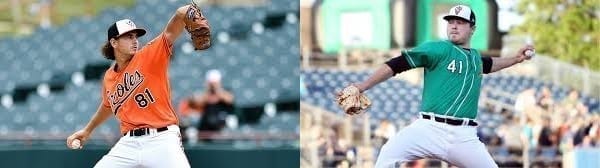
If players like Ryan McKenna, Yusniel Diaz, Dean Kremer, and others can gain major league experience without accumulating service time, we should have our fair share of rookies to watch this season, making 2020 much more exciting. This may not equal more wins, but I’d rather watch Dean Kremer or Michael Baumann drop a game while learning their craft than watch Tom Eshelman give up six runs and exit in the second inning.
What will the taxi squad look like? I think we’re going to see a group 4A type players including utility infielders and pitchers with a handful of Top 30 prospects who are close to breaking into the big leagues. We may also see a few of the younger top prospects placed on the 60-man roster, but don’t get too excited.
Prospects Keegan Akin, Kremer, Ryan Mountcastle, and McKenna are already on the 40-man roster and will be in camp once it opens up next week. Other candidates for the 60-man roster include pitchers Bruce Zimmermann, Alex Wells, Zac Lowther, and Baumann and hitters like Diaz, Rylan Bannon, and Mason McCoy.
You may see prospects like Grayson Rodriguez, DL Hall, Adley Rutschman, and Gunnar Henderson on the taxi squad, but don’t count on them seeing any major league action. A bout of mono and quick stops with the Gulf Coast League Orioles, Aberdeen Ironbirds, and Delmarva Shorebirds didn’t give Rutschman much of an opportunity to really settle into professional baseball life. I hope he is on the 60-man roster, if only to have the opportunity to work out with the young arms expected to be on the roster. As for everyone else, getting them on the roster allows them to work out, but putting them in a game would seem to be out of the question.
At the end of the day, I don’t think a lot of the bigger questions get answered this year, but at least it’s not a complete loss as far as player development is concerned. Pay close attention to the outfield competition, get excited about the rookies we are sure to see, and don’t rule out a successful season from the bullpen.
The bullpen has been touched on in numerous articles this offseason from myself and the staff here and with expanded rosters and taxi squads comes more opportunities for arms like Dillon Tate, Cody Carroll, and others to use 2020 to develop against major league competition without being heavily taxed by the end of May and constant rides on the Baltimore-Norfolk shuttle.
Welcome back, baseball. We may not be able to watch from the ballparks but let’s get weird and let there be baseball for as long as a global pandemic allows.

Orioles Analyst
A former high school teacher and coach in the mountains of Virginia, Nick Stevens has been writing about the Baltimore Orioles and their minor league system for five years. When he isn’t at a minor league stadium, he’s enjoying a Wizards game or supporting his alma mater, James Madison University. Co-Host of The Verge.