
Typically, the calendar change from December to January brings about heightened anticipation for another baseball season, with college baseball set to begin in about five weeks and the first spring training workouts for major league clubs set to take place around the same time.
As a Baltimore Orioles fan, that excitement and anticipation is a bit tempered in 2020, with year two of a complete rebuild set to commence and likely bring about darker times in Birdland before we start to see small rays of sunshine peeking over the warehouse.
(You can discuss this on the BSL Board here.)
This offseason hasn’t seen much activity, but the trading away of starting pitcher Dylan Bundy to Los Angeles and infielder Jonathan Villar to Miami for pitching prospects put the tank train into full speed. That doesn’t mean there won’t be storylines to follow throughout the year. From a full season of Hunter Harvey in the big leagues, to the emergence of much-anticipated prospects like Keegan Akin and Ryan Mountcastle, to following how the league responds to John Means and vice-versa, the 2020 season won’t be pretty, but it won’t be void of storylines to pay attention to.
A few of those storylines can be found in the infield. Don’t worry, I’m not going to sit here and tell you to believe in Chris Davis and hang on to hope that a turnaround is still possible. But there’s potential with the rest of the infield to develop into role players or provide value as trade pieces at the deadline
One of those players with the highest likelihood of a breakout season is third baseman Rio Ruiz. There are a lot of questions surrounding Ruiz and his future and none of his numbers will wow you, but he showed improvements as the season went along and plays respectable defense for a team that needs all the help on defense it can get.
The 25-year-old lefty saw his first substantial amount of major league action last season, slashing .232/.306/.376 with 12 home runs, a near 10% walk rate, a 21.3% strikeout rate, and a wRC+ of 79 in 127 games. Again, nothing that stands out.
Between a brief trip to Triple-A and more time for Hanser Alberto at third base, Ruiz saw fewer at-bats in the second-half of the season and saw his average drop from .235 to .227, but there were plenty of other numbers to like.
Ruiz hit seven home runs in 148 plate appearances after the break, compared to five in 265 before the break. He saw significant gains in his slugging percentage (.328 to .462), OPS (.635 to 766), ISO power (.092 to .235), and his wRC+ (69 to 97) while slightly increasing his walk rate and dropping his strikeout rate nearly four percentage points to 18.9%.
Those improvements are impressive, but can Ruiz become an everyday option at third base for the Orioles? His glove says yes. He was worth 2 Defensive Runs saved in the hot corner and his 3.2 Defensive WAR ranked 17th in baseball, according to FanGraphs. Hanser Alberto at second base was the only Oriole with at least 500 innings at a position to post a positive DRS and only Alberto and his 5.0 Defensive WAR ranked higher than Ruiz in Baltimore.
However, Ruiz recorded a wRC+ of 62 against left-handed pitching, 21 points lower than he did against righties. His near 60% groundball rate and increased amount of weak contact against lefties were also less than inspiring numbers, hence why Alberto and his extremely high success rate against lefties saw more time at third base, despite his more natural position being second base.
With Villar out of the picture, Richie Martin likely ticketed to Triple-A, and any potential free agent signing surely being a defense-first shortstop, Alberto could see more time at second, giving Ruiz a clear path to the everyday job. If he can continue to tap into his power and find some success against lefties, we may have ourselves a solid third baseman to bridge the gap.
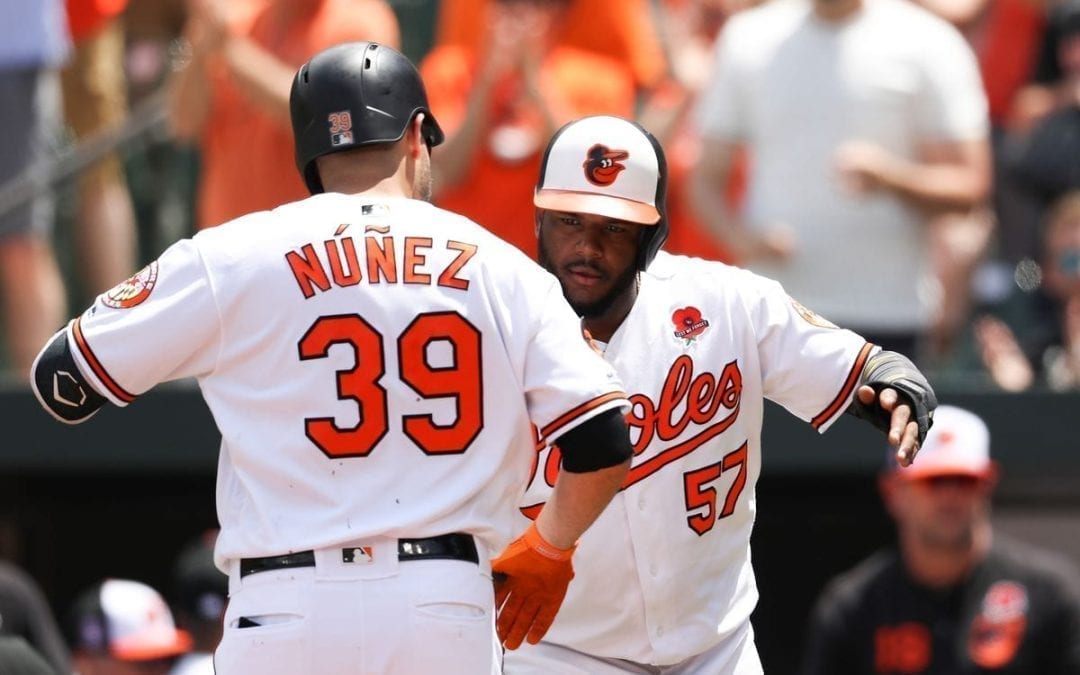
Like Ruiz, Renato Nunez was a waiver claim of the Orioles who now finds himself a regular on the roster. Unlike Ruiz, who brings a glove and athleticism in the field to the table, Nunez does not. What he does bring is a lot of power.
Overall, the 25-year-old has been a league-average hitter with big power and a subpar glove. Last season, Nunez slashed .244/.311/.460 with 31 home runs, 24 doubles, and 90 RBI, all of which ranked second among Orioles hitters, except in doubles where he ranked third (Trey Mancini led the club in all three categories).
While the power numbers are fun, if he wants to become a more consistent hitter, two things have to happen. For one, Nunez will have to find more success against right-handed pitching. A .229 average (41 points lower than his average against RHP) and an OPS 103 points lower against righties isn’t ideal for a full-time DH. One way to help fix this could revolve around his ability to connect on the slider. Nunez hit .213 against the slider in 2019 and whiffed on the pitch more than 40% of the time. Pitchers used the slider 21.7% of the time against Nunez, second only to the fastball.
Renato Nunez will be the DH for the Orioles this season, there’s no question about that. While he’s a capable first baseman, Trey Mancini and Ryan Mountcastle should be the first and second options to replace Chris Davis (if that ever happens). Maybe, if he shows a little more than just a .240 hitter who can hit 30+ home runs, a contender in the American League will come calling at the deadline, but at just over a $500,000 salary for 2019, he’s a cheap DH/reserve corner infielder who knows how to mash a baseball. That’s good enough, for now.
Finally, the man himself, Hanser Alberto. Both his average exit velocity and hard-hit percentage ranked in the first percentile in the major leagues. He walked a whopping 2.9% of the time, hit just .238 against righties, and recorded an ISO of .116. However, Alberto was among the league leaders in the American League with a .305 batting average thanks to a .398 average against lefties, he struck out 9.1% of the time (best mark among qualified hitters in the big leagues), and finished second on the Orioles with a .329 on-base percentage.
So, what can we expect in 2020 from Alberto? It’s fair to assume that a bit of a regression is in store. Despite hitting .305 overall, Alberto had a .318 batting average on balls in play and his expected batting average, according to Baseball Savant, was .290. He recorded a lot of base hits last season, 160 in total, but it’s unlikely his approach produces a second-straight season of numbers that make you shake your head in awe.
Alberto entered 2019 with fewer than 200 plate appearances at the major league level, so left-handed pitchers are going to have a different plan of attack for him next season now that they know what to expect.. He finished the year with a wRC+ four points below league-average (96), and the lefty/righty splits are extreme (151 wRC+ vs LHP, 51 wRC+ vs RHP). It’s going to take a lot of work, and a lot of luck, to keep his regression at the plate to a minimum.
Going on the guess that either Adeiny Hechavarria or Jose Iglesias is signed this offseason (has to be one of these two, right? Or is Dilson Herrera our guy?), Alberto should see a lot of time at second base. His 5 Defensive Runs Saved and 4.2 Ultimate Zone Rating at second both led all Orioles at any position last season. He could also spell Ruiz at third base against LHP, even though his defense in the hot corner leaves a lot to be desired. Add in his experience in the outfield and at shortstop and you have the type of versatile utility guy many hoped Stevie Wilkerson would become.
The Orioles aren’t going to find any multi-year All-Stars among this infield group, but with small improvements and more consistent at-bats, there’s value and potential to be reliable options through this rebuild.

Orioles Analyst
A former high school teacher and coach in the mountains of Virginia, Nick Stevens has been writing about the Baltimore Orioles and their minor league system for five years. When he isn’t at a minor league stadium, he’s enjoying a Wizards game or supporting his alma mater, James Madison University. Co-Host of The Verge.