
With pitchers and catchers reporting for Spring Training 2016, it’s time to take another look at some prospects in the Baltimore organization. If you follow the system, these names are everyday names that you’ve heard of. After spending extensive time reviewing the players below, I’ll give a brief overview of the player and their outlook for the 2016 season and forward. Last time out, we reviewed Trey Mancini, Tanner Scott, Jomar Reyes and others. You can check out previous write-ups here.
(You can discuss this on the BSL Board here.)
Jon Keller – RHP
Keller is a big right-handed, power arm that is a late inning reliever. He features a fastball (93-96 mph) with a slider (83-86 mph) and a change-up (85-87 mph). His slider is the best of his secondary pitches, as it features a sharp, downward biting action, but he can also be inconsistent with the release point. His change-up is firm, with minimal downward movement. His mechanics still need work, as he troubles replicating his delivery and can open up his front shoulder at times.
Going Forward:
Keller, drafted in the 22nd round of the 2013 MLB Draft, was promoted to Bowie (AA) late last season after striking out 17% of batters he faced in Frederick (A). However, he also walked 10% of hitters he faced across two levels in 2015. Keller will need to work on his command and mechanics to advance, but if he’s able to develop a third pitch (change-up), he will be an interesting relief pitcher to keep an eye on. He’ll begin the 2016 season in Bowie.
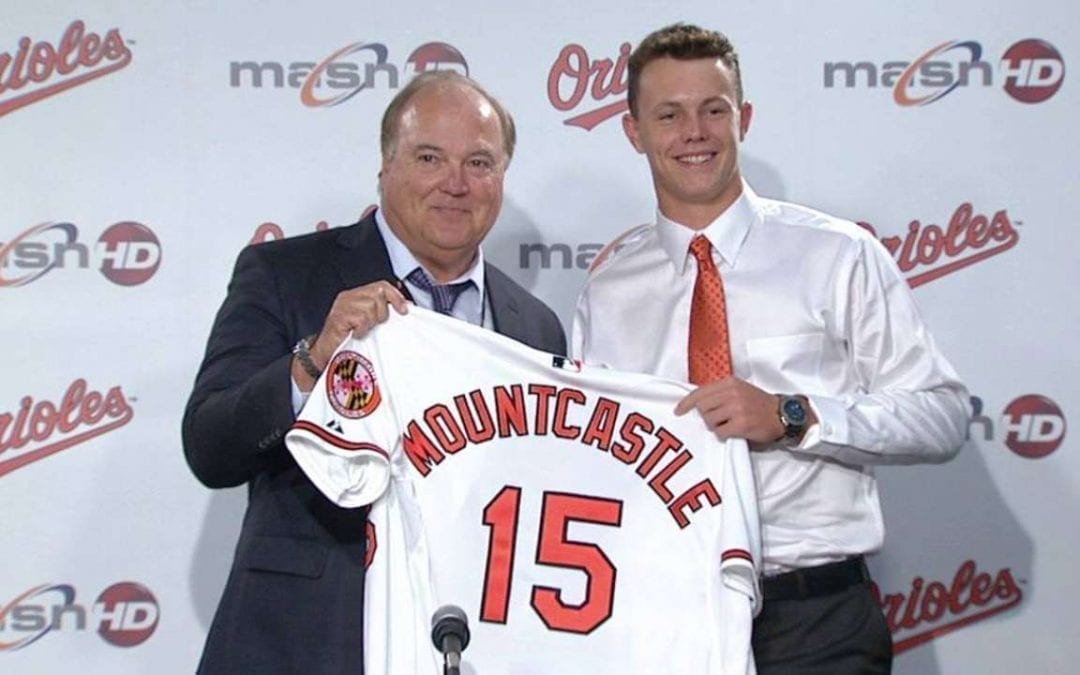
Ryan Mountcastle – SS
Mountcastle, drafted 36th overall in the 2015 MLB Draft, finished the season hitting .296/.325/.393 between the GCL (Rookie) and Aberdeen (A-). Offensively, Moustcastle has great bat speed. He has a slightly open, spread out stance, and a minimal leg kick. He’s able to generate power thanks to good velocity through the zone. As he continues to grow, the raw power will develop.
Defensively, although he has played shortstop his entire career, he simply doesn’t have the quickness, nor the arm to play the position. In the Instructional League this fall, he was given an extended look at third base. Additionally, as he continues to physically develop, he may be forced off of third base – maybe to left field.
Going Forward:
At the plate, Mountcastle looks comfortable and shows a good feel for hitting, but without a defined position, being the 36th overall pick is questionable. He profiles more as a 3rd or 4th round pick. I suspect we could see him shift from shortstop to third base and even have a shot at second base or the outfield. His arm and foot-speed are below average which ultimately limits his value defensively. However, at 19 years old, he’s shown that he’s able to use all parts of the field and hit for power. He’ll likely begin the 2016 season with Delmarva (A).
Lazaro Leyva – RHP
The Orioles signed the right-handed pitcher from Cuba during the 2014 off-season. With 2015 being his first professional season, Leyva opened some eyes with his big fastball. He has a four-seam fastball (96-98 mph – 99 mph), a curveball (78-80 mph) and has flashed a few change-ups (84-86 mph). He has an electric arm and a ton of arm speed from a 3/4 arm slot. The curveball has a 11-5 shape and he does a good job replicating his arm speed. The change-up is simply a “show-me” pitch at this point, but with more innings, it could be an average offering.
Going Forward:
In his first professional season, Leyva put together an interesting year. When I first viewed him in July, his command was all over the place. A big fastball, but little control. However, he appeared to be more comfortable in late August. He’s 21 years old, but has a feel for pitching and doesn’t look like he will need much mechanical work. He needs to fine tune his secondary pitches, but even if he sticks as a two pitch pitcher, he’s fastball makes him a late inning reliever.
Although he was used as a starter in Aberdeen (A-) – where he pitched 3 or 4 innings at a time, he will ultimately end up as a reliever. Starting a game and pitching a few innings is just allowing Leyva to get his work in – no different than pitching in the 6th through the 8th inning. He will likely start the season in Delmarva (A).
Drew Dosch – 3B
Dosh is a small, left-handed hitting third baseman. He has a slightly open stance with minimal movement in his stance. He has quick hands, and is more of a ground-ball and line drive type of hitter. He won’t generate a lot of velocity off the bat. Has a patient approach, but is fooled easily on breaking balls – specifically related to sliders.
On the defensive side, he plays an average third base. He’s rushed at times with his feet, making routine plays look difficult. Additionally, his arm is average from third base.
Going Forward:
Dosh projects as more of a utility player off the bench instead of an everyday starter. He has limited power and not a clear position to play in the field. He’s vulnerable to breaking balls, which opposing pitchers will pick up on as he faces them multiple times. After posting a .348 on-base percentage in Frederick (A) – Dosch had a .286 on-base percentage after his promotion to Bowie (AA). He’ll begin the season with the Baysox.

Reggie Yinger has spent the parts of five seasons as a Player Development Coordinator for the Baltimore Orioles. He has extensive experience in computer programming and baseball.