
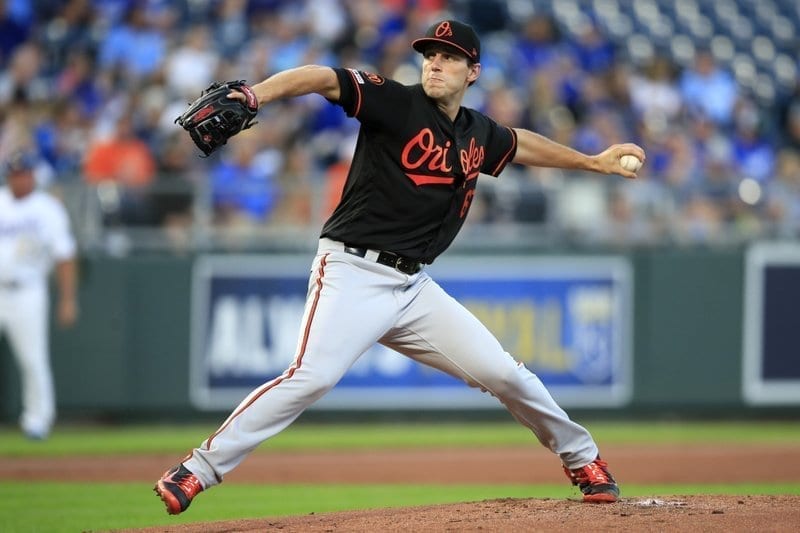
They say bad baseball beats no baseball any night of the week, but those who subscribe to this narrative likely didn’t have to sit through the last two seasons of Baltimore Orioles baseball and cringe in disbelief as Dan Straily and Aaron Brooks tried to stabilize what was supposed to be a major league rotation.
(You can discuss this on the BSL Board here.)
The 2020 season won’t bring about many warm and fuzzy feelings, but there’s just a bit more optimism in the air and a little more intrigue in seeing what some of the highly touted prospects bring to the table in their first taste of major league action and watching to see if veterans like Alex Cobb and Asher Wojciechowski can provide value in an Orioles uniform.
When we look back at the 2019 season, quickly scroll past the major league stats, and dive into the minor league numbers, we saw a lot of positives from pitchers up and down the organization. From watching Cody Sedlock go from an oft-injured first round bust to a Carolina League All-Star, to the near nightly dominant outings from arms all the way down in Delmarva and the emergence of Grayson Rodriguez as a legitimate top of the rotation prospect, it was a fantastic year of development on the pitching side of things in year one under general manager Mike Elias.
I can’t move on without highlighting what the 2019 draft class of pitchers were able to do in their first professional seasons last year. As a group, these arms combined to post a 1.81 ERA and 485 strikeouts in 432.2 innings pitched. They allowed just 10 home runs in total. Of course, a lot of these numbers came from the GCL ranks and statline scouting first-year numbers isn’t a worthy exercise in any sense, but it is another impressive note when talking about Orioles player development. Year two will provide us with many more answers and more concrete data to look at. In the meantime, every Orioles affiliate will feature a deep and intriguing rotation of arms, something we haven’t seen in a very long time.
The story is a bit different when we’re talking about the major league pitching staff. Dylan Bundy is gone, joining a list of arms no longer in the organization who accounted for more than 30% of total innings pitched at the major league level in 2019. How will the Orioles replace those innings? A mix of veteran experience, roster flexibility, and a whole lot of hope and prayer.
We know John Means is the top guy in 2020. His game action has been limited this spring, getting most of his work in on the back fields in more controlled environments where Brandon Hyde doesn’t have to expose his team ace to AL East opponents this early in the year. It’s easy to point to Means and his ERA/FIP discrepancy and say he is a notable regression candidate in 2019, but after rising from a middling prospect to American League All-Star last season, betting against John Means isn’t something I’m willing to do, yet.
If Wojo can continue to rack up the strikeouts, the veteran journeyman will be serviceable as a bridge to those notable prospects working their way up through the ranks. However, the biggest question mark is Alex Cobb. Since signing a 4-year/$57 million deal ahead of the 2018 season, Cobb is 5-17 with a 5.36 ERAin 31 starts. If Cobb is healthy and can successfully navigate his way through 2020, the Orioles can salvage a little something out of his contract. His value to the organization will certainly be higher in an Orioles uniform rather than trading him, should he turn things around in 2020. All we can hope for is two years of health, 160+ innings of work per season, and the passing of some veteran knowledge and work ethic to the younger group of arms.
That leaves two open spots remaining in the starting rotation. We can cross Rule 5 picks Brandon Bailey and Michael Rucker off the list. Rucker appeared to be a viable bullpen candidate with his powerful fastball and Bailey was seen as a possible rotation candidate or long-reliever to help build up his innings, but both have been jettisoned from the roster in the first week of March.
Mike Elias discussed roster limitations as a reason for returning both players to their previous teams, being able to keep only 13 pitchers on the 26-man roster this season, meaning without a rotation of reliable arms already entrenched at Camden Yards, flexibility will be the name of the game in 2020. Other than Tommy Milone and Wade LeBlanc, every other pitcher brought in to compete for a rotation spot has one thing in common, minor league options.
Bailey quickly endeared himself to fans, but moving on from both him and Rucker isn’t anything to lose sleep over. The same sort of production will likely be seen from veterans Wade LeBlanc and Tommy Milone, two guys who spent last season in Seattle and were brought in late in the off-season. Both will have to be added to the 40-man roster, but don’t have the Rule 5 roster restrictions attached to them.
LeBlanc has allowed one run on two hits across five spring innings, striking out five and walking just one. He has the inside track on a rotation spot and brings experience as both a starter and reliever. From 2014-2018, LeBlanc recorded a sub-6% walk rate and held hitters to a .245 or lower average in each season, finishing 2018 worth a career-high 1.6 fWAR. Last season was his first negative fWAR season (-0.4) since his rookie campaign in 2008 with the San Diego Padres. Unlike last year’s Nate Karns experiment, LeBlanc has logged over 280 innings in the last two seasons and could eat up 120-140 innings in 2020.
The final spot could end up belonging to a rotating group of arms or a piggyback option like the Orioles carried out at the end of last season with Gabriel Ynoa and Aaron Brooks. Milone has just two scoreless innings (3 K/0 BB) to his credit this spring, but is building up his workload on the backfields while recovering from neck soreness. Milone struck out a career-high 21% of opponents last season and has never walked more than 7% of hitters in a season in nine years of big league action.
Pairing him with one of two spring standout arms may be how Hyde handles the backend of his rotation to start the year. Veteran Tom Eshelman leads the Orioles with eight innings pitched this spring, posting a 2.25 ERA, 0.63 WHIP, .143 average against and a 6/1 K/BB ratio. Eshelman’s Opponent Quality is the second-highest among all Orioles pitchers this spring at 7.6. Eight is considered Triple-A quality, with 10 being MLB quality, per Baseball Reference.
The other possibility could be the local guy, lefty Bruce Zimmermann. Zimmermann has a 6.7 OppQual on Baseball Reference, but his slider has produced a fair amount of swings and misses and the fastball has lit up the spring radar gun with a healthy amount of 93 and 94 mph pitches, including the occasional 95 mph heater. Zimmermann is as polished as he’s going to get, or “fully baked” as Eric Longenhagen lovingly described him on FanGraphs, but his increased velocity, four-pitch mix and impressive 2019 campaign in Double-A are enough to warrant a shot on the 2020 Baltimore Orioles.
There’s still a high probability that the Orioles add a waiver claim or work a late-spring trade as roster casualties pile up and Mike Elias sees someone he likes, but until then, the picture of how this pitching staff will shake out seems to have become a bit more clear.
Kohl Stewart just made his first appearance on Sunday and looked like someone making their first spring start. He’s certainly still in the mix, but can easily be sent to Triple-A to start the year and build up his innings. Keegan Akin is ticketed to Triple-A after a few promising innings and a handful of struggles. He won’t be down long, but a few starts back in Norfolk won’t hurt Akin while veterans like Eshelman get an early opportunity in the big leagues.
Will it be pretty? Probably not. Will it be better than 2019? Possibly. Will it be more interesting to follow? Certainly.

Orioles Analyst
A former high school teacher and coach in the mountains of Virginia, Nick Stevens has been writing about the Baltimore Orioles and their minor league system for five years. When he isn’t at a minor league stadium, he’s enjoying a Wizards game or supporting his alma mater, James Madison University. Co-Host of The Verge.