
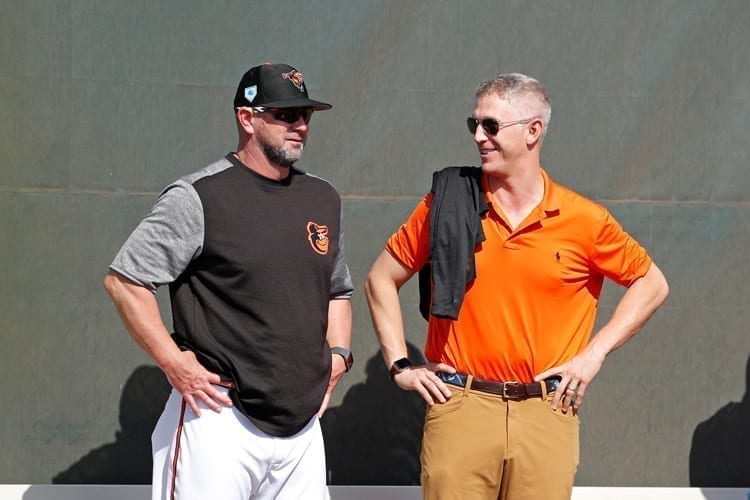
When the Orioles hired Mike Elias and put him in charge of the team, it was pretty clear which direction he would take the team. It’s like hiring a cheetah to run a deli. You know what’s going to happen, and you can’t really be upset when it all goes down. Elias came from the Houston Astros, and the Astros, along with the Cubs, pioneered what is now known as tanking. That is, a total teardown of the major league roster while simultaneously working to build up the talent level in the minor leagues. As Orioles fans sift through the wreckage of what, not even halfway through Spring Training, already looks to be another in an increasing string of lost seasons, it’s fair to wonder if there was a better, or at least gentler way to rebuild the team. Was tanking the only option?
(You can discuss this on the BSL Board here.)
It’s a fair question. The mere fact that tanking is a new term hoisted on the baseball community and pioneered by the recent-era Astros and Cubs indicates teams have operated differently for the vast majority of baseball history. Previously organizations would attempt to build the major league roster while at the same time working to improve the talent in the minors. Sometimes that even worked! The 2007 Red Sox won a World Series with a team composed mostly of home-grown stars, most of which were drafted within a few years of the Red Sox winning the 2004 World Series. So it can be done. The questions are, A) is it quicker and/or more effective to totally tear down and then build back up again, and B) what does this specific Orioles roster call for?
In this case, I’d argue the Orioles entire organization was virtually bereft of talent and so the difference between tearing down completely and continuing to attempt to compete at the major league level was not a large one. Sure, the Orioles could have added $60 million to the payroll by, let’s say, signing Cole Hamels, Martin Perez, and – let’s go crazy here – trading for Nolan Arrenado from the Rockies. But would even that push the Birds towards contention? Assume for the sake of argument the team wants to win a World Series. Would adding even that much talent push Baltimore into contention? Pretty clearly the answer is no. The amount of money the team would need to spend on their roster to make the 2020 Orioles even Wild Card contenders would be extraordinary. That’s not to say they shouldn’t do it, but it’s not a long-term plan to build a baseball team. It would lock the team into numerous long term deals for older players as well, making change that much more difficult. Imagine three more Chris Davises (Davi?) on the roster while the Orioles are trying to make free agent additions down the line, or even worse, while they’re trying to extend good pre-arbitration players. So considering where the Orioles were when Elias took over, picking in the top five of the draft with all the extra draft money that comes with, would be much more helpful to the Orioles than spending $60 million on older players to get to 75 wins while torpedoing that draft budget. Reasonable minds can disagree, of course.
But let’s go back to the Astros for a minute. Elias came from the Astros. He was a part of the front office that put together the 2017 World Series championship team. Where did the components of that team come from?
Well, it’s interesting because when you drill down on that, maybe tanking isn’t the only answer. The 2017 Astros were led in WAR by Jose Altuve. Altuve was signed as an international free agent (a market the Orioles absolutely need to be more active in) in 2007 by then-Astros GM Ed Wade. George Springer, who finished third in WAR on the team that season, was picked 11th overall in the 2011 draft also by Wade. In fact, Wade drafted or signed three of the Astros top five players in WAR that season, also drafting Dallas Keuchel in the seventh round in 2009. Having those players in the organization when Jeff Luhnow took over as GM from Wade sure made contending easier.
But once we get further down the roster we start to see some benefits from the philosophy. Carlos Correa was picked by the Luhnow regime first overall in the draft in 2011. Alex Bregman was picked second overall in 2015 with the pick the Astros received after failing to sign their 2014 first overall pick, Brady Aiken. Correa and Bregman very likely aren’t available to the Astros if they’re picking fifth or seventh in those drafts.
Even the high draft picks that didn’t pan out so well allowed the Astros to gain some value. Houston drafted Mark Appel first overall in the 2013 draft. Appel hasn’t yet made it to the majors and doesn’t appear likely to ever do so. But in 2015, before that was the certainty it’s become, the Astros flipped him to the Phillies as part of a larger trade to acquire closer Ken Giles. Similarly so with prep outfielder Daz Cameron who was signed out of a college career by the Astros in 2015 and then traded to Detroit as the big prospect piece for pitcher Justin Verlander. Trading pitcher Brett Myers in 2012 got Houston Chris Devinski, a major part of their championship bullpen. All those players are on the Astros now because the team chose to tear down their major league roster to the bare bones, like the Orioles have.
You can see it’s a mixed bag, with some valuable players already in the organization and others who came to Houston because of the front office’s choices. That’s because teams aren’t built all one way or all another. But using all means at your disposal to improve the team’s overall talent base worked for the Astros (regardless of what you think of them now or what you think of their championship, they are, without a doubt, a very good baseball team). Houston’s top draft picks and huge draft budget helped net them a Cy Young winning season, half a Cy Young runner-up season, two seasons of top five AL MVP baseball, the AL Rookie of the Year along with four other seasons from Carlos Correa, not to mention the to-come seasons from those players as well.
Getting back to the main question, of course tanking wasn’t Baltimore’s only option. The team could have spent huge money on the free agent market in attempt to build a contender, or at least a more interesting major league product, on a shorter time frame. Given where the team was when Elias took over though, spending that kind of money combined with the downsides of building an older roster with little to no help from inside the organization is a tough sell to ownership, and likely a not a recipe for job security for the front office. So in the end, the Orioles didn’t have to tank. Once Elias took over though, even had he not come from the epicenter of tanking, there wasn’t much choice.

Orioles Analyst
Matthew Kory is a Orioles / MLB Analyst for BSL. He has covered baseball professionally for The Athletic, Vice Sports, Sports On Earth, FanGraphs, and Baseball Prospectus. He lives in Portland, Oregon with his wife, two boys, and his cats, Mini Squeaks and The President. Co-Host of The Warehouse.