
How important is the 3rd quarter over the course of a football game? Clearly it depends on what happened in the 1st half. If the game is a blowout at halftime, the 3rd quarter probably has little meaning for the current game. My coaching experience at Army and Cal Poly has put me in locker rooms for 10 seasons of halftimes. What goes on in there? Let me pull back the curtain for you a little bit.
(You can discuss this on the BSL Board here.)
From the final whistle of the first half, you have 20 minutes until that ball will be set for play again. IT GOES QUICKLY…… and it goes something like this:
Once you get to the locker room, coaches from each unit will huddle for anywhere from 5-7 minutes. Optimally in separate rooms, most definitely separate from the players. Even though each unit has been on its own headset channel – in constant contact with each other for the first half, this face to face meeting for this group is very important. Communication is key in this industry and eye balls speak loudly. Sometimes everyone is on the same page but misunderstandings occur within the emotion of a football game. People may all be speaking the same language but now people know that they are all looking at the exact same picture on the board. The coordinator and coaches finalize their strategy for the start of the 2nd half. Sometimes the necessary path is obvious to all but sometimes it is not. This is not a business for those with thin skin. Speak now if you believe in your idea – you have about 30 seconds before this meeting breaks up. The clock on the scoreboard is ticking. This entire process is more of a reaction and less an exercise in thinking. Too late to think now. You have a locker room full of players ready to receive your message.
Special teams meeting with players starts first. Since players from both sides of the ball participate, an offensive or defensive meeting has to wait. Special teams units have a hard time meeting during the game since players involved on a unit may be on the field right now. If there is an adjustment in a return scheme, most likely it will happen here. I image Sean Payton in Supebowl XLIV with the Saints. “Guys its there. Trust me, their front line drifts before we kick it. This is why we practiced those onside kicks the first day of camp. Let’s just execute it and have fun with it.” (under his breath: “Did I just actually *&%^$@ say that to my team?“ – yes you did coach and you have a Lombardi Trophy to show for that macho play. )
As soon as the teams meeting is over, offense and defense split sides of the locker room. Starters sitting up front around the board. Coordinators get their chance to sell it their guys. “This is what we need to get done when we get the ball in the 2nd half…..” Depending on severable variables, time on the board could short or long. Could be a formation to draw, could be a play or two to diagram but this is NOT time to invent something. You had 6 days to create and invent – now is the time to polish your execution. Everybody has to be on the same page. Could be some words about focus, handle your own business, trust your teammates, etc. Could be A LOT of words about these things and very little drawn on the board. That board may get a hole put in the middle of it – probably not the most efficient use of the board but it gives you a chance to get some attention if you have no other options. Generally, after the unit meeting breaks, the position groups assemble. Probably one minute left until the team assembles and the head coach ritualistically addresses them. I’ve seen halftimes where scheme were not mentioned and the coaches did nothing but “coach emotion.” Pretty neat to be a part of this meeting environment. Oh yeah, once it is all over – coaches can often be found sprinting back to the press box. Just a little uncomfortable when you are forced to take the same elevator with your opponent up or down from the press box. Awkward defined.
I’ve never been in a “normal” company’s board of director’s meeting but I’ll assume it goes a little bit differently than what I just described. I would think the same goes for a share holder’s meeting. That team just knocked out both in about 16 minutes and there is a national audience ready to see the fruits of your labor. And they will let you know what they think pretty quickly.
How have the Ravens done in the 3rd quarter? I will borrow from my work over at TheQ5.com and evaluate drive performance through a proprietary success metric. I refer to these values as Q-scores. Each drive is evaluated and the overall average performance is tracked by year for the Ravens. I present points scored and allowed in the 3rd quarter in the following table. The difference is calculated along with the Q-scores for the team.
| Year | TEAM | Wins | Win Diff | Team Q | OFF Q | DEF Q | GM | HC | OC | DC |
|---|---|---|---|---|---|---|---|---|---|---|
| 2010 | 'ARI' | 5 | -- | -35 | -76 | -20 | Rod Graves | Ken Whisenhunt | vacant | Billy Davis |
| 2011 | 'ARI' | 8 | 3 | -26 | -29 | -21 | Rod Graves | Ken Whisenhunt | Mike Miller | Ray Horton |
| 2012 | 'ARI' | 5 | -- | -26 | -78 | 40 | Rod Graves | Ken Whisenhunt | Mike Miller | Ray Horton |
| 2013 | 'ARI' | 10 | 5 | 19 | -14 | 39 | Steve Keim | Bruce Arians | Harold Goodwin | Todd Bowles |
| 2015 | 'BAL' | 5 | -- | -26 | -15 | -34 | Ozzie Newsome | John Harbaugh | Marc Trestman (CHI HC) | Dean Pees |
| 2016 | 'BAL' | ??? | ??? | Ozzie Newsome | John Harbaugh | Marc Trestmanæ | Dean Pees | |||
| 2014 | 'CHI' | 5 | -- | -45 | -29 | -68 | Phil Emery | Marc Trestman | Aaron Kromer | Mel Tucker |
| 2015 | 'CHI' | 6 | 1 | -14 | 15 | -31 | Phil Emery | John Fox (DEN HC) | Adam Gase (DEN OC) | Vic Fangio (SF DC) |
| 2009 | 'CLE' | 5 | -- | -33 | -64 | -18 | George Kokinis | Eric Mangini | Brian Daboll | Rob Ryan |
| 2010 | 'CLE' | 6 | 1 | -23 | -25 | -25 | Tom Heckert | Eric Mangini | Brian Daboll | Rob Ryan |
| 2012 | 'CLE' | 5 | -- | -15 | -24 | -2 | Tom Heckert | Pat Shurmur | Brad Childress | Dick Jauron |
| 2013 | 'CLE' | 4 | -1 | -35 | -45 | -27 | Mike Lombardi | Rob Chudzinski | Norv Turner | Ray Horton |
| 2011 | 'JAX' | 5 | -- | -20 | -66 | 15 | Gene Smith | Jack Del Rio | Dirk Koetter | Mel Tucker |
| 2012 | 'JAX' | 2 | -3 | -62 | -58 | -50 | Gene Smith | Mike Mularkey | Bob Bratkowski | Mel Tucker |
| 2015 | 'JAX' | 5 | -- | -25 | 0 | -48 | David Caldwell | Gus Bradley | Greg Olson (OAK OC) | Bob Babich |
| 2016 | 'JAX' | ??? | ??? | David Caldwell | Gus Bradley | Greg Olsonæ | Todd Walsh (JAC DL) | |||
| 2013 | 'MIN' | 5 | -- | -27 | 6 | -50 | Rick Spielman | Leslie Frazier | Bill Musgrave | Alan Williams |
| 2014 | 'MIN' | 7 | 2 | -2 | 2 | -15 | Rick Spielman | Mike Zimmer (CIN DC) | Norv Turner (CLE OC, SD HC) | George Edwards (MIA LB coach) |
| 2009 | 'OAK' | 5 | -- | -57 | -95 | -37 | Al Davis | Tom Cable | vacant | John Marshall |
| 2010 | 'OAK' | 8 | 3 | 9 | -4 | -1 | Al Davis | Tom Cable | Hue Jackson | John Marshall |
| 2009 | 'SEA' | 5 | -- | -18 | -42 | -6 | Tim Ruskell | Jim Mora | Greg Knapp | Gus Bradley |
| 2010 | 'SEA' | 7 | 2 | -30 | -56 | -18 | John Schneider | Pete Carroll | Jeremy Bates | Gus Bradley |
| 2015 | 'SF' | 5 | -- | -45 | -33 | -58 | Trent Baalke | Jim Tomsula (SF DL) | Geep Chryst (SF QBs) | Eric Mangini (SF TEs) |
| 2016 | 'SF' | ??? | ??? | Trent Baalke | Chip Kelly (PHI HC) | Curtis Modkins (DET RB) | Jim OÍNeil (CLE DC) | |||
| 2011 | 'WSH' | 5 | -- | -19 | -23 | -18 | Bruce Allen | Mike Shanahan | Kyle Shanahan | Jim Haslett |
| 2012 | 'WSH' | 10 | 5 | 28 | 64 | -14 | Bruce Allen | Mike Shanahan | Kyle Shanahan | Jim Haslett |
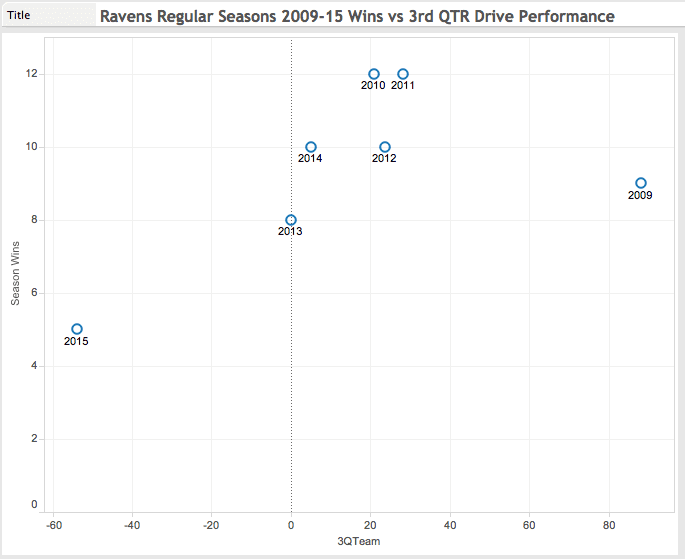
This data is meant to help calibrate you to the concept of tracking performance on all drives, not just scoring drives. For some and at certain times, points scored and allowed is all that matters. The work on drive analytics helps the narrative exploring why points are scored and what happens when points are not being scored. Points (TDs and FGs) are scored on about 35% of drives. The other 65% are either punts (50% and turnovers in many fashions). What a team does with the football when it is not scoring points impacts the game – my belief is that this impact is significant. Each play is a chance to send a message to the opponent. You either win or lose on every play. There are no draws in this regard. Extend this philosophy to the drive level and you desire to evaluate every drive. You may win a lot – score a TD – or lose a lot – turn it over – but you can track everything in between as well. That is what Q-scores are intended to accomplish.
Examining the data above – the Ravens had a more favorable point differential in 2014 (+1.9) in comparison to 2012 (+0.6) but a significantly lower Q-score (5.2 vs 23.6). What does this mean? Specifically, the 2012 team “played better” in the 3rd qtr than the 2014 team but they had a lower point differential to show for it.
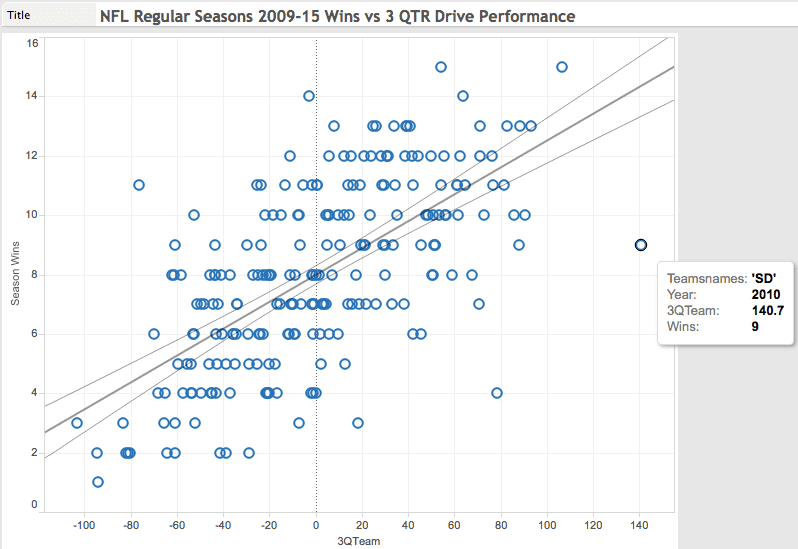
For comparison, the following picture shows 3rd QTR Q-scores for 7 years of teams and game data. Best performing team in the 3rd QTR – 2010 San Diego Chargers.
The Ravens Q-score for ALL DRIVES is also shown below. This too is tracked versus season win total. That 2009 Ravens team dominated the 3rd qtr but the rest of the game was pretty unspectacular.
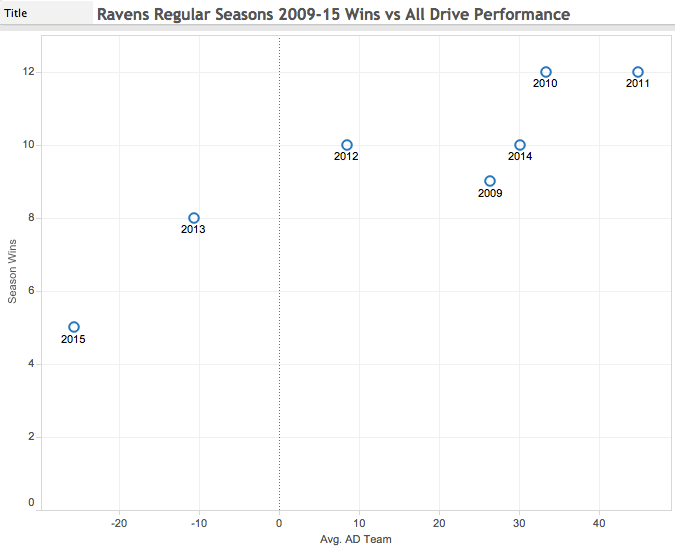
Takeaway: The Ravens were bad in 2015, no surprise. They were horrible coming out the locker room at halftime. However necessary, that needs to get fixed. If it means playing better in the first half, so be it. You can practice halftime – what you do with your team so that they know what to expect. An athlete’s core body temperature will drop over these 20-25 minutes and bringing it back up to playing levels is important. I would leave no stone left un-turned to explore the reasons for this problem in 2015. Play calling coming out of halftime would be high on the list as would decisions on risk exposure on kicking plays and 4th down decisions.
As halftime goes quickly, so does the preseason. The opener on Sept 11 vs Buffalo approaches quickly and so does their first chance to come out of a halftime and show that 2015 and its 5 wins was an anomaly.

Dr. Guyader is the Owner / Founder of The Q5.com, which specializes in Football Visualizations and Drive Analytics. Additionally, Guyader has 10 years of Division I football experience coaching top-tier and historic programs. From guiding third round NFL draft pick Ramses Barden for four seasons at Cal Poly to converting 6-foot 10-inch lineman Ali Villanueva to wide receiver at the United States Military Academy at West Point, Andy knows how to coach on the field and how to game-plan in a meeting.