
Entering the offseason, the Baltimore Ravens had plenty of work to do massaging their payroll.
As the new league year approached, the team had less than $3 million in available cap space and numerous upcoming expenditures to worry about. To prevent place kicker Justin Tucker from hitting free agency, Baltimore decided to assign him the non-exclusive franchise tag, a move which carried a $4.5 million cap hold. Meanwhile, they extended the second-round tender to restricted free-agent wideout Kamar Aiken, adding another $2.5 million to their books. While the team did not need to fully comply with the cap immediately, the front office had to figure out a way to carve out some money in short order.
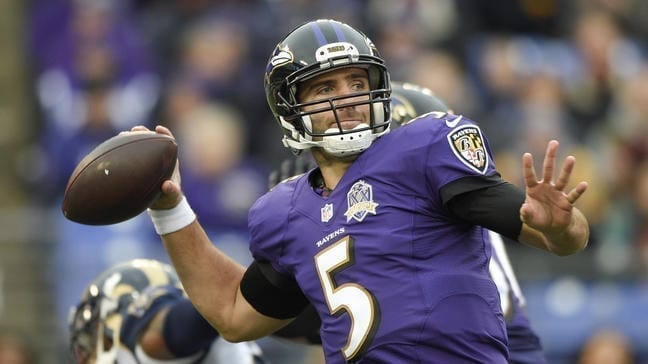
Part of the reason the Ravens found themselves in this predicament is their quarterback. Four years earlier, Joe Flacco rejected a multi-year offer from the team, instead deciding to bet on himself to have a breakthrough campaign in his contract year. The quarterback’s faith was rewarded, as he led Baltimore to its first Super Bowl victory in over a decade while putting together one of the best individual playoff runs of recent vintage. Faced with no reasonable alternative, general manager Ozzie Newsome made Flacco the highest-paid player in NFL history.
While the deal kept Flacco from leaving, it had the deleterious effect of sucking up most of the Ravens cap flexibility. The resulting shortfall of financial resources depleted the roster of much of its depth, which in turn contributed to the team’s lackluster 2015 campaign.
So with another large cap number looming for his franchise quarterback, Newsome decided to resolve the matter while gaining something valuable in return.
On Wednesday, Newsome added three years to Flacco’s contract, a move pushed him back above Aaron Rodgers as the highest-paid player in the NFL. While that sounds like great news for Flacco’s accountant, it also works out well for the Ravens. The deal shifts much of the cap burden from 2016 into future seasons, spreading it out over the duration of the extended deal.
In doing so, the team clears approximately $6 million off this year’s books, enough to cover the cost of Tucker and Aiken as well as some additional funds for other purposes. Newsome also cut ties with linebacker Daryl Smith and defensive end Chris Canty, freeing up an additional $4.775 million.
Still, Baltimore has more work ahead if it hopes to retain free agent Kelechi Osemele or extend rising stars Brandon Williams and Ricky Wagner a year before they reach the open market.
Osemele, the 26-year-old left guard coming off his rookie deal, rates as the No. 1 offensive linemen in this year’s free-agent class, and consequently can expect multiple lucrative bids from protection-starved teams. Meanwhile, Williams has become the anchor of the Ravens defense and a core piece of the roster. Likewise, Wagner has established himself as one of the better right tackles in the league. In order to sign one or both to team-friendly deals, they need to start negotiating now.
To make a competitive offers while accounting for their other upcoming financial obligations — namely the cost to sign their 2016 draft picks — the Ravens likely need to clear another $2-4 million in cap space. While they could continue extending contracts to lower cap numbers for this season, the safer route involves letting go of some expensive veterans.
On such option is defensive back Lardarius Webb. Once a top cover man, Webb has seen his skills diminish as the result of multiple injuries and age. Both player and team have discussed a transition to safety fulltime, and while that could produce favorable results on the field, it still seems unlikely that he can justify his lofty $9.5 million cap hit. At the same time, Baltimore would have to swallow $6 million in dead money, saving just $3.5 million in the process. Still, that amount could prove the difference between re-signing Osemele and watching him depart.
The Ravens could also consider releasing outside linebacker Elvis Dumervil. While still a capable pass rusher, Dumervil doesn’t create the same amount of disruption as when he first arrived three years ago. Like Webb, releasing him generates a significant dead-money hit, but the team could save $2.625 million.
Regardless of the method Newsome chooses to reduce salary, the Ravens must focus the next few years on bringing in cheap, high-level talent to take the place of the older, more expensive players that have populated the roster in recent years. That way, the team can build the most complete team possible around Flacco and, if things go well, contend for another Lombardi Trophy.

Jason B. Hirschhorn is an award-winning sports journalist and Pro Football Writers of America member. He has bylines at NFL.com, SB Nation, Sports Illustrated, and other outlets.