

The scripted part of your offensive game plan, the opening drives, should not be complicated or tough to execute on game day.
Consistently inconsistent is really the only accurate way to describe the Ravens offense. Week in and week out the inconsistencies stem from each unit and like dominoes, one seems to effect the next unit and so on. Stop me if you have heard any of the following before.
“The offensive line isn’t opening holes for the running game.”
“The offensive line isn’t giving Joe Flacco enough time in the pocket.”
“The poor/absent running game doesn’t let Flacco use play action to his advantage.”
“If the fast receivers would stretch the field it opens up the running game.”
“If the running game was explosive, the fast receivers would get behind defenses.”
“If Joe wasn’t taking a beating…” “If Steve Smith wasn’t hurt…” “If they change offensive coordinators…” “If John Harbaugh wasn’t an alpha…” “If if if if if…”
Enough already.
This is pro football. Everyone gets hurt. Everyone has to rely on the 53rd man on the roster at some point. Everyone has to learn a playbook. Everyone has to develop young players. Everyone has to work as a team, as a unit. Everyone has to hit the weight room. Everyone has to watch and understand film. Everyone has families at home. Everyone has hurdles and limitations.
There is a lot, a ton that has to go right in order to succeed in the course of a season, succeed in a game, succeed on a drive. With so many variables, 11 moving parts against 11 opposing moving parts, how can you keep it all straight?
With the KISS method. One of those old military acronyms like SNAFU, or FUBAR. KISS stands for “Keep it simple stupid”. Unnecessary complexity leads to inefficiency.
Discuss your thoughts on this topic on our message board.
Inefficient is another way to describe the Ravens offense. Yeah, they handled business last week against the Browns. But Cleveland is 0-10. You are supposed to do that at home. While the final was 28-7, the Ravens trailed 7-6 at the half. The first half offense seemed all kinds of FUBAR. Even with the solid overall game Joe Flacco finally had, he still ranks 31st out of 33 QBs in yards per attempt. A good measure of efficiency. Also 29th out of 33 in passer rating and 27th out of 32 in QBR.
The leader in all of those categories, to no one’s surprise is Tom Brady. Here’s a guy who survives having Logan Mankins, the Patriots version of Marshal Yanda, traded away a week before the start of a season back in 2014. The Ravens lose Ronnie Stanley and fans throw in the towel. Brady just carries his team to another Super Bowl win. Ho hum. Five running backs on the roster fighting for playing time. He’s got Rob Gronkowski when sometimes healthy, and no one else really any better than anyone on any other team. Chris Hogan, Julian Edelman, Danny Amendola. I don’t see Julio Jones, Odell Beckham, Ezekiel Elliott and the Dallas O-line over there.
How does Brady do it? Cheating of course. But besides that, keeping it simple.
I’ve hit on this in the past when examining different styles of offenses used in the NFL. The two in question are the Ravens version of the West Coast Offense, and the Patriots version of the Erhardt-Perkins System which I covered a few years ago.
What is the one thing you hear almost every team say the want to accomplish in every game. “Start fast.” On the road, a fast start, scoring early silences the crowd. At home it fuels the energy, swings momentum. Starting fast is important to teams to the point where they script their first 15 or so plays. I think Bill Walsh made the “15 plays” script common practice leading up to the game over and over again.
If you don’t start fast, if you don’t execute the plays you worked on repeatedly, you start second guessing your entire game plan. In my opinion, this happened in the Ravens most recent game hosting the Browns.
I’m going to get to their first few drives against Cleveland in a moment. But first, I say the Ravens aborted the original game plan last week for a couple reasons. Rightfully so too. If you go back and look at the tape from the Ravens first matchup with the Browns, play action was almost non-existent. They didn’t run it often, so the Browns didn’t expect it. The couple times Marc Trestman called for play action, the Browns defense bit hard and receivers were wide open. The one that stands out though is the Chris Moore drop where the rookie would have walked in for a touchdown.
This looked like an area the Ravens wanted to exploit the second time around as they called for play action five times in their first three drives last Thursday. Sounds good. But you have a coach on the other side who isn’t just any coach. Hue Jackson is no slouch. He has worked in the same building, in the same film room as John Harbaugh. He could have as good an idea as anyone as to what Harbaugh would key in on based on their last game and the chess match begins. Advantage Browns after stymying the Ravens for 30 minutes.
The chess match continues as the Ravens have to go in the locker room at the half, acknowledge that what they prepared for in game prep was not going to cut it. They second guess, they have to go in another direction. That’s exactly what the Ravens did. Came out for the second half committed to no huddle for most of that drive and attacked the middle of the field. Cleveland couldn’t answer back often or enough. Checkmate. Ravens win.
Back to the original point. 28-7 is nice. But 28 against the Browns is tied for the second lowest amount of points the Browns have given up this year. The lowest was the 25 points the Ravens scored on them in week 2.
Even if the Browns expected to see play action more, that only accounts for five of the first 18 snaps Joe Flacco took in that game, leading to zero points on the board.
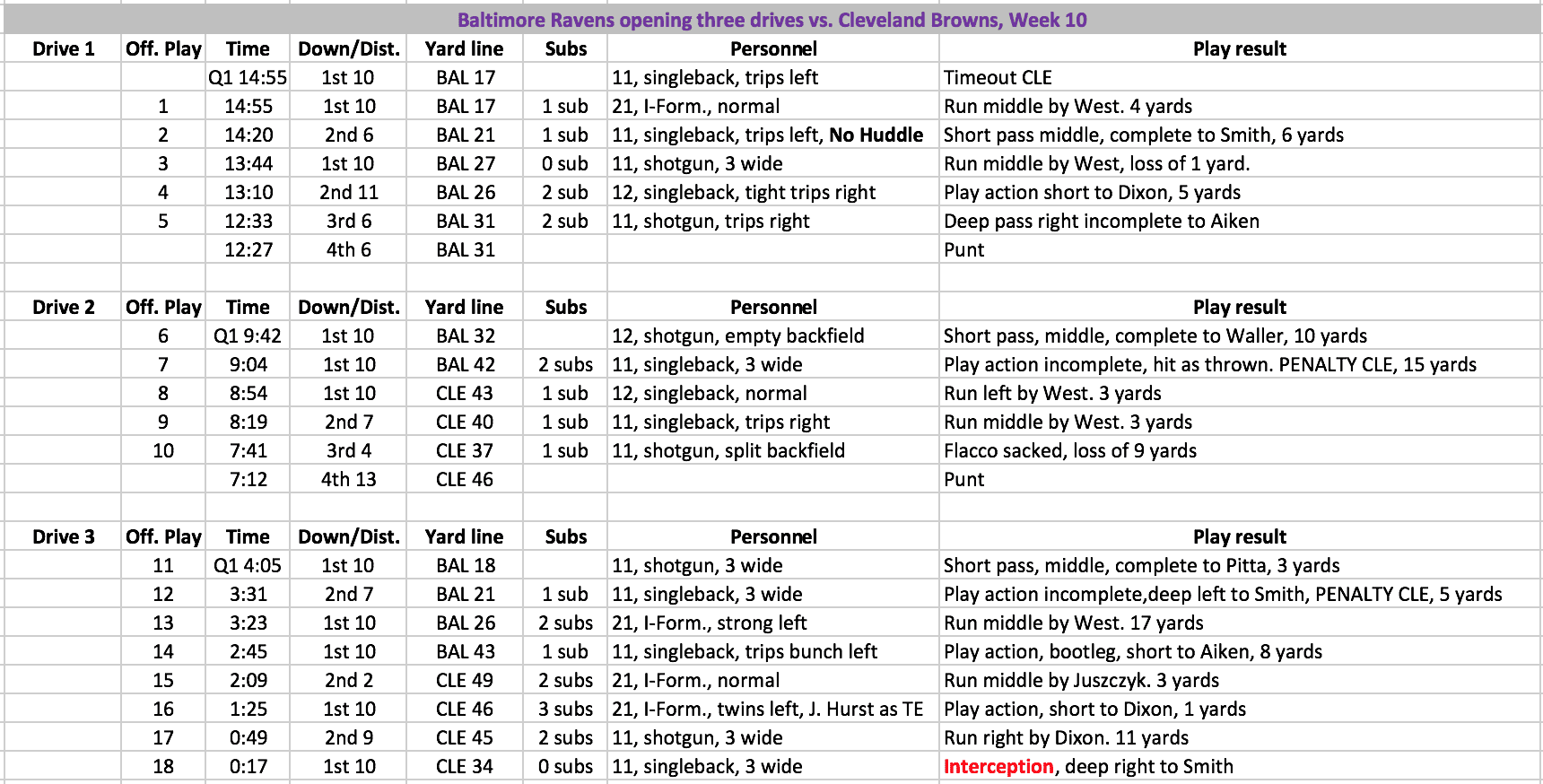
Here is a chart of the Ravens first 18 offensive plays, spread out over their opening three drives from their week 10 matchup, then I’ll compare to the Patriots.
**Personnel groupings are numbered by running backs then tight ends. Where “12” means there is one RB and two TEs. Leaving you with two WRs. “11” is one RB, one TE, three WRs. Also tried to paint a picture of the formation.
Moving onto the Patriots, here is a chart of their first 14 offensive plays over their opening drive against the Buffalo Bills from week 9.
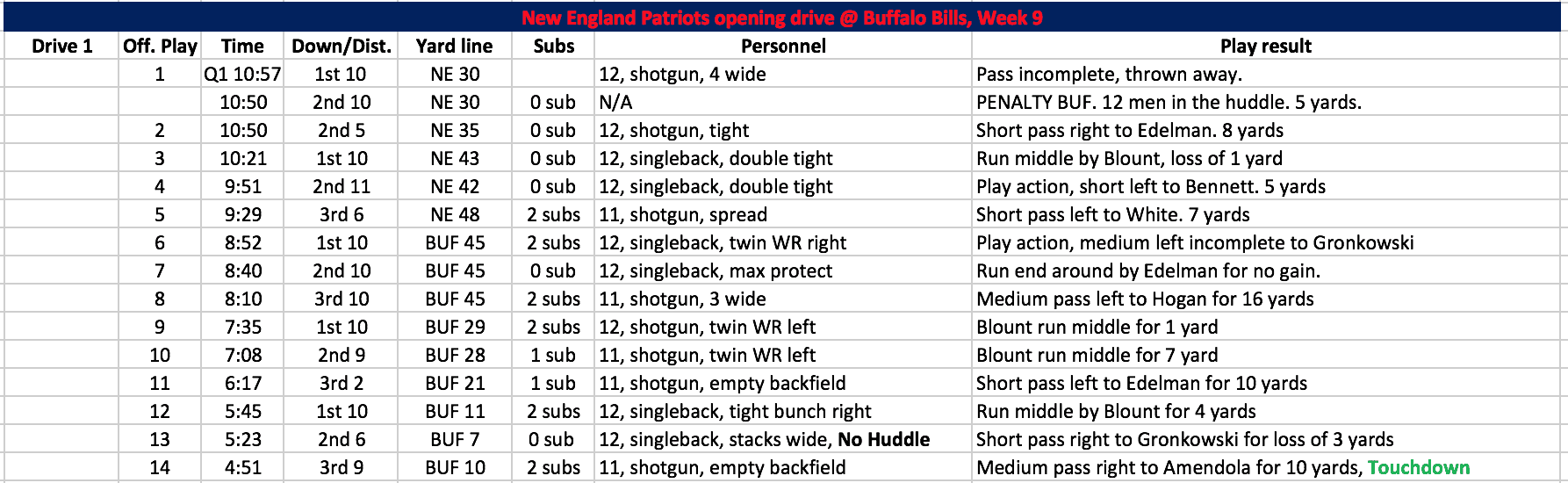
Notice any differences? The big one is the substitutions. Look at the Patriots chart first. I didn’t list it, but their common “12” personnel included: RB – Blount, TE – Gronkowski, TE – Bennett, WR – Edelman, WR – Hogan. They didn’t deviate from these players in their sets for four straight snaps to start. Why would they? Guys are fresh. Game just started. Can’t be tired after one or two plays.
When the Pats switch to “11” personnel on 3rd downs, they sub in and out: RB – White (pass catching threat, sub out Blount), WR – Amendola (Gets a better route runner in, sub out Bennett). When they get the first down, Blount and Bennett re-take their spots from White and Amendola. Only on one exception on the drive did Amendola come in for Bennett on 2nd down instead of 3rd, and remained there for 3rd down.
That is it. Seven different eligible receivers saw the field in the course of a 14 play drive resulting in a touchdown. They tried to catch the Bills off guard with a no huddle, quick snap, but Rex Ryan is keen on a lot of Bill Belichick’s tricks by now and the Bills defense wasn’t fooled.
Look back at the Ravens chart. On every play except two, oddly enough the one with the worst result, the drive killing interception, the Ravens subbed players in and out. The Patriots common, or starters set is “12” and the five eligible receivers are often the same. The Ravens showed the “11” more than the “12” or “21”. The players making up that common set were: RB – West, TE – Pitta, WR – Smith, WR – Wallace, WR – Aiken. After the Browns call a timeout for having 12 men before the flag came out, the Ravens switch to a “21” taking out Aiken and bringing in: FB – Juszczyk. On the third play, the no huddle, Aiken and Juszczyk sub for each other again, same set as the play the Browns called timeout on, Flacco probably decided to just call that first scripted play there.
Later in the drive we saw entering the game: RB – Dixon, TE – Waller
So on the first drive, as short as it was, the Ravens already showed more personnel groupings, and eligible receivers in five offensive snaps than the Patriots did in 14. Didn’t really catch the Browns off-guard if that’s what they are going for.
Drive two for the Ravens started on their own 32 yard line. One yard away from where the last drive ended. If you have a scripted set of 15 plays for that first drive, this is the perfect time to pick it up right there where you left off. The setup for this drive was vastly different. Ravens come out in a spread set, empty backfield. RB – Dixon (split out wide right), TEs – Pitta, Waller, WR – Wallace (all three bunched in the slot right), WR – Smith (split out wide left). Right away, Waller and Dixon come out and grab water. One play and need subs? On play two, another 1st and 10, field position not a factor in play calling, they go back to the common starting “11” set: RB – West, TE – Pitta, WR – Smith, WR – Wallace, WR – Aiken. Why wasn’t this the first set, or why couldn’t the same personnel from play one stay out there for play two of the drive.
It looks complicated doesn’t it? All the subs, all the players involved. What’s the difference in 1st and 10 from your own 32 and 1st and 10 from your own 42 that you need to bring two new players in? Or 1st and 10 from your own 18 and 2nd and 7 from your own 21 that you can’t leave the same personnel out there from one down to the next? The same set of play calls are in play in all four situations on the field.
Let me sum it up:
The Patriots used seven eligible receiving players and two personnel groups to navigate 70 yards on 14 plays in around six minutes. Finished the drive with a touchdown and an early lead on the road.
The Ravens used eight eligible receiving players and thee personnel groups to navigate 14 yards on five plays in around two and a half minutes. Punted. Got the ball back on a punt right about where they left off. Used a very different set of players to open the next drive. Continued to sub guys in and out for the next 12 plays over two drives, first one resulting in a 3rd down sack taking them out of field goal range, forcing a punt, second ended in an interception to end the third drive.
So here is another one for the “if” cause and effect list above.
Joe Flacco could be on the same page with his receivers if the same receivers and backs played more than one play at at time together.
Is this level of complexity in the offense rendering the Ravens and Joe Flacco inefficient? With so many substitutions, are they telegraphing their plays by who they sub in and out at times? Are the Ravens play callers focused on the right things? Are they too worried about getting the preferred personnel out on the field for a specific play rather than execution of the play itself?

Ravens Analyst
Mike was born on the Eastern Shore, raised in Finksburg, and currently resides in Parkville. In 2009, Mike graduated from the Broadcasting Institute of Maryland. Mike became a Baltimore City Fire Fighter in late 2010. Mike has appeared as a guest on Q1370, and FOX45. Now a Sr. Ravens Analyst for BSL, he can be reached at mike.randall@baltimoresportsandlife.com.