
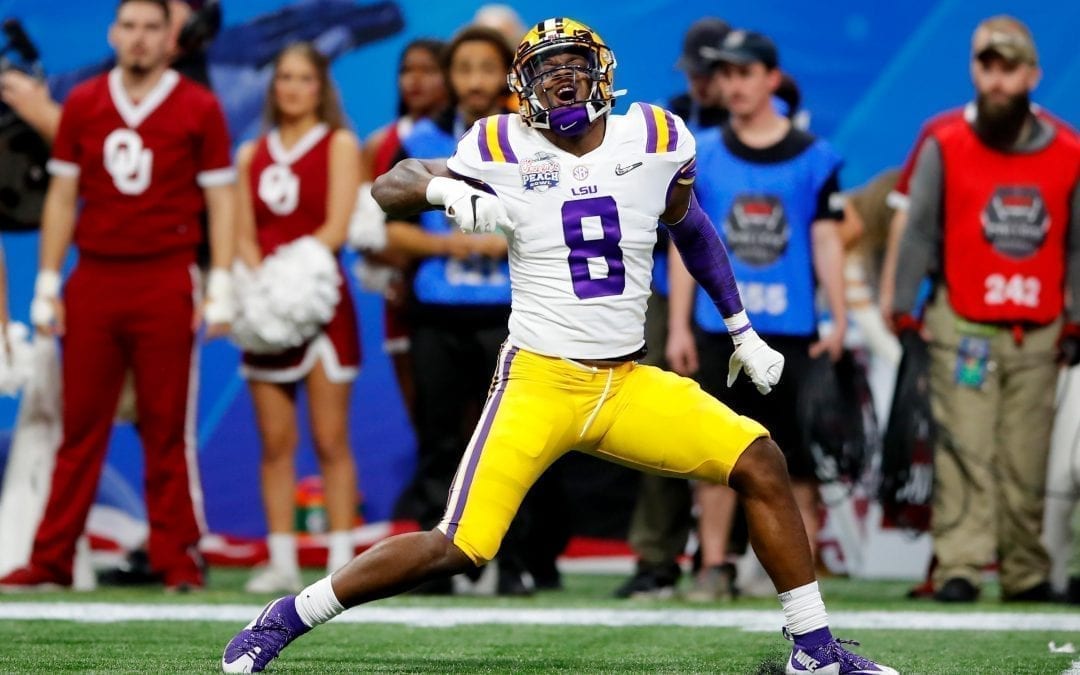
The 2020 NFL Draft has come and gone. While a full evaluation of how each team performed will have to wait until years in the future, some aspects of the process don’t require such a long period of time to decipher. The Baltimore Ravens walked away from the draft with most of their biggest needs filled without packaging picks in order to move up and grab targeted players. That approach works more often than others and highlights the front office’s understanding of value and team-building.
Maximizing value and favoring smart, long-term team-building strategies became a theme with the Ravens’ draft class.
[Discuss this article on the BSL message board]
Landing Patrick Queen supports decision to let C.J. Mosley walk
In a draft with few apparent top-shelf linebacker prospects, the Ravens somehow managed to scoop up Patrick Queen, LSU’s impact linebacker, with the No. 28 overall pick last month. Queen’s speed and coverage skills fit the pass-first nature of the modern NFL while his age (he doesn’t turn 21 until August) suggests he has more upside than a typical first-round selection.
Only time will tell whether Patrick Queen develops into the Ravens’ next field-tilting off-ball linebacker. The one-time running back has yet to master all the nuances of the position and will likely struggle at times against the run due to his size (6-foot-1, 227 pounds). Baltimore must account for those concerns as Queen acclimates to the next level.
Still, the selection lends support the Ravens’ decision not to more aggressively pursue a new contract with C.J. Mosley last offseason. The former first-round pick signed a five-year, $85 million contract with the New York Jets that completely reset the market for the position. Within a few months, other linebacker signed megadeals, including the Seattle Seahawks’ Bobby Wagner (three years for $54 million), the Atlanta Falcons’ Deion Jones (four for $57 million), and the Jacksonville Jaguars’ Myles Jack (four for $57 million). In the wake of those extensions, the price tag for Mosley didn’t seem quite as extreme.
But all but a few off-ball linebackers affect the game enough to justify such a cost. Mosley, though one of the better players at the position, doesn’t quite measure up to the likes of Wagner and the few other elites. Though the Jets don’t yet know if they’ll regret the contract, the Ravens found a way to replace Mosley within a short period of time at a fraction of the cost.
Ravens a year ahead of Taysom Hill trend
The Philadelphia Eagles made waves during the draft by selecting former Oklahoma signal-caller Jalen Hurts in the second round. While Hurts projected to come off the board sometime on Day 2, the selection seemed strange given the presence of Carson Wentz, the 27-year-old quarterback who signed a four-year, $128 million extension less than a year ago.
The explanation offered for the selection centered on Hurts’ ability to replicate Taysom Hill, the quarterback-tailback-receiver dynamo of the New Orleans Saints. Hill’s success has convinced other teams to take a chance on college signal-callers who might not possess the prototypical size and arm talent but can perform things even the most accomplished players at the position can’t.
Whether Hurts will develop into the next Hill remains an open question. But despite the attention his selection received, the Eagles didn’t become the first team to try to imitate that role within their offense. A year earlier, the Ravens did just that with sixth-round pick Trace McSorley.
Like Hill and Hurts, McSorley doesn’t look like a traditional dropback passer. He measured in at just 6-foot and 202 pounds, possesses average arm strength, and didn’t make it onto every team’s draft board as a quarterback.
However, McSorley offset those deficiencies in college with abundant athleticism and play-making ability. He performed well at the NFL Scouting Combine, scoring well enough in the workouts to land in the 77th percentile for pSPARQ, according to Three Sigma Athlete. Though not quite as impressive as Hill’s 96th percentile showing two years earlier, McSorley did enough to demonstrate his athletic traits and ability to fill a similar role in an offense.
With reigning MVP Lamar Jackson behind center, the Ravens don’t need to graft on a Hill-esque package into the offense. Still, as coordinator Greg Roman continues to evolve the system in hopes of staying ahead of the league, finding a role for McSorley could provide another wrinkle that NFL defenses struggle to stop. Just as importantly, Baltimore didn’t need to spend a second-round pick to land their Hill-type weapon due to getting ahead of the trend by a year.
Ravens continue to invest Day 2 picks in the defensive front
Few certainties exist in life beyond death, taxes, and the Ravens investing Day 2 picks to augment the defensive front. Only once in the last nine drafts has the team not added a defensive lineman or edge rusher in the second or third round, a strong indication of the value the front office places in the trenches.
2020 proved the latest example. In the same offseason that the Ravens dealt Chris Wormley and let Michael Pierce walk, they answered with a trade for Calais Campbell, the signing of Derek Wolfe, and the selection of Texas A&M’s Justin Madubuike 71st overall.
Madubuike looks like a lot of Day 2 defensive linemen the Ravens have added over the years. He possesses strong athletic traits but needs more refinement before becoming an every-down contributor. By taking him in the third, the team doesn’t need more than a handful of snaps during his rookie season. Moreover, the presence of veterans should allow Madubuike to develop at his own pace, allowing him to take over a more prominent role at some point in the future.
That approach to player development doesn’t just benefit the prospects, it also allows for the front office to more easily manage the salary cap. As players reach the end of their rookie deals and become more difficult to afford — Pernell McPhee, Za’Darius Smith, Matthew Judon just to highlight a few examples — reinforcements come at a steady pace due to near-continuous investment on the second day of the draft. Not all those selections work out, but enough will to account for losses in free agency.
— Jason B. Hirschhorn is an award-winning sports journalist and Pro Football Writers of America member. Follow him on Twitter: @by_JBH

Jason B. Hirschhorn is an award-winning sports journalist and Pro Football Writers of America member. He has bylines at NFL.com, SB Nation, Sports Illustrated, and other outlets.