
Though training camp, contract stalemates dominate the NFL news cycle, the Baltimore Ravens have perhaps the most interesting story to tell. At a time when the league places more emphasis than ever on the passing game, the Baltimore Ravens have taken the opposite approach. In doing so, they aim to bring about a new era of offensive football to the NFL.
“We’re probably doing iPhone 1 now,” Harbaugh told The Washington Post last month. “We have a whole new idea. It’s not that there’s anything new in there, concept-wise, that has never been done in football before. But the way we put it together, to me, is unique and different.”
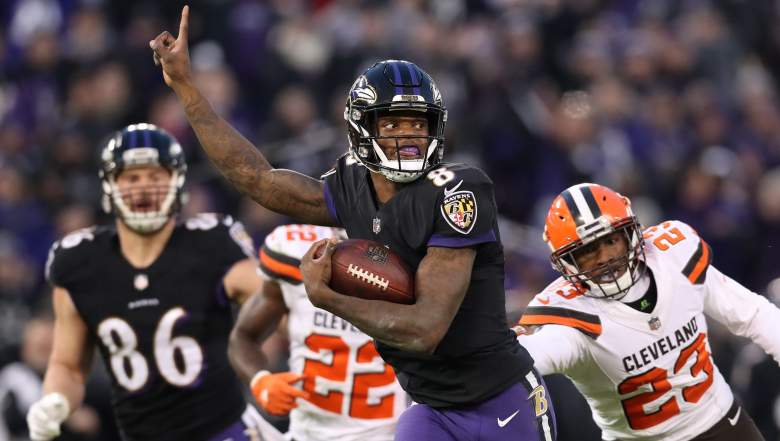
That idea centers around Ravens starting quarterback Lamar Jackson, one of the premier athletes to ever play the position in the professional level. Jackson set an NFL record for rushing attempts last season despite starting just seven games and could see even more carries in 2019. Harbaugh said he would “bet the over” on Jackson eclipsing last year’s carry total in Baltimore’s new offense during an appearance on NFL Network, leaving little doubt that the team wants to lean into the quarterback’s running abilities rather than minimize his exposure to hits.
[Discuss this article on the BSL message boards]
Jackson represents just one part of a ground attack that also includes the Ravens’ leading rusher from 2018 (Gus Edwards), a two-time Pro Bowl tailback added in March (Mark Ingram), and a first-year speed demon (Justice Hill). Though a typical NFL offense might struggle to give each ample touches, Baltimore clearly believes the foursome will receive plenty of work. If true, the offense could become one of the biggest anomalies in the NFL’s modern era.
Though the NFL pushed the boundaries of football schematics in its infancy, the league has famously come to resist new ideas, leaving experimentation to the lower levels of the sport. As the AFL ushered in pro football’s first passing boom in the 1960s, the NFL shifted towards its de facto dead-ball era, eschewing deep passes in favor of ground-and-pound offenses. That trend continued into the 1980s when the air-raid offense began to proliferate across high school and college football, eventually becoming one of the most popular schemes across the country. The NFL ignored the offense’s existence well into the new millennium. Not until the Arizona Cardinals tabbed Kliff Kingsbury as their head coach earlier this year did any NFL team go all in on the air raid.
All of which makes the Ravens’ supposed offensive revolution seem even dubious. Each of the recent scoring explosions in the NFL have roots in something from a different league. The record-setting 2007 New England Patriots used spread concepts borrowed from Boise State and other like-minded college programs. Andy Reid’s Kansas City Chiefs built air-raid principles into their offense. Even the Los Angeles Rams, whose head coach and offensive play-caller Sean McVay came out of Mike Shanahan’s version of the West Coast offense, uses run-pass options popular across college football.
But while the Baltimore’s plans to revolutionize offense in the NFL might sound hyperbolic on first blush, the team’s recent changes to the offensive coaching staff support its vision.
Outside of the trade that sent former Super Bowl MVP Joe Flacco to the Denver Broncos, the Ravens’ biggest change this year came at offensive coordinator. Harbaugh replaced the underwhelming Marty Mornhinweg with Greg Roman, the play-caller behind the efficient, run-heavy offense that helped carry the San Francisco 49ers to three consecutive NFL Championship Games and a Super Bowl. Those units featured a dual-threat quarterback (Colin Kaepernick), a versatile power back (Frank Gore), and a diverse receiving corps not unlike the personnel Roman will work with in Baltimore. Roman’s background lends credence to the idea that an NFL team can build an offense around a run-first quarterback and the ground game.
Likewise, quarterbacks coach James Urban will help mold the new-look offense. Urban joined the Ravens a year ago but should have a more prominent influence under Roman. Before arriving in Baltimore, Urban served as the position coach for Michael Vick during his MVP-caliber 2010 campaign. That year, Vick reached new personal heights as a passer while leading all quarterbacks in carries (100) and rushing yardage (676). Urban knows how to balance his signal-caller’s running ability against the risk of injury.
“Of course you don’t want your quarterback to get hit,” Urban said of Jackson following the first week of training camp. “That’s the No. 1 priority. He has to understand the protections and things. But I’m not worried about that.”
And if the track records of the two most prominent offensive coaches leaves any doubt as to the Ravens’ plans, the team also brought in triple-option wizard Paul Johnson during minicamp. Johnson most notably coached Navy and Georgia Tech during his illustrious career and became the triple-option’s leading evangelist. For a Ravens offense that will feature so many running threats, Johnson’s insight could prove invaluable.
Much remains uncertain about the Ravens’ offensive approach. Though training camp has provided previews as to what the coaching staff has in mind, the true scope of the schematic innovation probably won’t surface until the regular season begins on Sept. 8. Even then, Baltimore could continue to open up the offense as the season progresses, leaving even more quirks for later in the year.
But regardless of how the Ravens roll out their offense, the devotion to a ground game predicated on the quarterback means it likely won’t resemble anything else currently in the NFL.

Jason B. Hirschhorn is an award-winning sports journalist and Pro Football Writers of America member. He has bylines at NFL.com, SB Nation, Sports Illustrated, and other outlets.