
When I first sat down to write this, while I had a lot of heavy words on my heart I had no idea as to how I would formulate them all. Of course much of the sports world has been on hiatus due to the coronavirus pandemic, but there have been signs that some leagues could be back in the near future. And that would make things easier for many who work in sports, from the players to the media members to the hourly workers that man concession stands. But I honestly couldn’t care less about the playing of sports right now, especially when myself and those who look like me continue to fight against an issue that’s been present in America for centuries.
How much is a Black person’s life worth? That’s not an easy question to answer these days, even as a Black man. On Memorial Day in Minneapolis, George Floyd was murdered in broad daylight and shortly thereafter video of his death was broadcast for the world to see. Of course the officer that had his knee on the back of Floyd’s neck for nine minutes has been arrested and charged with third degree murder and manslaughter, but the three other officers on the scene that day remain free. Floyd’s death was, at the time, the most recent death of a Black person at the hands of law enforcement.
Before that there was Breonna Taylor in Louisville, and after there’s been Tony McDade in Tallahassee (the TPD alleged that McDade pointed his gun at the arresting officer, with a resident of the apartment complex saying that no warning was given before the shooting according to WFSU). There were many names before Taylor, who was shot eight times in her home, and sadly there will likely be more to come after her. That may come off as pessimistic to some, but to those people I ask the following: why should I have faith that things will change?
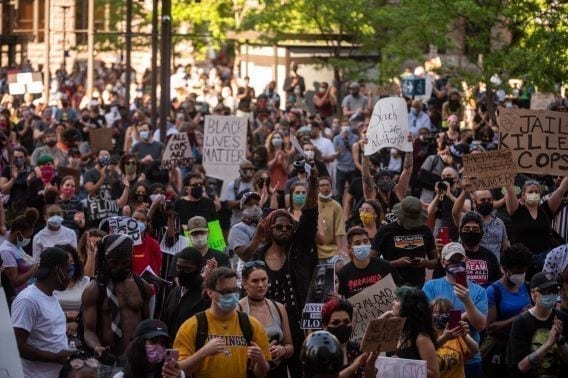
The murder of Floyd has sparked something in people, who in some instances would have simply looked up at their television for a few seconds before going back to whatever they were doing without much thought. People have taken to the streets in many cities, the majority of them demanding that justice be served and that their voices be heard. And no matter the vocabulary used to describe some of the things have happened, be it a “riot” or a “rebellion,” the words of the late Dr. Martin Luther King Jr. immediately come to mind.
“A riot is the language of the unheard.”
The interesting thing to me about Dr. King is that so many people will rush to quote him, cherrypicking the most convenient — and comfortable — of lines to make it seem as if they’re standing for something. Type out a quote of his, post it on social media, and mission accomplished. The job is done, and we can just get on with our lives. Well life doesn’t work that way, especially for those who have long distrusted the system and don’t feel as if they’ve been given a reason to change that approach.
Being a Black person in the country means that you essentially have to master existing in two worlds: the one where you’re most comfortable and don’t feel as if you need to have your guard up constantly, and the other in which even following the “rules” to a T could come with dire consequences. “Code-switching” usually refers to one’s dialect, but it means so much more than that for myself and many others. While we all received “the talk” about sex from our parents when we were kids, for someone like me that’s not the only “talk” that we remember from our childhood. There’s the talk about how to deal with law enforcement when approached, from the words you use to respond down to your body language. And here’s the thing: even if you do everything right, that person could very well decide that you’re still wrong. Dead wrong.
Sadly many of us have stories of negative interactions with law enforcement officers, and while some may go the route of filing a complaint many don’t. Why? Because we’ve pretty much accepted that it’s what we have to deal with.
You hear so often that “it’s 2020” when it comes to issues of race in the country, as advancing on a calendar automatically means progress. But something I’ve learned in my 39-plus years on the planet is that our nation has a nasty habit of pushing painful conversations to the back burner. And when people who are in pain feel that their concerns are being ignored, they either stand up and make enough noise to be heard, or they submit.
If you want to use recent examples of people bringing these issues to the attention of the masses, the sports world has been at the forefront. Colin Kaepernick did so in 2016, going from sitting on a bench to kneeling so as to avoid anyone thinking that he was “disrespecting the troops.” As we all saw, folks who didn’t want to hear what he had to say would look for any reason to disregard his message. And that’s commonplace when it comes to forms of protest: those who don’t want to be bothered with any of it will attempt to make up “rules” for the way in which the person(s) goes about using their platform. Kaepernick, and many others since, attempted to go the peaceful route but all they received in return was anger.
Vice President Mike Pence, who tweeted out his support of peaceful protests on Saturday, made a big show of going to a game and angrily leaving after seeing players do just that prior to an Indianapolis Colts game. And as others rose to support Kaepernick, they were met with demands such as “shut up and dribble.” If a public figure can’t peacefully protest, what’s the average citizen to think, especially if they’ve seen their pleas for respect go unanswered for far too long?
What made things even worse within the sports world was that athletes were doing so in a space that, beyond the fans, was poorly equipped to address the issues at hand. Who can forget Malcolm Jenkins’ press conference in which he didn’t even say a word to the assembled media, simply holding up signs such as “you still aren’t listening” while some asked the same questions that proved his point? Questions such as “why are you protesting,” when those issues had already been discussed ad nauseam. Professional sports seems to have improved, with the NBA leading the way, but there is still a long way to go.
As for college sports, boy. Some coaches, most notably Ohio State’s Chris Holtmann and North Carolina Central’s LeVelle Moton, didn’t hesitate to offer up their support. Others have been very quiet, even after being called out (and rightfully so) by USA TODAY’s Dan Wolken in a recent column. And if you look at the rosters of many revenue (football, men’s and women’s basketball) sports, many of those athletes are the same complexion as a George Floyd, Breonna Taylor, Tamir Rice…and so on. Yet in their time of need, to at the very least know that the person that they’ve pledged to play for supports them, many of those players haven’t heard a word from the coaches they’ve helped enrich.
So when those coaches sit in a recruit’s living room and pledge to their parents that they’ll “treat your son/daughter as if they were my own kids,” are those words legitimate? Or are those words a lie told with one goal in mind: get the kid, by any means necessary? That’s something that a lot of those coaches are going to have to address, not in their staff meeting rooms, but rather when they look in the mirror.
At this point what needs to be done? First and foremost justice needs to be served, and not just in one case because that isn’t enough to establish any kind of trust. Those who feel disenfranchised can’t give up; the fight must go on until the words “liberty and justice for all” truly mean that in this country. And for those who may not have to deal with these issues firsthand, the rest of us need you. Our voices can only carry but so far on their own.

BSL Analyst
Raphielle’s been writing about college sports for more than a decade, making the move to college basketball alone in 2013. Beginning his work with the former website CollegeHoops.net in 2003, Raphielle spent 3 years writing for NBCSports.com beginning 2013, covering CBB and the Olympics. In 2016, Raphielle joined Heavy.com. If there’s a game on, there’s a strong likelihood that he’s watching it.