
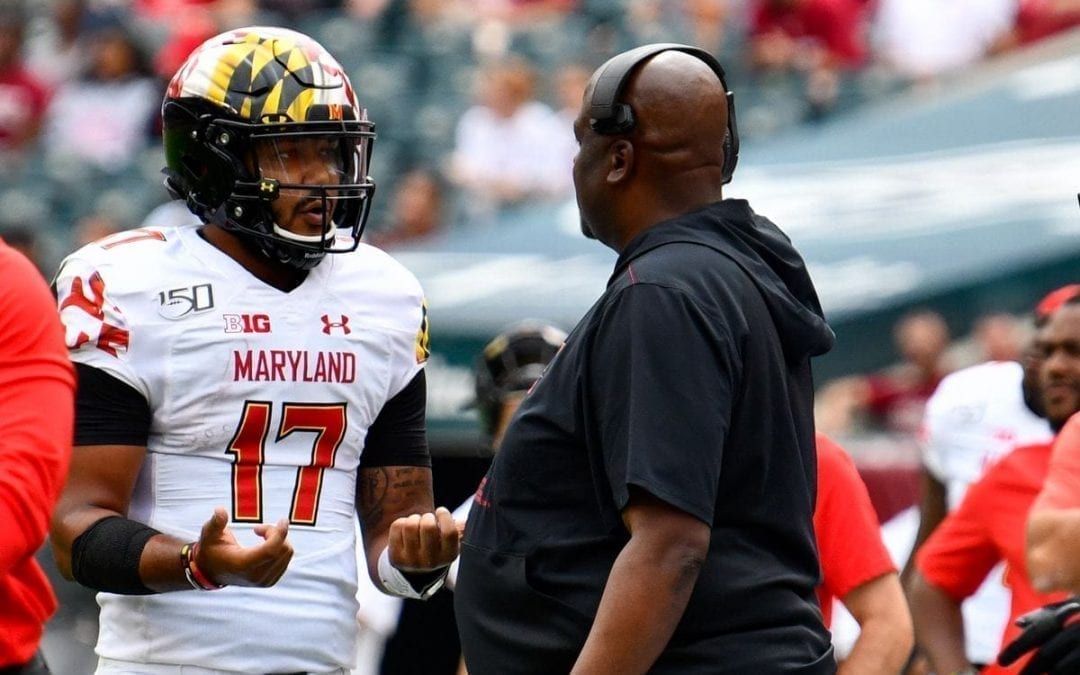
After a red-hot start to their 2019 season, the Maryland Terrapins sputtered in their first road trip of the year last week, falling to Temple by a score of 20-17. They’ll head into conference play with a 2-1 record, facing Penn State at home next Friday night after a bye week. The Nittany Lions are currently the 13th-ranked team in the country and will enter the game with a 3-0 record after also enjoying a bye week. While a lot has gone right for head coach Michael Locksley and his team, a lot went wrong last week. They’ll need to ensure that the mistakes made in Philadelphia were a fluke, not a sign of more to come.
(Discuss this article on the BSL Message Board here.)

1. What’s Gone Right
Let’s look at the good parts of Maryland’s non-conference schedule first. They currently hold a 2-1 record, which is likely what most people would’ve predicted before the season. That prediction probably would’ve included a loss to Syracuse and a win against Temple, but a 2-1 record nonetheless. The team owns the 14th-best offense and 32nd-best defense in the country. Their rushing offense ranks 13th-best and their rushing defense is 11th-best. Their third-down defense is also 10th-best in the nation.
Josh Jackson is currently 5th in the Big Ten Conference for passing yards and ranks 4th for passing touchdowns. Anthony McFarland, Jr. ranks 4th in the conference for rushing yards and is tied for the most rushing touchdowns with Wisconsin’s Jonathan Taylor. Tight end Tyler Mabry is tied for the conference lead for most receiving touchdowns. Linebacker Keandre Jones is tied for the 4th-most sacks in the conference.
Defensive coordinator Jon Hoke’s unit has done an excellent job of forcing turnovers, and they grabbed two fumbles and an interception in the loss to Temple. So far this season, they’ve forced 6 turnovers, tied for 20th-most in the country. With the offense turning the ball over just twice, the team currently holds an excellent +4 turnover margin, tied for 15th-best in the nation and 2nd-best in the conference.

2. What’s Gone Wrong
Nothing went wrong for the Terrapins during their first two games, so this section will be entirely focused on their loss to Temple. The team’s issues began and ended with the offense, specifically the passing game and the offensive line. After nearly-perfect outings against Howard and Syracuse, quarterback Josh Jackson struggled mightily last weekend. He completed less than 39% of his passes and averaged less than 5 yards per completion. He was under constant pressure from the Owls’ defensive line, who were able to manhandle Maryland’s offensive linemen without blitzing very much. This led to a lot of rushed throws and tipped passes.
While the offensive line was bad, Jackson also shares blame for his poor reads on many of the team’s run-pass options (RPOs). Locksley mentioned this week that Temple’s defense showed a different look against the RPOs than they had in film, which threw Jackson off. But for a veteran signal-caller, he has to realize that early and make adjustments in his reads. The RPO game is a crucial part of this offense, and it only works if both the run and pass are equal threats.
Hoke’s pass defense also struggled last weekend, allowing a lot of big plays through the air. They were fortunate to force three turnovers which negated many of those plays, but the team’s veteran secondary has to lock things down much better than they did against Temple. They were also able to record just one sack against the Owls’ defense despite frequent blitzes, which allowed quarterback Anthony Russo plenty of time to scan the field and find open receivers. 3-4 defensive schemes rely on their deception and ability to create confusion, and getting a better pass rush has to be an item of focus as Maryland heads into conference play.

3. Goal Line Play Calling
Locksley’s play calling near the goal line against Temple was so egregious, it needed a separate section. Maryland’s offense began two different drives inside the red zone in the game, including one inside the Owls’ 5 yard line. Neither drive resulted in points, primarily due to some mind-boggling play calling decisions. If the team had scored a touchdown on just one of those drives, or made field goals on both, they’d be heading into the bye week with a 3-0 record.
In the first quarter, the Terrapins inherited the ball at Temple’s 19 yard line after a muffed punt. After a 15-yard run by McFarland, Jr., they found themselves at the 4 yard line. An incomplete pass and a 2-yard Jackson run later, it was third and goal from two yards out. McFarland, Jr. ran into the line and only gained one yard. In a situation that seemed ripe for play-action, Locksley decided to run the same play on 4th down, resulting in a two-yard loss and a turnover on downs.
In the fourth quarter following a 55-yard punt return by DJ Turner, the offense once again found themselves on Temple’s 4 yard line. This time Locksley elected to run McFarland, Jr. into the line not once, not twice, not three times, but four times in a row. Unsurprisingly, the Owls’ defense was ready for this and forced a turnover on downs. On a day where Temple’s defensive line had a clear advantage over Maryland’s offensive line, it’s incomprehensible as to why Locksley wouldn’t call a play-action pass near the goal line that he’d been setting the Owls up for all day long.

4. What Defensive Line Concerns?
Before the season began, one of the biggest question marks for the Terrapins was an apparent lack of talent and depth along their defensive line. Through the first three games, these concerns have all but disappeared. All six players on the two-deep depth chart have played very well, and the emergence of Sam Okuayinonu at the 3-technique and Brandon Gaddy at nose tackle have been huge for Hoke’s defense.
The job of the defensive line in a 3-4 scheme is almost entirely to plug holes and stop the run. So far this season, the Terrapins have the 11th-best run defense in the country. They haven’t allowed a rushing touchdown all year, and are holding opponents to just 2 yards per carry. In order to win games in this conference you have to be able to stop the run, and Maryland has done an excellent job of that so far despite the depth concerns.

5. Moving Forward
The Terrapins will need to find at least 4 more victories during their slate of conference games in order to qualify for a postseason berth. Their next game against Penn State will be a measuring stick of sorts as to how close the team is to competing with the blue blood programs of the Big Ten Conference. After nearly beating Ohio State at home in 2018, they ought not to have a repeat of their last few blowout contests against the Nittany Lions. If they can keep the game close heading into the fourth quarter, anything can happen.
For as important as the Penn State game is however, the next 4 weeks are likely even more crucial. While 3 of those 4 games are on the road, all come against beatable opponents in Rutgers, Purdue, Indiana, and Minnesota. A sweep of these games would guarantee bowl eligibility for the Terrapins in Locksley’s first season as head coach. The final 4 games present a bigger challenge, with contests against Michigan, Ohio State, Nebraska, and Michigan State. The Terrapins will face the Wolverines and Cornhuskers at home.
Despite a slip-up against Temple, Maryland still ought to be able to find at least 6 wins on their schedule, if not more. More than wins however, they’ll need to show that they can hang with the big four of Michigan, Michigan State, Ohio State, and Penn State.

Terps Analyst
Zack is a financial analyst for a defense contractor in Washington, DC. The Owings Mills native focuses most of his efforts on Maryland Football recruiting and individual coach and player pieces; but also covers Terps Basketball. He has established relationships with Big Ten beat reporters across the conference, which he utilizes in his game previews. Now a Sr. Terps Analyst for BSL, Zack can be reached at: zack.kiesel@baltimoresportsandlife.com.