
For much of their history, the Orioles haven’t been a franchise that wins by overwhelming spending power or flashy star-chasing. Rather, their greatest eras have been built on timing, evaluation, and a belief in finding the right player at the right moment in the right role, oftentimes through trades.
Some of the most important players in Orioles history didn’t arrive amid major hype or headlines but were acquired quietly, and then, with the benefit of hindsight, we look at those trades and realize the Orioles got an all-star quality player for virtually nothing.
Now, unfortunately for the Orioles, they’ve also been on the bad end of a few of those trades (the Glenn Davis and Jake Arrieta trades come to mind), but they’ve made some pretty great deals too.
So what are the five best trades in the history of the franchise?
Honorable Mention: Orioles acquire Chris Davis and Tommy Hunter from the Rangers for Koji Uehara
This trade isn’t in my top five but it’s pretty darn close, and I went back and forth on it, so I’m giving it an honorable mention.
In 2011, the Orioles acquired Chris Davis and Tommy Hunter for reliever Koji Uehara. Now, this is a trade that actually worked out decently for both teams, as Uehara was a pretty awesome reliever for the Rangers in 2012, posting a 1.75 ERA over 36 innings and a solid season after being traded the year before.
Davis, however, arguably contributed more during his peak (though we all know how bad his valleys were). In Texas, Davis never really had a place. The team knew he had power, he hit 21 home runs in 2009 for them, but he struck out a ton. Ultimately, the Rangers thought that Mitch Moreland was a better fit for them at first base, and there was definitely no way Davis was going to usurp third base from Adrian Beltre, so he became expendable.
Enter the Orioles, who desperately needed offense. Davis seemed like a good fit — Camden Yards is a great park for left-handed power, and he was worth the price of a reliever like Uehara.
The next season, Davis batted .270/.326/.501 with 33 HRs, and followed that up with a .286/.370/.634, 53 HR season, ultimately becoming a central figure in the Orioles’ 2012-2016 run.
Obviously we all know what came next though — Davis’s highs were incredible but once he started declining, he plummeted (in my opinion, because MLB made him change his ADHD medication, but that’s a discussion for another time), posting the worst single season in MLB history in 2018, slashing .168/.243/.296.
Tommy Hunter, meanwhile, ended up being a solid bullpen option (and a fun clubhouse guy). Between Davis’s peaks and valleys, Hunter’s return as a reliever, and how good Ueheara was, this is definitely an honorable mention trade.
5. Orioles acquire Scott McGregor, Rick Dempsey, Tippy Martinez, Dave Pagan, and Rudy May from the Yankees for Doyle Alexander, Elrod Hendricks, Grant Jackson, Jimmy Freeman, and Ken Holtzman
In 1976, the Orioles and Yankees figured their record-breaking 17-player trade in 1954 was such a fun time that they’d do it again, with a 10-player trade that netted the Orioles three major contributors to their team.
Scott McGregor went to an All-Star game in 1981, won 20 games for the Orioles in 1980, and had a fantastic couple of postseasons, especially in the Orioles World Series year of 1983. McGregor only allowed two runs in the ALCS and World Series openers that year and pitched a complete game shutout against the Phillies in Game 5 of the World Series.
Meanwhile, every Orioles fan knows Rick Dempsey as the guy has been heavily involved with the organization forever, appearing on TV for years. While Dempsey was never much of a hitter (he had a career batting average of .233), he was phenomenal defensively and never got hurt.
Where Dempsey most contributed was in the 1983 World Series, where he batted .385 with a .923 slugging percentage and won World Series MVP, one of only six catchers to ever win the award.
And while Tippy Martinez may be best known for picking off three players in one inning, he played for the Orioles for 10 years and had a nice career as a reliever. He, along with Dempsey and McGregor, was another leader on the ‘83 World Series team.
4. Orioles acquire Ken Singleton and Mike Torrez from the Expos for Dave McNally, Rich Coggins, and Bill Kirkpatrick
In December 1974, the Orioles acquired Ken Singleton from the Expos, and it worked out beautifully for the Orioles.
Singleton came into Baltimore and put up two solid seasons before really breaking out in 1977 with a .328/.438/.507 season with 24 home runs, 90 runs, and 99 RBI. After that, Singleton was rock solid year to year, putting up his best season in 1979 when he slashed .295/.405/.533 with 35 home runs, 93 runs, and 111 RBI, finishing second to Don Baylor in the AL MVP voting.
Singleton was a three-time All-Star once joining the Orioles, won a World Series with the team in 1983, and was a Roberto Clemente Award winner in 1982.
While Singleton is the obvious get of the trade, let’s not forget Mike Torrez who won 20 games for the Orioles in 1975, his only year with the team, in 270.2 innings while posting a 3.06 ERA and 119 strikeouts before he was shipped off to Oakland alongside Don Baylor and Paul Mitchell for Orioles legend Reggie Jackson (and also Ken Holtzman and Bill Van Bommel).
3. Orioles acquire Mike Cuellar, Elijah Johnson, and Enzo Hernandez from the Astros for Curt Blefary and John Mason
In 1968, the Astros and the Orioles made a six-player trade in which nearly all the players ended up not amounting to a ton, with one major exception — Mike Cuellar.
Cuellar had pitched well as a member of the Astros, but when he came to the Orioles, he kicked it up a notch, and has gone down as one of the best pitchers in Orioles history (and one of the more underappreciated).
The first season Cuellar pitched for the Orioles was one of the greatest pitching seasons in Orioles history, in which Cuellar pitched to a 2.38 ERA (worth noting, the league average ERA that year was 3.61) and went 23-11. That season won him a Cy Young (actually, he tied with Tigers pitcher Denny McLain for the Cy Young, the last pitcher to ever tie for the award).
Between 1969 and 1974, Cuellar won 20+ games four separate times and pitched over 290 innings three times. He was a four-time All-Star, was key in the Orioles’ 1970 World Series win, and led the majors in wins in 1970 with 24.
Also, fun fact, Cuellar is, as of now, the only pitcher to hit a grand slam in a league championship series, which he did in the 1970 ALCS.
2. Orioles acquire Adam Jones, Chris Tillman, George Sherrill, Kam Mickolio, and Tony Butler from the Mariners for Erik Bedard
In 2007, Erik Bedard had one of the better seasons we’ve seen from an Orioles pitcher, posting a 3.16 ERA and setting an Orioles record for strikeouts in a season with 221. The Orioles then cashed that in in a big way by getting five players from the Mariners in exchange for Bedard.
While Mickolio and Butler never amounted to much, Jones, Tillman, and even Sherrill, to an extent, became valuable contributors to the Orioles. Bedard, meanwhile, struggled mightily with injuries and was never able to really repeat his 2007 season.
Jones ended his career as a five-time All-Star, four-time Gold Glove winner, and a Silver Slugger winner, while Tillman ended up being a fairly solid starter for the Orioles, even earning an All-Star nod in 2013.
And Sherrill certainly had his moments, snagging 31 saves for the Orioles as their main closer in the 2008 season, though those 31 saves also came with a 4.73 ERA and a 13.8% walk rate.
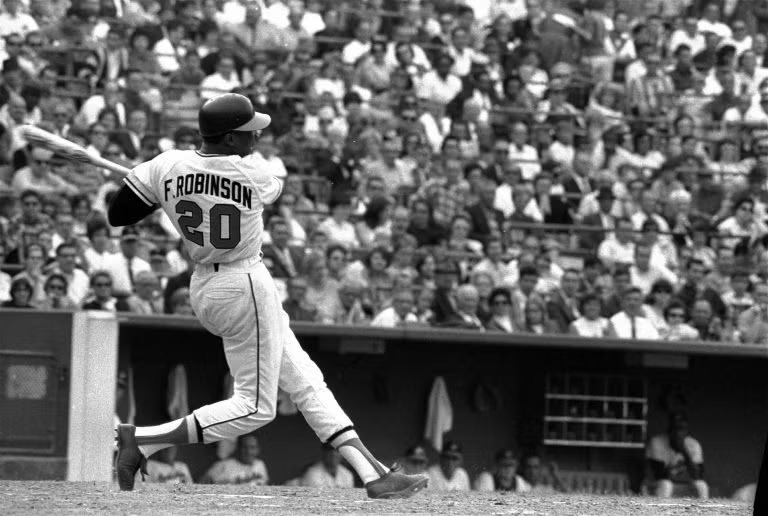
1. Orioles acquire Frank Robinson from the Reds for Milt Pappas, Jack Baldschun, and Dick Simpson
In what has gone down as one of the most lopsided trades in history, the Reds traded eventual Hall of Famer Frank Robinson to the Orioles for three players who didn’t amount to all that much.
Pappas had a really good season in 1965 when he was traded, pitching to a 2.60 ERA in 221.1 innings, but he never really replicated that again, spending only two more seasons with the Reds and throwing a 4.29 ERA in his first season and a 3.35 ERA in his next.
Listing the accomplishments of Frank Robinson could take forever, but to sum up the career of one of the greatest players in the history of baseball: Robinson was a 14-time All-Star, two-time World Series winner, two-time MVP, World Series MVP, Triple Crown winner, NL Rookie of the Year, and a Gold Glove winner.
He finished his career as a member of the 500 home run club with a career .294 batting average and just under 100 hits shy of 3,000 total. In fact, in his first season with the Orioles, Robinson demolished the ball, slashing .316/.410/.637 with 49 home runs on his way to his second MVP.
To say that this trade was lopsided is understating it a little bit. The Orioles got one of the greatest players in the history of baseball, and the Reds got three players who didn’t amount to all that much, making this easily the greatest trade in Orioles history.

Ben Palmer has lived in Maryland his whole life and currently spends his days working as a health care journalist. He also previously wrote for and was a site expert for the FanSided blog The Baltimore Wire and currently works as managing editor at Pitcher List where he writes about fantasy baseball.