
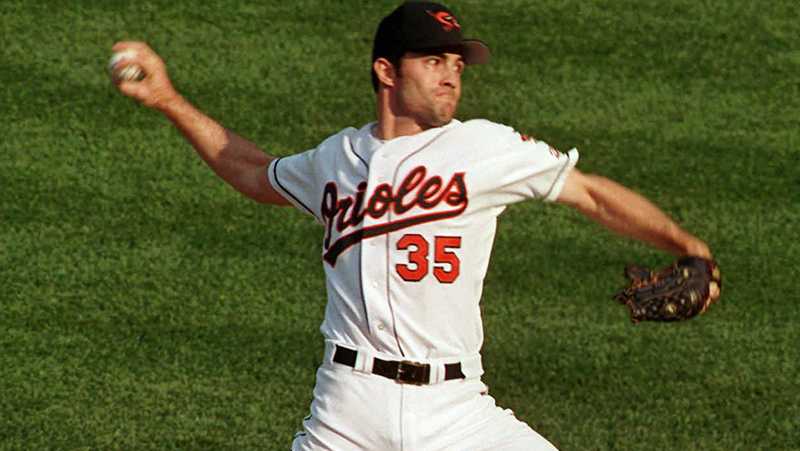
Listen, I may be biased as a lifelong Orioles fan, but it sort of does feel like few teams in Major League Baseball have had as many lingering “what ifs” as the Orioles.
For a team that’s been around as long as the Orioles with three World Series titles and long (very long) stretches of irrelevance, the Orioles have had plenty of pivotal moments that feel like they could’ve changed things, whether that’s a trade, a call, or a philosophical blindspot.
So here, I’m going to take a look (and relive the pain, in some instances) of five of the biggest “what ifs” in Orioles history.
What if the Orioles had kept Schilling and Finley?
In the early 90s, the Orioles quietly developed a pretty impressive collection of talent. Mike Mussina emerged as a bona fide ace while Curt Schilling was acquired from the Red Sox alongside Brady Anderson for Mike Boddicker, and Steve Finley was drafted in the 13th round of the 1987 MLB Draft.
But by the time the Orioles had hit their competitive peak in 1996 and 1997, Schilling and Finley were long gone, having been dealt alongside Pete Harnisch to the Houston Astros for Glenn Davis in 1991
But what if the Orioles hadn’t made that deal and kept Schilling and Finley?
The implications are obviously huge. We all know the career Curt Schilling ended up having (personal stuff about him aside). He put up Hall of Fame-caliber numbers, getting six All-Star nods, three World Series, a World Series MVP, an NLCS MVP, leading the Majors in wins twice, and leading the National League in strikeouts twice, on his way to a career 3.46 ERA and 3,116 career strikeouts.
And while Finley wasn’t necessarily a Hall of Famer, he was a two-time All-Star and five-time Gold Glover, finishing his career with a .271/.332/.442 line. In 1996, Finley slashed .298/.354/.531 with 30 home runs, 126 runs, 95 RBI, and 22 steals. Imagine that on an Orioles team that made it all the way to the ALCS that year.
What if Jeffrey Maier never reached over the wall?
Speaking of the 1996 season, this is a moment that’s going to trigger a lot of Orioles fans of a certain age—Game 1 of the 1996 ALCS in which Derek Jeter’s fly all drifted toward the glove of Tony Tarasco when 12-year-old Jeffrey Maier reached over the wall and deflected it into the seats.
The play was called a home run, the Yankees tied the game, won in extra innings, and ultimately took the series in five games.
What if that play had been ruled fan interference, or Tarasco had caught it?
Before you start getting angry at me, I’m not suggesting Jeffrey Maier alone lost the Orioles the ALCS in 1996. Of course not. But it was a major factor in Game 1, and the Orioles not only had home-field advantage but arguably the better roster of the two teams.
Winning Game 1 changes the tenor of the entire series. A Baltimore pennant, or even a World Series title in the late-90s would fundamentally alter how that team, and that era, is remembered. Instead, it’s the start of the Yankees’ late-90s dynasty.
What if the Orioles had re-signed Mike Mussina?
After the 2000 season, the Orioles were at a crossroads. Mike Mussina, the homegrown ace, and face of the franchise (and future Hall of Famer) was a free agent.
Ultimately, Mussina signed a six-year, $88.5 million contract with the Yankees, an offer the Orioles declined to match. Eventually, Mussina was a post-season fixture with the Yankees while the Orioles entered one of the longest downward spirals in modern baseball.
The “what if” here isn’t that Mussina alone would have saved the franchise. Rather, it’s what his departure represented.
Keeping Mussina would’ve signaled that the Orioles remained a serious, competitive organization capable of retaining elite talent. Instead, losing him to a division rival (especially to the Yankees) damaged the Orioles’ credibility with players, agents, and fans, and marked a psychological breaking point—one from which the Orioles arguably didn’t recover until over a decade later.
What if Zack Britton pitches in the 2016 Wild Card game?
The 2016 Orioles were largely built around a dominant bullpen, headlined by Zack (at the time, Zach) Britton’s incredible season that saw him pitch to a 0.54 ERA with 47 saves in 67 innings pitched.
Yet in the AL Wild Card game against the Blue Jays, Britton never left the bullpen as the game went to extra innings. Instead, Ubaldo Jimenez, who had been exceptionally inconsistent that year, came into the game in the 11th inning and allowed a walk-off home run to Edwin Encarnacion.
But what if Buck Showalter had used the best reliever in all of baseball, who had one of the best seasons in the history of relievers, in the highest-leverage moment of the season?
One inning could’ve changed everything. A win sends the Orioles to the ALDS with momentum, depth, and legitimate upset potential. Instead, the loss became one of the defining moments of the Buck Showalter era, one of the most second-guessed managerial decisions in the postseason in a long time, and effectively marked the end of the Orioles’ mid-2010s contention window.
What if the Orioles had embraced analytics earlier?
Throughout the 2000s and early 2010s, the Orioles consistently lagged behind their rivals in adopting modern analytical approaches. This wasn’t some big secret, it was something former Orioles mentioned after they left the team, including Jake Arrieta who ended up winning a Cy Young after leaving Baltimore.
While teams like the Rays and the Red Sox exploited inefficiencies in player evaluation and roster construction, the Orioles relied on outdated models, which led to inefficient spending and fragile roster depth.
So what if the Orioles had modernized a decade sooner than they actually did once Mike Elias came to town?
An analytically aligned front office might have extended the Orioles’ mid-2010s competitive window, better supported Manny Machado’s prime, and avoided the catastrophic collapse that necessitated tearing the team down to the studs in 2018.
The Orioles’ success in recent years underscores how costly that delay was. Baltimore didn’t lack resources, it lacked alignment.

Ben Palmer has lived in Maryland his whole life and currently spends his days working as a health care journalist. He also previously wrote for and was a site expert for the FanSided blog The Baltimore Wire and currently works as managing editor at Pitcher List where he writes about fantasy baseball.