

Twenty-six is old for a prospect. The scouting community has usually given up by then. Whatever great leap forward could be projected at 18 or 21 is assumed to, because of the brutalities of human aging, have fallen by the wayside. There are stretches of virtual road that stretch to the horizon with the bodies of prospects past, some as old or even a tad younger than Bruce Zimmermann, laying along the shoulder. But despite getting his first cup of coffee in the majors at the end of last season and his first start this past Sunday, Zimmermann isn’t prospect roadkill. Instead he’s the third starter for the Baltimore Orioles.
(You can discuss this on the BSL Board here.)
That’s pretty cool in and of itself, but when you consider that Zimmermann was born in Baltimore and attended Towson University before transferring, it becomes something kids dream up while playing stickball in the backyard. But this isn’t a dream. Zimmermann made the major league rotation out of Spring Training this season after throwing 13.1 innings over four games, striking out 13 while walking only three with no homers allowed. That led to the 6’2 lefty making his first major league roster, and a start in the third game of the season as the O’s went for a series sweep of the Red Sox (spoiler alert: they succeeded).
Zimmermann is maybe a bit more than your prototypical crafty lefty. He’s tall at 6’2 and can reach the low-to-mid 90s with his fastball, not fast but not slow either. He can command his slider and curveball, but his changeup isn’t quite good enough to miss bats. So that sounds like a good scouting report, and it is, but it’s not mine. That’s a paraphrased report from FanGraphs.com‘s article on the Orioles top 45 prospects, written by Eric Longenhagen on March 3 of this year. Longenhagen is certainly a better scout than I, but as Zimmermann pitched last Sunday against Boston, I wanted to see how he looked compared to that report.
In his start, Zimmermann threw six innings and 73 pitches. He faced 23 batters, allowed four hits including one homer, while striking out five and walking one. A quality start officially and unofficially a high quality effort. His pitch count certainly suggested he could go further into the game had manager Brandon Hyde wanted to push him, but it being Zimmermann’s first start, Hyde made the conservative choice and pulled him.
First Inning
Zimmermann missed his first two pitches to leadoff hitter Enrique Hernandez. He left his first pitch, a 91mph fastball over the middle of the plate, but Hernandez ignored it for strike one. Then he left his second pitch, another 91mph fastball up in the middle of the zone and Hernandez roped it down the left field line but just foul. Now up on the count 0-2, Zimmerann’s third pitch was a thing of beauty, a low and away changeup that barely dipped below the zone. Hernandez rolled over on it and was thrown out for the first out of the inning.
The second at-bat against Alex Verdugo was a clinic. Fastball on the outside corner for strike one, fastball on the inside corner for strike two, slider low and away exactly where he wanted it but Verdugo laid off for ball one. A high fastball that Verdugo laid off for ball two, and then a slider that hit the bottom outsider corner of the zone. Verdugo swung through it but it would’ve been called strike three anyway. Every pitch was in its perfect location, up, down, in and out. When a pitcher does that successfully it’s very hard to hit.
Then came J.D. Martinez. Zimmermann started Martinez with a change up just below the zone. It could’ve been called a strike but wasn’t. Then he threw an 85 mph pitch that did nothing. It could’ve been a changeup or a flat slider, but either way, yuck. However it was on the outside corner and Martinez hit it off the end of his bat for a pop foul that was caught by the stands by Trey Mancini.
A mixed bag overall, with some hittable pitches and some domination mixed in.
Second Inning
Zimmermann struck Xander Bogaerts out on three pitches, two fastballs almost exactly where he wanted them on the outside corner and a changeup that just dipped below the outside corner at the last second and got and swing and a miss.
He then got Marwin Gonzalez to ground out to third, then put on another clinic of an at-bat against Hunter Renfroe. He hit the catcher’s glove with all three pitches, a fastball at the top outside corner of the zone for strike one, a fastball at the top inside of the zone fouled off for strike two, and a changeup at the bottom outside corner of the zone that Renfroe hit the top of for a weak ground ball to shortstop.
This was Zimmermann’s best inning. He threw all his pitches exactly where he wanted and buzz-sawed through the heart of Boston’s order with seemingly minimal effort.
Third Inning
Coming off a seven run top of the third inning, Zimmermann gave up a lead-off double to Christian Vazquez, but even in that two pitch at-bat he hit his spots both times. In fact, on the double, the pitch was a bit further in off the plate than he wanted, in effect a few inches less hittable, but Vazquez hit it off the Green Monster anyway. Then he got Bobby Dalbec to fly out weakly to center on a changeup just below the zone. After a fastball up for a ball, Zimmermann threw a change to second baseman Christian Arroyo that was hit back off his foot for an infield single. Next, Enrique Hernandez got another change at the bottom of the zone but this one he waited on, unlike in the first inning, and drilled it, but right at the left fielder. That scored Vazquez from third. Then, after taking a high fastball and fouling off a low slider, Verdugo lined out to center field for the third out.
Through three innings the themes are emerging. The fastball command has been quite good, but so has the changeup. The slider is used intermittently, but the whole package is one that, when Zimmermann commands it, can be successful against a major league lineup. At the risk of skipping over anything interesting, let me highlight one more at-bat, the first of the fourth inning, a home run he gave up to J.D. Martinez.
One More AB…
Martinez led off the inning with an illustration of the incredibly small difference between success and failure for a major league pitcher. Zimmermann wanted to start off the at-bat with a fastball on the bottom outside of the zone, which he kinda did, but he left it in, just a bit. Here you can see where Chance Sisco puts his glove, where he wants the pitch.
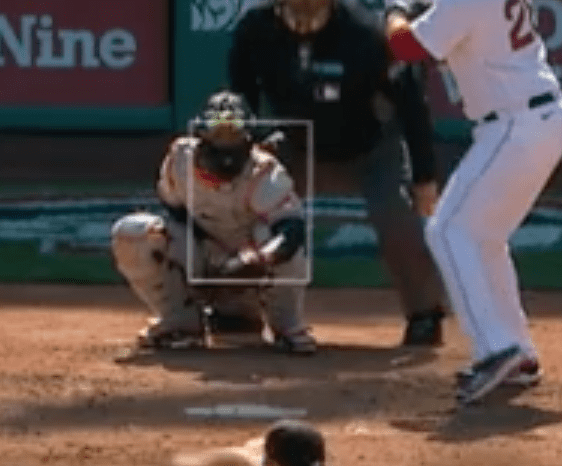
And here you can see where the actual pitch crossed through the strike zone.

That’s not a huge difference. Often a pitcher will hit the general area of the zone, and that will be good enough, but sometimes it’s not good enough to be general. You have to be specific. If Zimmermann had really put that fastball three inches further towards the outside corner, Martinez doesn’t hit that homer. Maybe he hits a different homer, who knows, it’s J.D. Martinez after all, but he can’t do what he did if that pitch is where it is supposed to be.
This isn’t meant to be a critique of Longenhagen’s scouting report. That is presumably put together over numerous appearances and views of the pitcher by different people. I am but one person watching but one start. That out of the way, I was very impressed by Zimmermann’s command. He commanded his changeup in particular low in the zone and got numerous swings and misses out of it. There were a few times when he left it up a bit, and true to form, the changeups higher in the zone don’t tend to drop as much, leaving them vulnerable to hard contact. In fact, based on that start, I wonder if perhaps Zimmerann’s changeup has been a bit undersold. It’s clearly not a blow you away pitch, but with the command he exhibited it’s a league average pitch, and a collection of league average pitches with better than league average command is a pretty good package.
Then there’s the times that a good hitter just wins, and that’s something that Zimmermann will have trouble controlling. The harder a pitcher throws, the more movement a pitcher has, the less that kind of thing can happen, but Zimmermann isn’t Jacob deGrom or Walker Buehler. He doesn’t have that kind of stuff to work with and as such his margin for error is far less, and sometimes there’s simply nothing he can do to avoid damage. His stuff just isn’t good enough. But even those times can be minimized on the whole, certainly enough to feel comfortable putting Zimmermann out there every fifth day.
It appears that Zimmermann’s command, and specifically of his changeup and fastball, are the cornerstone to his success. As long as he can spot the changeup low in the zone and play it off his fastball on the corners, with a tossed in slider from time to time, he should be able to get big league hitters out. There will be times when his command ditches him, and when that happens he figures to get hit hard. But at the very least he’s earned a shot in the rotation. If he can keep his command up, he can pitch at this level.
The Orioles are trying to sort through their younger guys and see if there is anyone who can stick longer term. Zimmermann isn’t going to front the next great Orioles starting rotation, but the fact that he could be a part of it at all, compared to the alternative, is a win for the organization and the man.

Orioles Analyst
Matthew Kory is a Orioles / MLB Analyst for BSL. He has covered baseball professionally for The Athletic, Vice Sports, Sports On Earth, FanGraphs, and Baseball Prospectus. He lives in Portland, Oregon with his wife, two boys, and his cats, Mini Squeaks and The President. Co-Host of The Warehouse.