
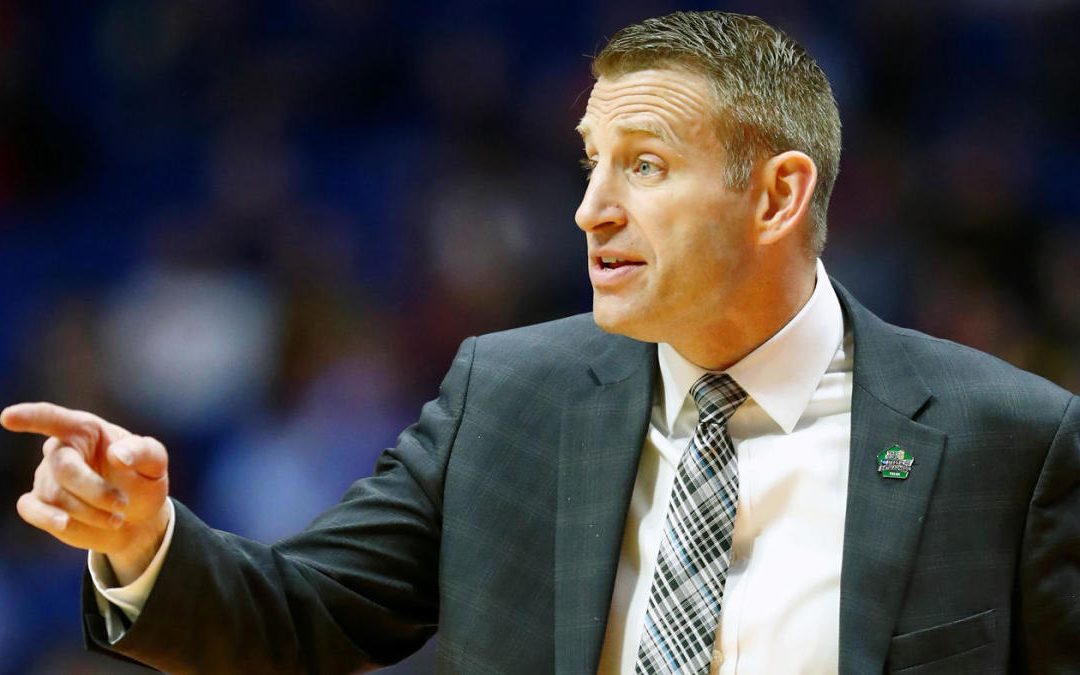
Few candidates for the next head coach of Maryland men’s basketball have generated more discussion than Alabama’s Nate Oats.
In just three years, Oats has generated plenty of attention and a decent amount of success for a basketball team that will always be second fiddle to the legendary Crimson Tide football team.
Oats has also made Alabama play with a unique style that combines pace and plenty of three-point attempts, which I’ll analyze in-depth for this article.
Of course, any discussion of hiring Oats at Maryland also requires a discussion of the finances. Oats has a buyout clause of 10 million dollars, which is quite the pretty penny that isn’t associated with other potential candidates to take the reins in College Park.
Ultimately, I don’t think Oats has currently proven himself enough at a power conference school to be worth it for Maryland. His playstyle is certainly exciting, but we don’t have a large enough body of work to know if it’ll consistently work in the regular season or the NCAA tournament.
However, you’re free to reach your own conclusion on Oats and I think this article will provide you with plenty of data to make your own decision.
Let’s begin with an in-depth look at how his teams play.
How they play
The most unique thing about the three seasons of Oats at Alabama is the Crimson Tide have been willing to shoot three-pointers at an incredibly high rate.
Over 45 percent of Alabama’s field goal attempts have been three-point attempts in every season with Oats in Tuscaloosa and each of those seasons has seen Alabama in the top 20 nationally for their three-point attempt rate. To put it simply, Oats coaches teams that will live by the three and die by the three.
Alabama is currently 4-5 in SEC play this year and is shooting under 30 percent on their threes in conference play, so it’s fair to say the Crimson Tide are currently dying by the three. Three of their five SEC losses have seen them make under 30 percent of their threes, with a home loss to in-state rival Auburn providing an especially dreadful day of making just 22.6 percent of their threes in an 81-77 defeat against the Tigers.
Two of those three losses where Alabama made under 30 percent of their threes have also seen them with a three-point attempt rate above 50 percent. If you aren’t making your threes and you’re shooting them at a higher rate than you’re shooting two-pointers, your offense is probably going to run into some issues.

Of course, Maryland fans have also seen first-hand what it looks like when Alabama shoots plenty of threes and makes them. When the Crimson Tide defeated the Terps in the NCAA tournament last season, Alabama had a three-point attempt rate of exactly 50 percent, shooting 33 two-pointers and 33 three-pointers. That ratio produced an impressive 96 points as Alabama made 57.6 percent of its twos and 48.5 percent of its threes in the win.
During the 2020-21 regular season, Alabama also managed to score 105 points at LSU with a three-point attempt rate above 60 percent. The Tide shot 43 threes compared to 25 twos and it was hard to argue against the strategy as they made over 50 of their threes in a dominant offensive performance.
Alabama’s reliance on the three-pointer creates a real boom-or-bust offense and it’s up to you if you want that potential game-to-game inconsistency in College Park.
On top of aggressive three-point shooting, Oats also has his teams push the pace. His four seasons at Buffalo all saw them in the top 40 for adjusted tempo according to Kenpom. That pace has continued in Tuscaloosa, with Alabama ranking in the top 20 for adjusted tempo during every season with Oats. If you thought Mark Turgeon’s teams played too slow, then Oats at Maryland will be a remarkable contrast.
As for the defense, an Oats team will tend to be more successful defending three-pointers than two-pointers. During the 2018-19 season at Buffalo, his team ranked ninth in the country for opposing three-point percentage and last season saw Alabama have the tenth-best three-point defense in the country. Each of the last five seasons across Buffalo and Alabama has seen his team in the top 100 for three-point defense, while his teams have been in the top 100 for opposing two-point percentage just once.
So in summary, an Oats team will shoot a ton of threes, push the pace and be better at defending three-pointers than twos when the other team has the ball.
NCAA tournament results
Oats made the NCAA tournament in his first year Buffalo with #14 seed in 2015-16 but lost a relatively close game to #3 seed Miami 79-72. Just two years later, his 2017-18 Buffalo squad made quite the impression as a #13 seed with an 89-68 upset over #4 Arizona.
A #13 seed upsetting a #4 seed is always going to be one of the stories of the tournament but winning by 21 points is an especially remarkable outcome. A #13 vs. #4 upset has happened 31 times in the history of the men’s tournament and that was the only third time the #13 seed won by at least 20 points. Oats picked up a historically dominant upset and did it against an Arizona team that included Deandre Ayton, a future #1 pick in the NBA draft.
Buffalo then lost to #5 seed Kentucky but still, the 2017-18 tournament established Oats as an up-and-coming coach who could get results at a mid-major.
The following year, Oats built on the tournament success with a much stronger regular season that earned Buffalo a #6 seed. They comfortably beat #11 seed Arizona State in the first round before losing to a #3 seed Texas Tech team that’d eventually make the national title game.
Since 2010, Ohio is the only MAC school besides Buffalo to have multiple tournament wins, demonstrating that Oats found success in a conference that doesn’t usually produce victories in March Madness.
As for his tenure at Alabama, the aforementioned win over Maryland in last year’s tournament is the most recent tournament victory for Oats. As a #2 seed, the Crimson Tide made it to the Sweet 16 but then ran into an #11 seed UCLA squad enjoying a magical run to the Final Four. In the loss, Alabama was a horrendous 11-for-25 on free throws, missing more than 50 percent of their attempts in a game that went into overtime. Of course, making exactly one-fourth of their three-pointers also didn’t help.
We only have a one-year sample of how Oats does in the tournament with a power conference school, but the 2017-18 and 2018-19 results with Buffalo are certainly impressive for coaching a school in the MAC.
Conference tournament results
The MAC is generally not a conference that will earn at-large bids, so Oats knew his only chance at making the NCAA tournament at Buffalo would be winning the conference tournament and sure enough, he did it three times in four years. The 2015-16, 2017-18 and 2018-19 seasons all saw Buffalo win three straight games in the MAC tournament to earn an automatic bid in the NCAA tournament.
Given the stakes, I’d argue winning three conference tournaments in four years is much more impressive at a school like Buffalo compared to a power conference school.
Most mid-majors need a conference tournament title to have a chance at the NCAA tournament, while that isn’t true for power conference schools. Funny enough, Maryland is the perfect school to prove this point. The 2016-17 and 2018-19 Terps, as you might remember, failed to win a conference tournament game but still easily made the NCAA tournament.
Of course, Oats also won the only conference tournament he’s had at Alabama so far. As the #1 seed and the regular-season conference champion, Alabama beat Mississippi State, Tennessee and LSU to win the conference tournament. Tennessee was a #5 seed in the NCAA tournament and LSU was a #8 seed, which meant that Oats hardly had a cakewalk to win the SEC tournament.
It’s also worth mentioning that the 2020 SEC tournament during his first year at Alabama didn’t happen due to the pandemic. Alabama was going to be a #9 seed in the tournament that year after an 8-10 SEC record, so perhaps an early exit from the tournament would’ve been a blemish on his record after a weak regular season. We’ll just never know.
Performance against ranked teams
A funny thing has been happening to Alabama this season: they’re doing well against ranked opponents and just okay against unranked opponents.
They’re 5-2 against ranked opponents this year, with both of their losses coming against Auburn. In fact, the five ranked teams they beat this year include both teams in last year’s title game. They beat Baylor in Tuscaloosa on January 29 when the Bears were ranked #4 and Gonzaga was #3 when they lost to Alabama in Seattle during December. Houston, also part of last year’s Final Four, was ranked #14 when they lost to the Crimson Tide at Alabama’s gym.
Meanwhile, their losses to unranked teams include a 6-16 Georgia team and an 8-13 Missouri squad. They also were defeated on a neutral court by Rick Pitino’s Iona back in November.
Alabama already playing seven games against ranked teams is quite a contrast to last year, when they only played four games in total against ranked schools. They beat #7 Tennessee on January 2, 2021, before dropping three straight games against ranked opponents.
During his first year at Alabama, Oats was 2-4 against ranked teams. However, one of those wins came against #4 Auburn, which seems like a pretty good way to make a first impression.
At Buffalo, Oats had eight chances to play ranked teams during the regular season and went 1-7. Due to the fact that they’re a mid-major, Buffalo never got a chance to play a ranked team at home, playing seven true road games plus a neutral site game in the Cayman Islands.
Buffalo’s lone win against a ranked team in the regular season during the Oats era came at West Virginia in November 2018, as they earned a 99-94 overtime victory against the Mountaineers.
Buffalo’s 1-7 record shouldn’t be held against Oats given the circumstances, but it is worth knowing that Buffalo’s performance during his tenure did have a limit to its success.

BSL Analyst
Rose Katz is a recent graduate of the University of Maryland’s journalism school, where she worked for The Diamondback as the online managing editor and a sports blogger. As a student, she spent almost all of her time on campus in The Diamondback’s newsroom or at Xfinity Center, Ludwig Field and Maryland Stadium. Rose gained intern experience with the Mid-Atlantic Sports Network (MASN).