
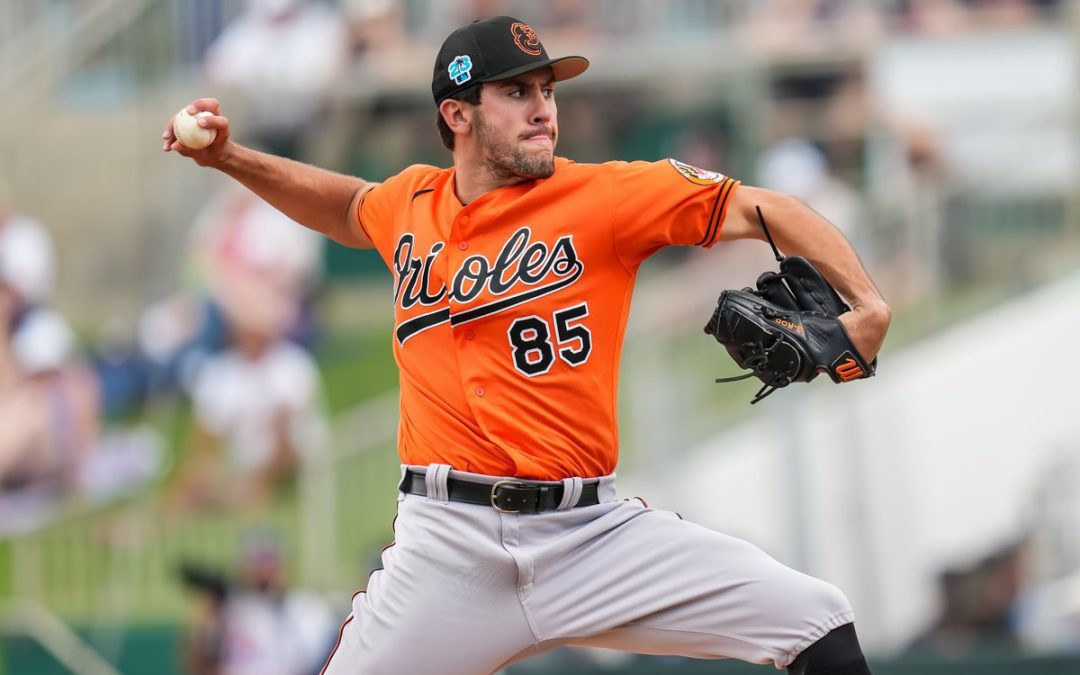
On Monday, the Baltimore Orioles delivered a major reason for pessimism entering this season when Grayson Rodriguez failed to make the Opening Day roster.
The news, first reported by Andy Koskta of The Baltimore Banner, meant that all of Birdland would have to continue waiting for the debut of Baltimore’s top pitching prospect and MLB.com’s #7 overall prospect.
As for why Rodriguez won’t be on the major league roster, it’s hard to find an answer that feels particularly satisfying.
If it’s service time manipulation, then it’d be a clear signal that the front office is placing more weight on the distant future than trying to win games right now.
Actively avoiding the best possible roster on Opening Day would be frustrating in any context, but it’s especially an issue given how last season unfolded. As you may recall, the 2022 Orioles started April with a 7-14 record before finishing the season just three games out of the playoffs. They spent the entire season trying to overcome a slow start and just couldn’t quite to do it.

A loss in April counts the same in the standings as a loss in September and it’d be unacceptable if waiting weeks for Rodriguez harms their playoff chances by even one game. Making the playoffs this year should be a bigger priority for the front office than the 2029 rotation.
Some would argue that there isn’t much difference between Rodriguez and Tyler Wells starting the year in the rotation and as such, this decision isn’t that big of a deal. Given that Wells finished last year with a respectable ERA of 4.25, they certainly have a point.
However, it’s also worth wondering how much better the bullpen would be if it included Wells. As a reliever in 2021, he had a WHIP under 1.000 and a K/9 of 10.3 in 57 innings. Using Rodriguez as a starter and Wells as a multi-inning reliever certainly seems like a stronger Opening Day roster than Wells as a starter and Rodriguez in AAA.
Of course, there is an easy way to avoid worrying about what year Rodriguez becomes a free agent, but that would require the Orioles to spend more than $10 million on a pitcher.
While service time is the most likely explanation for this, the performance-based reasons for Rodriguez not making the Opening Day roster don’t feel especially convincing either.
Rodriguez ended spring training with a 7.04 ERA, which is hardly ideal. However, the sample size feels just as important as the ERA: 15.1 innings and five games. During the regular season, a 15-inning stretch with a 7.04 ERA from a starting pitcher would raise some eyebrows, but it’d hardly be seen as anything definitive.
Any argument against Rodriguez making the rotation because of spring training also feels flimsy when looking at the spring numbers from two other pitchers who are expected to make the Opening Day rotation. The aforementioned Wells put together a 5.74 ERA and Kyle Bradish also struggled with a 6.61 ERA. Those performances don’t mean they should also be in Norfolk, but rather that spring training isn’t exactly a perfect way to predict regular season production.

Also, if spring training is a deciding factor for prospects making the roster then why isn’t Jordan Westburg going to Boston on Thursday?
Westburg is a consensus top-100 prospect who put together a .896 OPS in Florida to go along with a .869 OPS in AAA last year and yet, that combination couldn’t earn him a roster spot. The Rodriguez decision is frustrating in a vacuum but looks even worse when it seems like a prospect’s spring training performance only matters if he struggles.
Even if this decision is based on meaningful red flags in spring training and not service time, there’s another question worth asking: what can Rodriguez learn in AAA at this point?
Prior to his injury, Rodriguez spent 2022 comfortably dominating AAA hitters where it seemed abundantly clear he was ready for a new challenge in the majors. Among the 88 pitchers with at least 60 innings and ten starts in the AAA International League last year, Rodriguez was first in ERA, FIP and HR/9 while finishing in the top five for several other major pitching stats.

Rodriguez wasn’t quite elite when it came to avoiding walks but every other stat in that table pretty easily demonstrates that he was pitching like no one else did in AAA last year.
If the struggles against major league hitting in spring training were legitimate concerns then how exactly is he going to get better facing hitters who aren’t in the majors? At a certain point, you need to trust that a top-ten prospect who dominated AAA should be able to figure things out at the next level.
Pitching development and hitting development are hardly identical, but it still feels like Adley Rutschman last year is a perfect example for elite prospects successfully adjusting in the majors. He had a .422 OPS in his first 15 games after debuting on May 21 but flipped the switch after that and ended the year with a .806 OPS.
Rodriguez potentially taking his licks in April would be frustrating given what a poor April did to last year’s playoff chances. However, I’m skeptical that a couple of starts in AAA would suddenly save the Orioles from dealing with a bumpy start for Rodriguez in competitive games. If he’s going to struggle for a few weeks no matter what, you might as well get it out of the way now and give him the rest of the season to adjust and help the team.
Rodriguez is Baltimore’s best pitching prospect and a top-ten overall prospect. So why isn’t he being given the Opening Day roster spot someone like that deserves?

BSL Analyst
Rose Katz is a recent graduate of the University of Maryland’s journalism school, where she worked for The Diamondback as the online managing editor and a sports blogger. As a student, she spent almost all of her time on campus in The Diamondback’s newsroom or at Xfinity Center, Ludwig Field and Maryland Stadium. Rose gained intern experience with the Mid-Atlantic Sports Network (MASN).