
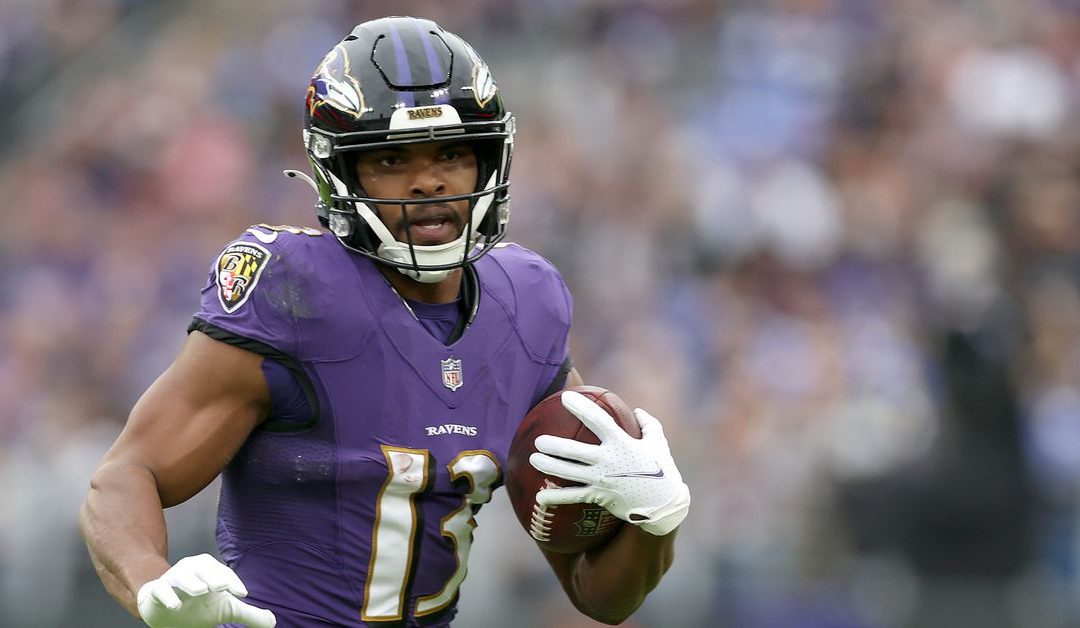
After dealing with dozens of injuries in 2021, the Ravens have spent the offseason rebuilding a roster that seems poised to be among the league’s best this season. They revamped the secondary with the additions of Marcus Williams, Kyle Hamilton, and Kyle Fuller, improved the offensive line by drafting center Tyler Linderbaum, and added stability to the trenches by bringing in offensive tackle Morgan Moses and defensive tackle Michael Pierce. However, the wide receiver position, which many analysts expected them to improve this offseason, remains very thin. Baltimore’s failure to add pass catchers, and their decision to trade Marquise Brown to the Cardinals on draft night, has raised questions about what this offense will look like in 2022.
Between free agency and the NFL Draft, the Ravens have had no shortage of opportunities to bring in new wide receivers. That being said, given that they entered the offseason with minimal cap space, signing a high profile receiver like Christian Kirk or Allen Robinson may never have been in the cards. Still, bringing in a productive veteran like Jamison Crowder or Jarvis Landry would have certainly been possible if the front office had made it a priority.
In terms of the draft, it made sense for the Ravens to pass on receivers in the first three rounds in favor of the best player available strategy they have employed over the past few years. But considering that they had an NFL record six fourth round picks, it was surprising that they repeatedly passed on receivers like Calvin Austin III (Steelers), Khalil Shakir (Bills), and Kyle Phillips (Titans). It should be noted that they did take two tight ends in Charlie Kolar and Isaiah Likely, though it is unlikely (no pun intended) either will set up wide very often since they are both 6-foot-6 and close to 250 pounds.
What makes the Ravens’ lack of urgency with respect to the wide receiver position even more concerning is the fact that two of their leaders in last season’s air attack have left the team. Sammy Watkins’ decision to leave via free agency came as little surprise given that he never really found his footing in Baltimore. He caught just 27 passes on 49 targets and recorded only one touchdown in 13 games with the team.
The departure of Marquise Brown, however, shook the fanbase to its core. Not only did Brown enjoy a breakout campaign in which he broke 1000 yards in 2021, but he was also a fan favorite who shared a special connection with Lamar Jackson. It’s hard to argue that the Ravens didn’t get good value when they traded Brown and a third round pick for a first round pick on draft night, but only time will tell if it was worth leaving such a large hole in both the offense and the locker room.
Needless to say, it’s been a curious few months for Eric DeCosta and co. Some may point to Lamar Jackson’s affinity for throwing to tight ends and running backs as the justification for the actions (or inaction) of the front office. However, in past years, the Ravens have taken the opposite approach, investing first round picks in Brown and Rashod Bateman, and actively seeking free agents like Watkins and Willie Snead. Others may say that there were too many other holes to fill, but ask any front office executive in the NFL and they’ll tell you Baltimore has one of the most well-rounded rosters in the league.
Therefore, the only logical explanation for the current state of the Ravens’ receiving corps is that the front office truly believes in the young pass catchers they have accumulated in recent years. As it stands, every receiver on the roster was either drafted by or signed as an undrafted free agent by the Ravens, save for Binjimon Victor who spent last season on the Giants’ practice squad. Of that group, none of them have more than two years of experience in the league.
The “veterans” are Devin Duvernay and James Proche, both of whom are entering their third NFL season. Between the two of them they have 90 career catches for 689 yards and two touchdowns. That’s not exactly the resume most teams are looking for in their potential WR2 and WR3, but clearly the Ravens are not most teams. The front office apparently believes that the catch-and-run dominance Duvernay has shown in his role as punt returner will translate quickly into the receiving game. It also seems as though they trust the ball skills that helped Proche record nearly 4000 receiving yards during his career at SMU will finally come to the forefront in his third year with the team.
Meanwhile, the clear WR1 will be Bateman, who is entering his second season after being drafted in the first round just over a year ago. He will look to build upon the 46 catches and 515 yards that he recorded in his first 12 games with the team last year. Though he still has much to prove, Bateman possesses all of the tools necessary to become an elite wideout. His strong hands and 6′ 1” frame allows him to win consistently on the perimeter, and his quick release and crisp route running helps him create plenty of separation. The front office has put a lot of trust in Bateman to unlock his potential this year, but if he can do so, it will take a great deal of pressure off the rest of the unit.
Beyond Bateman, Duvernay, and Proche, it’s a whole bunch of unknown names and faces who will be battling it out for the final few spots. Second-year wideout Tylan Wallace certainly seems to have the best chance to make the team, given that he has experience both with the Ravens offense and in an actual NFL game (he caught two passes for 23 yards last year). Jaylon Moore, who spent all of last season on the Ravens practice squad, figures to have a good shot to make the team alongside Wallace.
Given that most teams carry six receivers, that leaves one spot open to an undrafted free agent. I’d keep an eye on 20 year-old Makai Polk out of Mississippi State, who was viewed as a potential fifth round pick entering the draft. His size and catching ability, in addition to his young age, make him an intriguing prospect. Shemar Bridges, Binjimen Victor, and Devon Williams, each of whom stand at 6′ 4” or taller, could also earn a spot given that the Ravens are lacking a truly big-bodied receiver.
There’s also still time for Baltimore to add a free agent receiver to fill that final spot. Veterans like Julio Jones, Will Fuller, Cole Beasley, and Emmanuel Sanders could provide the veteran presence that is currently lacking from the receiver room. However, if the Ravens were going to go after one of those names they would have to clear a significant amount of salary cap space, as they currently have the smallest amount of available space in the league at just $1.367 million.
So, for now, it seems as if Eric DeCosta is going to roll the dice and enter the season with what he currently has on the roster. It’s a bit of a gamble, but one that could pay great dividends as it has allowed the team to invest heavily in other positions. Whether it’s been the front office deciding to trade up to take Lamar Jackson in 2018 or John Harbaugh going for seemingly every fourth and short situation, the Ravens have never been a team to shy away from risk. Will it pay off this time? We’ll just have to wait and see.

Luke Rollfinke is a student at Vanderbilt where he is pursuing a career in sports journalism. A recent graduate from the Friends School of Baltimore, Luke has spent his entire childhood in Charm City and is a devoted Orioles fan. In the past, he has written for SB Nation and has worked closely with Ravens columnist John Eisenberg. From nights at Camden Yards to Sunday afternoons watching NFL Redzone, Luke eats, sleeps, and breathes sports. He is excited to bring his perspective to BSL.