
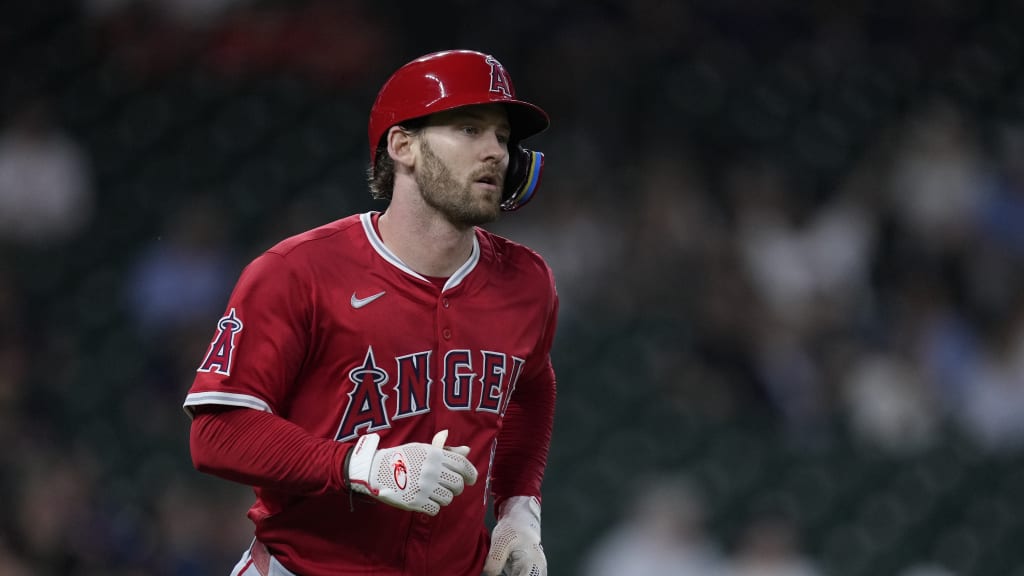
On Tuesday night, the Baltimore Orioles made their first major move of this offseason with a trade. They acquired outfielder Taylor Ward from the Los Angeles Angels, sending Grayson Rodriguez the other way in a one-for-one deal. Here are three takeaways from the surprising trade.
Ward sure does offer a similar profile to Tyler O’Neill
When the Orioles signed Tyler O’Neill last offseason, they added a right-handed hitting corner outfielder who offered good power and discipline with a tendency to strike out a lot and a batting average that wasn’t exactly prime Tony Gwynn.
Now, the Orioles find themselves with a second player who checks those boxes.
In 2024, when O’Neill had enough at-bats to qualify for Baseball Savant’s percentiles, he was in the 65th percentile for chase rate and the 87th percentile for walk rate. In comparison, last year saw Ward in the 92nd percentile for chase rate and the 82nd percentile for walk rate.
Meanwhile, 2024 saw O’Neill in the fifth percentile for whiff rate and the second percentile for strikeout rate. As for Ward, his 2025 whiff rate was actually an above-average figure in the 55th percentile, but that didn’t stop him from having a 16th percentile strikeout rate.
O’Neill and Ward are also similar batters when it comes to their platoon splits. In 2024, O’Neill enjoyed a spectacular 1.179 OPS when facing lefties paired with a significantly worse .693 figure facing righties. Ward’s 2025 splits weren’t as extreme, but were still notable: .918 against lefties and .765 versus righties.
Of course, there is one mighty significant stat where O’Neill and Ward differ: games played.
In both 2024 and 2025, Ward appeared in over 150 games for the Angels, while O’Neill appeared in 113 games in 2024 and just 54 games in 2025.
Perhaps the front office was simply looking for a version of O’Neill they can count on playing a full season.
The outfield is getting a little crowded
As of right now, there isn’t a particularly obvious answer for how the Orioles will balance Ward with the other outfielders.
Prior to this deal, the Opening Day outfield looked like it would be Dylan Beavers and O’Neill in the corners with Colton Cowser playing center.
The Orioles called up Beavers with the hope of him winning Rookie of the Year next year, so it’s hard to picture them doing that and then trading him a few months later. Meanwhile, O’Neill’s
injury history and 16.5 million dollar price tag doesn’t make him seem like a particularly desirable option for anyone to acquire.
Using O’Neill and Beavers in a platoon feels like one of the more plausible outcomes right now, but it’d also require the front office to swallow their pride and admit they made a significant three-year commitment for a bench bat.
Of course, the designated hitter spot also exists, but it currently seems like that will be used for keeping Samuel Basallo and Adley Rutschman both in the lineup.
Ward does offer a wild card that Beavers, Cowser and O’Neill lack: 46 career games as a third baseman.
During Ward’s 2018 rookie campaign, he appeared in 40 games as a third baseman. Ward has only been a third baseman six times since then, but it is a wrinkle that could be relevant to how the Orioles use him. If we really want to have fun speculating, Ward could even get moved back to the infield after the Orioles use Jackson Holliday or Jordan Westburg in a major trade.
Moving on from Rodriguez makes sense, especially for this front office
While I was certainly surprised to see Rodriguez traded, it feels pretty reasonable that the front office was ready to make his health concerns someone else’s problem.
Rodriguez had last appeared for the Orioles on July 31, 2024, meaning it had been one year and two months since his last start. The consensus among the fanbase was that counting on any production from Rodriguez in 2026 would be incredibly risky and it seems the front office felt the same way.
Just about any front office would’ve been skeptical of Rodriguez at this point, but especially a front office that has repeatedly demonstrated it doesn’t think highly of taking pitchers early in the draft.
The Elias front office inherited Rodriguez from Dan Duquette’s 2018 draft, where Rodriguez was selected out of high school with the 11th overall pick. I highly doubt Elias was eager to get rid of Rodriguez from day one, but it does seem pretty reasonable to speculate that they valued Rodriguez lower than other front offices would’ve viewed a top-15 draft pick who became a consensus top-10 prospect.
The idea that the Elias front office isn’t particularly attached to pitching prospects inherited from the previous regime is also backed up by previously trading DL Hall (and Joey Ortiz) for Corbin Burnes.

BSL Analyst
Rose Katz is a recent graduate of the University of Maryland’s journalism school, where she worked for The Diamondback as the online managing editor and a sports blogger. As a student, she spent almost all of her time on campus in The Diamondback’s newsroom or at Xfinity Center, Ludwig Field and Maryland Stadium. Rose gained intern experience with the Mid-Atlantic Sports Network (MASN).