
This time of year is often reserved for taking a look at the Ravens, game by game. Each week’s matchups so key and important for us to analyze. The second half of the seasons games especially, so important as the division takes shape, and playoff scenarios are on the horizon as the have and have nots become more clear. The Ravens, unfortunately, are in the have not group. From an analyst standpoint, the matchups take a back seat to the big picture. Trying to figure out how to become a winning team again.
From a players stand point, coaches standpoint, they will be taking it one game at a time. They should until they are mathematically eliminated from the playoffs. Don’t underestimate John Harbaugh’s knowledge for the history of the game. I’m sure he’s let his players know that 1975 Baltimore Colts rattled off nine straight wins after a 1-4 start (14 game season then) in order to make it to the playoffs. The Ravens face the task of having to rattle off eight to get to 10 wins, and a possible playoff berth.
Players and coaches can take it one game at a time. Analysts have the luxury of being a bit more, realistic. Sometimes realistic comes off as pessimistic. Let the Ravens win four in a row to get to .500, then I’ll start paying attention to the importance of each game as the “P” word becomes more attainable. Today, does it matter to you or I what Jimmy Smith has to do to be successful against Jaguars wide receiver Allen Robinson in their upcoming game? If the Ravens win four winnable games in a row, I’ll get back to that single game, individual matchup importance. Until then, I want to focus on how to make the team better in 2016.
In this article, I’m going to focus on the potential top draft prospects at three key positions.
Discuss your thoughts on this topic on our message board.
Wide Receiver
Fans have been critical of the Ravens brass for not giving Joe Flacco a #1 receiver to throw to. When you put that “#1” title out there, it kind of skews the vison a bit. You see, a receiving group isn’t like a pitching rotation in baseball where you have an ace (#1), then number the other four pitchers according to their spot, #2-#5. In football you have an “X”, a “Z”, and a “slot” receiver. The “Y” receiver is the tight end.
An “X” is your #1 if you want to continue to call it that. It’s a guy that you most often line up one on one. He’s Calvin Johnson, Julio Jones, Dez Bryant. He should be 6’2” or taller and be able to win those physical battles for the ball against the oppositions best defensive back. “X’s” should have the ability to high point the football, so he doesn’t have to be wide open to throw it to him. Larry Fitzgerald is the best high pointer of the ball in the league, and they say “he’s always wide open…four feet above his head.” It certainly helps to have that kind of talent, but only about 10 teams can lay claim to that. The Ravens aren’t one of them, but it’s not like 6’5” guys that catch 100 balls a year just grow on trees.
The “Z” receiver is often lined up to the side of the tight end. They are usually smaller, but physical WRs that don’t mind getting dirty in run blocking. They have to run block more because on the side of the field with the tight end, or the “strong side”, is where runners have a tendency to run more. The “Z” usually creates his own separation on short routes, and has great catch and run ability. He is aided by the coverage rolling to the “X” receiver side, if the “X” is an elite talent. Also aided by running crossing routes with the slot receiver or tight end on their side to try to rub defenders off coverage, or find holes in their zones. The Ravens “Z”, is Steve Smith. He’s not an “X”, despite being the Ravens “#1” before the injury.
The “slot” receiver is similar to the “Z” but doesn’t mind going over the middle. He has to be precise in his routes to beat a nickel cornerback off the line. But also fast and physical enough to beat a bigger linebacker in coverage. He’s often the safety blanket for the QB, so his hands have to be elite. Think Julian Edleman and Wes Welker. The Ravens have a potential guys like this in Michael Campanaro, but he can’t seem to stay healthy for more than a handful of games.
So with Smith at the “Z”, Camp and the “slot”, I would venture to say that Breshad Perriman, 2015 first round draft pick, was selected with the intent of being the missing “X” receiver. Of course you can’t predict injuries. But I’m not going to place the blame on Ozzie Newsome for not trying to surround Joe Flacco with receiving talent. They also took a late round flier in Darren Waller, who at 6’6” would be a “X” if that lottery ticket cashes in. The Ravens also drafted two tight ends, including trading up to get the best one on the board in Maxx Williams. So drafting four new receiving options for Joe Flacco shows me they are trying to find someone reliable for Flacco to throw to, since the cap situation doesn’t allow them to buy elite WR talent on the free agent market.
Now, if Steve Smith commits to his retirement plans, then the Ravens are without a “Z” receiver. That may dictate who they target in the draft. If Smith decides to comeback, and Perriman returns to full health, wide out may become less of a priority through the draft because they have the full complement the need, pending unpredictable injuries. Do you draft for depth with the first round pick? I however don’t think it should change the priority for adding at receiver because Smith will definitely be gone after 2016, and who knows how he responds coming off the Achilles tear anyway. They should approach the draft as if Smith will not be here, or will be a shell of his former shelf. If you get Smith back at a high caliber level, consider it a bonus.
Cornerback
In a pass happy league, you need a shutdown corner to eliminate one section of the field. Often the oppositions “X” receiver. Lardarius Webb was this but hasn’t been himself since an ACL tear in 2012, and has even been relegated to nickel corner at times. Jimmy Smith was this last year until injury ended his season, and he hasn’t been anything close to a shutdown corner in 2015. Signing Kyle Arrington hasn’t worked out. Anthony Levine pops up every preseason but is not a threat to earn playing time outside of special teams. Shareece Wright was signed off the street. Add it all up and you see one reason why the Ravens rank 25th in pass defense.
But before you look at the cornerbacks, you have to figure which skill set is needed from a prospective corner. The Ravens play a lot of “cover-2” zone coverage. The “cover-2” requires bigger cornerbacks who provide run support. Jimmy Smith is one of the bigger CBs around at 6’2”, 206 lbs. Lardarius Webb is a little smaller at 5’10”, 182 lbs. A common theme in “cover-2” is having one CB line up in press coverage against a WR. He will mirror the receiver for the duration on the play. Has to be able to jam the receiver at the line to disrupt the timing, then be able to turn and run quickly with his guy. The other CB will be in zone coverage, playing off the ball. He backpedals on the snap and keeps his eyes toward the backfield. If it is a run, he sprints in in run support. If it’s a pass, he backpedals far enough until he passes off coverage to the safety behind him, and then moves up to defend a receiver that may have entered the area in front of him.
What do the Ravens need? Anyone will do. Webb is getting worse and worse, and was always susceptible to the double move some WRs can put on. Smith Is playing more of the zone role, but not well. Smith needs to be playing up on his man, and being physical. I would target a similar sized corner to Smith, but who can play zone and defend the run. Someone with better instincts and awareness than Smith. Smith is better suited with one job, “cover this man like white on rice”, than he is having to play the guessing game in zone. The big plays against him have been in his backpedal, and he doesn’t anticipate in time having to stick with his man because the eyes are on the backfield. This problem is magnified when Dean Pees puts other corners like Shareece Wright in press-man coverage against a speed demon like Torrey Smith in the 49ers game, and we know that worked out.
Edge rusher
The Ravens are feeling the effects of not having Terrell Suggs around after he tore his Achilles in week 1. Last year, the rushers had the ability between Elvis Dumervil, the now ailing Suggs, and the now departed Pernell McPhee, to generate a decent pass rush without having to all-out blitz to pressure the quarterback. Or, sell out a safety or corner that should be in coverage to blitz, leaving a zone or a man open if the pressure doesn’t get there in time. Without Suggs, Dumervil is still holding his own, but the pressure is coming from sending more guys after the QB. Sending more guys on blitzes leaves your secondary vulnerable. Another reason why the defense is giving up big yards, especially on third down, which are usually blitzing and passing downs.
Suggs faces the same dilemma as Steve Smith, and this is his second Achilles tear. He and Dumervil are not getting any younger. Za’Darius Smith will be entering his second season next year. There are some higher hopes for him as he looks like he has all the tools. Just needs a season like this one to refine his technique, and get into NFL shape for next year. Instead of Combine shape the guys get into just out of college. I feel like Smith will likely blossom into the McPhee type. A stand up, freelance type rusher that lines up anywhere on the defensive front. Always moving, confusing the opposition. If he doesn’t learn by next year to get lower hip angle to beat large tackles on the edge, this should be the move for him. Play to his strengths instead of teaching something he can’t do.
The Ravens run a 3-4 defensive scheme, so the edge rushers are the outside linebackers. In a 3-4, the three down lineman up front have the job of occupying two gaps on the offensive line, so the four linebackers can come in and clean up as assigned. To take up two gaps, you have to be big bodied, like Brandon Williams, Timmy Jernigan, Carl Davis, and Chris Canty are. In a 4-3, the four down lineman occupy one gap, and it is their job to beat their guy and penetrate the backfield. The defensive ends in a 4-3 are slimmer than defensive tackles, but bigger than linebackers. For example, Jared Allen, a 4-3 DE, is 6’6”, 270 lbs. Chris Canty, a 3-4 DE, is 6’7”, 320 lbs. Allen has been an elite talent in his prime, and could maybe switch to 3-4 outside linebacker at that size. Terrell Suggs is 6’3”, 260 lbs. But most guys you are looking for in the draft, are not going to be able to make that switch without asking them to either drop weight, or learn new techniques. It’s not fair to ask prospects, no matter how impressive in college, to do things proven NFL veterans have done.
So we are looking for 3-4 outside linebackers. 4-3 defensive ends won’t likely help unless they are a special, versatile player. The 4-3 DE has one job, to get into the backfield. The 3-4 OLB will sometimes have to cover the flat on swing passes, turn and run with a tight end if they go out for a pass, as well as set the edge on a run, and of course rush the passer. Thats why they need to be a little lighter and fleet afoot.
With that, let’s breakdown the top prospects at these three positions. Consider it a primer, a guide of players to watch more closely when you watch your college games on Saturdays, and your bowl games over the holidays.
Wide receivers to watch
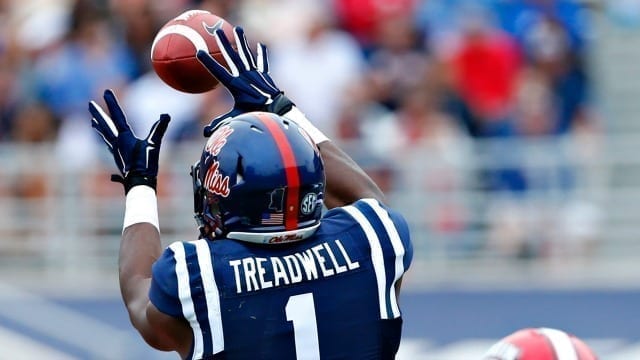
Laquon Treadwell, Ole Miss – Treadwell is the consensus top wideout among many draft guru’s boards. He’s 6’2”, 210 pounds, and CBSsports.com compares him to Dez Bryant. If they are talking about the primadonna aspect of being an elite receiver, they are spot on. Otherwise, I don’t see the hype. Maybe it’s a bad WR class. I haven’t seen mush to suggest he has a large catch radius. He has decent hands, runs a lot of short to intermediate routes. He can make plays after the catch in the open field as he displays a knack for making defenders miss. But he doesn’t do well with contact. I haven’t seen many contested catches. He gets tackled easily when a defender gets his hands on him. Won’t break tackles, or drag defenders for tough extra yards. Keep an eye on his progress the rest of the year, as Treadwell will need to do more to show me he is a top ten pick. Worth mentioning in 2014 he suffered a gruesome leg injury where he fractured a tibia and dislocated an ankle on the same play.
Josh Doctson, TCU – Doctson is a Senior and is on pace to break pretty much all the receiving records at TCU. He put on clinic against Texas this year, and came up big in the clutch against Kansas State where he caught a 4th quarter two-point conversion, then the game winning TD with under two minutes to go. Doctson stands 6’2”, 195 lbs, and runs all the routes in the tree. His hands aren’t elite as I’ve seen him drop some easy ones. But the good outweighs the bad as Doctson is elite at finding the ball on deep routes, high pointing it, and contorting his body around defenders to pluck the ball out of the sky. Doesn’t rely on his body to haul in balls. He lacks burner speed, but makes up for it with technique and instincts, anticipating the oppositions move. Mel Kiper ranks Doctson as his number two WR on his big board.
Michael Thomas, Ohio State – Thomas is the biggest of the top prospects at 6’3”, 210 lbs. Ohio State is a run heavy team using the read option, so Thomas’ looks are limited. But he shows physicality with the ball in his hands. He’ll break tackles with his big frame. He isn’t much of a vertical threat, but excels underneath. Thomas had one his better games in 2014 going up against an NFL first round draft pick in CB, Tray Waynes. Receiving is in Thomas’ DNA as he is the nephew of former number one overall pick, Keyshawn Johnson. CBSsports.com ranks Thomas as their number two receiver in the draft. Experts are sold on his tools playing at the next level, despite just a month ago posting his first career 100+ yard receiving day. It was against Maryland.
Josh Doctson and Michael Thomas, in my opinion, project as an “X” receiver at the next level. Guys that win in coverage, make plays after the catch, go get the ball, plays smart, physical, drawing attention their way. Laquon Treadwell projects as a “Z” receiver to me, where he’ll be better suited lined up on the same side of the field as a slot guy, or tight end. This way they can scheme to get him open, and let him beat guys with his open field skills. He doesn’t run block as good as you would like to see from the “Z” position. But receiving ability outweighs that trait.
Cornerbacks to watch
Jalen Ramsey, Florida State – Ramsey is the most versatile of the top cornerbacks. Ramsey started at free safety in 2014 with NFL draft picks P.J. Williams and Ronald Darby playing corner. He plays corner now, but also lines up as a safety, slot corner, and even a blitzer lining up as an outside linebacker. Similar to how Troy Polamalu used to play. A little less of the element of surprise than what Polamalu would do, often sprinting to the line at the last moment. Ramsey just lines up there and goes for it. As a corner, he excels at playing press-man coverage. He plays in that coverage often, turning and running with his man, and keeps up. But then he’ll switch to zone, and fool the quarterback into thinking he’s still in man coverage. QBs think he’s about to vacate an area, only to break off the coverage, come back and make a play in his zone. Ramsey is a solid tackler as well. Wraps up, head up, and finishes. Not one of these “just put a shoulder in him” guys. He’s the biggest of the top CBs at 6’1”, 202 lbs.
Vernon Hargreaves, Florida – When watching corners, I like to see how they respond against the best receivers. When Florida played Alabama in 2014, Hargreaves was shadowing the top WR in the draft Amari Cooper. This year when they played Ole Miss, Hargreaves actually wasn’t tasked with covering top WR prospect, Laquon Treadwell. Which of those players is that a knock on? I’m not sure it’s that simple, as Hargreaves plays a lot of off-man and off-zone coverage. He gives huge cushions, which is a trait of Dean Pees defense here in Baltimore that has come under a boat load of scrutiny. As I said looking at Treadwell, you don’t want to give him space. The difference is that Haregreaves has elite closing speed. He plays off the line most often, and on those short curl or hitch routes, he closes in the blink of an eye and either makes a tackle right there, or breaks up the pass. Don’t be fooled by Amari Cooper going for 10 catches, 201 yards, and three TDs against Florida that day. Most of that was not when he was lined up with Hargreaves, or when playing zone, he passes coverage off to a safety, and it’s that safety getting beat. Cooper did get his on one occasion against Hargreaves, a jump ball on the endzone fade route. At 5’11”, that’s just plain a mismatch that could be exploited by taller receivers at the next level.
Jalen Ramsey and Vernon Hargreaves are undoubtedly the top two cornerbacks in the upcoming draft. You can watch both men at the same time when the Gators and Seminoles square off on November 28th.
Edge rushers to watch
Joey Bosa, Ohio State – Since debuting as a true freshman three years ago, Bosa has drawn comparisons to the likes of J.J. Watt. His play backs up those comparisons. But size wise, I’m not sure. Size, strength, speed, football IQ, he has it all, which is why Bosa is likely to be selected in the top three picks in the draft. But J.J. Watt is a defensive end in a 3-4 scheme, at 290 pounds. Bosa is 6’6”, 275 pounds. That is too small to play DE in a 3-4. Even Watt at 290 pounds is on the small end for a 3-4 D-lineman, but Watt is the exception to a lot of rules, and it’s really not fair to compare anyone to Watt. You could say Bosa has room to grow at 21 years old, but it’s possible he is at his peak. He isn’t likely to pack on another 25 pounds to play 3-4 DE. If you select him to play 3-4 linebacker, now you are asking a 275 guy to also drop into pass coverage at times. That could be ugly. Do you ask Bosa to shed 15, 20 pounds to play 3-4 OLB? Does he sacrifice strength in doing so? Bosa might be the surest thing, the safest draft pick, in the right system. The Ravens…might not be the right system for him. Let’s just hope the Ravens win some more games, and Bosa is long gone off the draft board before the Ravens have the option to take him.
Jaylon Smith, Notre Dame – Smith is the best all-around linebacker in the draft, expected to go in the pick 10-15 range. We’re talking about edge rushers, but that is just part of the skill set Smith possesses. He lines up at inside linebacker, edge rusher, and has great instincts and anticipation when dropping into pass coverage, covering slot receivers and tight ends. The Fighting Irish team captain is 6’3”, 240 lbs. No doubt he is linebacker in any scheme. Not a tweener like Bosa may be. Smith might need to bulk up to 250-255 pounds to be a more dominant edge setter in run defense. But being able to move him around the field depending on the package is an asset not many teams have. For the Ravens, could he play some more inside linebacker, stepping in for a diminishing veteran in Daryl Smith, or be the ILB in coverage on 3rd downs where C.J. Mosley has struggled mightily? Does he get a year to bulk up and learn from two of the game’s best in Terrell Suggs and Elvis Dumervil, then become a force on the edge when it’s likely one of those guys is gone by 2017? Could he step right in and fill the void that might be left by Courtney Upsahw in his contract year. Upshaw has been a quiet disappointment. Not bad, but not good enough either.
Shilique Calhoun, Michigan State – Calhoun has the most prototypical size to play in the Ravens 3-4 defense as an edge rusher. At 6’5”, 252 pounds, he would be undersized to play DE in a 4-3, making him a better fit to play 3-4 OLB. The senior passed on the opportunity to enter the draft a year ago, and it paid off as he has exploded into one of the best defensive lineman in the Big Ten. His power was on display a couple weeks back when he notched three tackles for loss, and two sacks against Michigan. The game remembered for the botched punt at the end. He plays on a four-man front at Michigan State, but exemplifies some of the traits you want in an edge rusher. Calhoun shows good hip bend to gain leverage, a nasty streak to bull rush blockers, and he is able to contain the run by not getting shoved off his mark. The nasty streak in him makes him over commit at times, but I feel that is a characteristic that can be coached up though.
You can watch Bosa and Calhoun square off on November 21st in Columbus.
Before kickoff in week 9, the Ravens were slated to pick fourth in the 2016 draft. There is a long way to go, and lot more scouting to do before the draft next April. But these guys are expected to be at the top of the boards, at the Ravens positions of need. Get to know these names.

Ravens Analyst
Mike was born on the Eastern Shore, raised in Finksburg, and currently resides in Parkville. In 2009, Mike graduated from the Broadcasting Institute of Maryland. Mike became a Baltimore City Fire Fighter in late 2010. Mike has appeared as a guest on Q1370, and FOX45. Now a Sr. Ravens Analyst for BSL, he can be reached at mike.randall@baltimoresportsandlife.com.