

For those who don’t know, one of my main beats as a writer is making MLB DFS picks. One of the challenges new DFS players face is setting aside their rooting interests to make potentially profitable choices. As you might expect, selecting Orioles every day is a recipe for steep losses. However, most regulars on the Baltimore roster have a use case. It’s just a matter of plucking them in the right circumstances.
DFS platforms tend to give outweighted importance to home runs for hitters and strikeouts for pitchers. Commonly, a home run is worth four or more singles when including both the self-batted run and RBI. On DraftKings, a single is worth 3-points plus any RBI. A home run is worth 10-point and a guaranteed 2-points from a run and 2-points from an RBI. A grand slam adds 6-points for RBIs. On the pitching side, an inning pitched and a strikeout usually have the same value. DraftKings assigns 2.25-points for an inning and 2-points for a strikeout. Thus, maximizing for home runs and strikeouts is often a good place to start.
When to Stack
A stack is a collection of three or more hitters from the same lineup. Stacks are useful for network effects. Here’s a quick example. Trey Mancini hits a first-inning grand slam then Austin Hays tacks on a two-run dinger. The opponent turns to their bullpen early, using their worst pitchers as sacrifices. Maybe position players too! The team keeps hitting and everybody gets more plate appearances. More plate appearances equal more chances to score points. Moreover, if you had Cedric Mullins and Mancini, the run Mullins scored in the first inning was double-counted: a run for Mullins and an RBI for Mancini.
At present, this Orioles lineup is only stackable against bad opponents. In the past, home games against non-elite left-handed starters had some value, especially for Ryan Mountcastle, Anthony Santander, and Mancini. The new park dimensions have me hesitating. Another split to keep an eye upon is the ground ball and fly ball rates of the opposing pitcher. Santander and Mountcastle have consistent power on pitches down in the zone. Mancini and Ramon Urias hit for more power against elevated pitches.
Individual Batters
Let’s look at when to use specific Orioles by themselves. A player’s value is subject to two constraints: his projection for that day and his price tag. There are times when a good player will be a bad value because of price and vice versa. For this section, I’m going to assume accurate pricing which I’ll loosely define as “the platform got it right.” Often, the platform assigns a bonkers price tag – either high or low – which completely changes the calculus. That’s why we write daily articles.
It should go without saying that Mullins is the best DFS performer on the team. Like home runs, stolen bases also receive more points than they should. If Mullins finds himself back on a 30/30 pace, he’ll remain a popular and productive choice. His batted ball distribution is evenly balanced between grounders and flies which means he can be deployed against any right-handed pitcher. DFS players shy away from using left-handed hitters against left-handed pitchers even where they’re still a good value. Using Mullins against a mediocre southpaw can be a profitable approach, especially if you think Mullins will get two or more plate appearances against below average right-handed relievers.
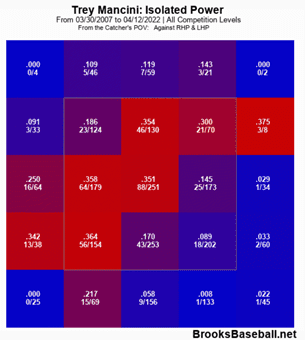
Mancini has two regions he likes – down-and-in or up-and-away. He’s equally effective against both fastballs and offspeed stuff which is unusual. There’s also no need to concern yourself with the handedness of the opposing pitcher. These traits make Mancini a useful plug-and-play guy – just so long as the opponent doesn’t live exclusively down-and-away.
Mountcastle has a few similar traits to Mancini – most notably in that he lacks any evidence of a platoon split. Another thing he lacks is power against pitches located on the outer-third. He generates pop on offerings over the middle or down-and-in.
Santander is a free swinger so I like to reserve him for opposing pitchers who fill the strike zone. This is actually complicated advice because many command-and-control pitchers can work effectively outside the zone while some wild pitchers have a bad habit of throwing cookies right over the plate. Judging when to use Santander often takes some legwork. As mentioned, he’s best against ground ball pitchers. The middle-low portion of the zone is his nitro spot. He’s often overpriced because of his excellent 2020 campaign.
Austin Hays and Ramon Urias are next on the docket. Hays is challenging to leverage because he has what’s referred to as a loose launch angle. The best hitters strike balls within a (relatively) narrow band of launch angles. Those like Hays commonly range from choppers to infield flies and everywhere in between. It renders them less predictable… in a bad way. Urias has this problem too, and it’s aggravated by a near-50 percent ground ball rate. Ground balls cannot be home runs.
The use case for Rougned Odor is very simple. He has a history of getting scalding hot for a few weeks at a time. Wait for it to happen, then see if you can catch and ride the wave. Otherwise, he tends to be laughably terrible. Last up, at least until Adley Rutschman is on the scene, is Jorge Mateo. The former top-prospect-turned-bust-turned-waiver-fodder-turned-Orioles-starter is flashing a change in plate discipline. Historically, such efforts don’t stick. As the grind of the season wears on, the hitter resumes their normal swing decisions. Even so, a brief blip of upgraded discipline can presage other types of breakouts. We can discuss him in more detail in a standalone analysis piece. For DFS purposes, he’s unlikely to muster predictable value. Sure, he’ll have his days when he drops three hits, steals a bag, and maybe even adds a home run. If he’s near-minimum priced, he’s playable – but only if that helps you to roster something special.
Pitchers
Bruce Zimmermann’s excellent 2022 debut notwithstanding, you’ll generally want to avoid Orioles pitchers until the likes of Kyle Braddish and D.L. Hall begin to percolate onto the roster. The exception, obviously, is John Means. He should benefit dramatically from the new left field dimensions. Pulled fly balls by right-handed hitters are his greatest weakness. If more of those stay in the yard, he could replicate the lucky-looking 3.62 ERA he posted last season. You’ll still want to avoid lineups that skew heavily right-handed, especially if they include sluggers with low-to-medium launch angles. Specifically, Means matches terribly against hitters like Aaron Judge, Giancarlo Stanton, and Josh Donaldson. You might see what they have in common.

Brad Johnson is a fantasy baseball analyst for NBC SportsEDGE. He also contributes to “Front Office” content at MLB Trade Rumors. You can additionally find his work and support him directly at Patreon.com/BaseballATeam or follow him on Twitter @BaseballATeam.