

There hasn’t been a ton for Orioles fans to cheer about over the past couple of seasons, but the success of John Means has been one of the delightful bright spots in the organization.
Means’ three years in the Orioles’ rotation have been a bit of a roller coaster. There was his excellent 2019 with a 3.60 ERA and 1.14 WHIP in 27 starts, there was a rough 2020 with a 4.53 ERA over 10 starts, and then a return to form last year with a 3.62 ERA and 1.03 WHIP over 26 starts.
And while last year’s numbers look great, if you dive into them a little bit, there are some suggestions of regression. That 3.60 ERA came with a 4.62 FIP, for example, as well as a 4.10 SIERA and a 4.09 xERA, all of which suggest that his ERA was a bit lower than it should’ve been.
But, that doesn’t necessarily mean regression is a sure thing. So exactly what can we expect to see from John Means this year? Well to do that, let’s take a look at what was and wasn’t working last year.
What worked (and didn’t) for John Means last year
When talking about a pitcher, I think it’s important and very useful to dive deep into their repertoire, so let’s do that.
Means threw four types of pitches last year. His primary pitch was his fastball, here’s a look at it:
The pitch averaged around 93 MPH and maxed out a 95.3. That’s a tick down from 2020, when the pitch averaged about 94 MPH and topped out at 96.5, and a slight bit concerning to me. I’d much rather see Means averaging around 95 MPH on that pitch, but you know what? It worked out pretty well.
Last year, opposing hitters had a .332 wOBA against Means’ fastball. That’s not bad actually, an average wOBA against for a pitch would be around .320ish, so Means’ fastball got hit, but it didn’t get hit a ton.
Where the pitch struggled was in how hard it got it. It was essentially an all-or-nothing pitch, hitters often made weak contact against it, but they also often made pretty hard contact against it, posting a .274 ISO against the pitch last year. If you have an ISO against of .200, that’s really bad. So .274? That’s really really bad.
If you’ve watched Means over the years, you know what his primary swing-and-miss pitch is—it’s his changeup, and last year, the changeup looked quite good.
The pitch posted a 34.9% chase rate (which is very good) and a 17.2% swinging-strike rate (which is also very good). What’s especially impressive to me is that Means located his changeup in the strike zone 62% of the time. For an off-speed or breaking pitch, a 62% zone rate is really high. And what’s impressive is, he still got a lot of swings and misses on the pitch (remember, a 17.2% swinging-strike rate).
So that means that the pitch was good enough that even though it was a “hittable” pitch (i.e. in the strike zone), hitters were still swinging through it. And even if it was thrown outside of the zone, they were chasing it.
It’s a great pitch—the only problem? Command. While opposing hitters had a .294 wOBA against Means’ changeup last year, they also had a .213 ISO. What that says to me is there were one too many times Means was laying that changeup in there as a meatball to get crushed, and that suggests some command problems to me.
Means also has himself a pretty nice curveball:
You might actually be surprised to learn that, from a strikeout rate perspective, Means’ curveball was his best pitch, as it had a 35% strikeout rate last year, the best of his repertoire.
That’s actually a bit surprising to me, because believe it or not, Means’ curveball wasn’t much of a swing-and-miss pitch last year, posting a very below-average 23.1% chase rate and an average 8.9% swinging-strike rate.
That, I think, is due to its location—look at where Means placed his curveball last year:
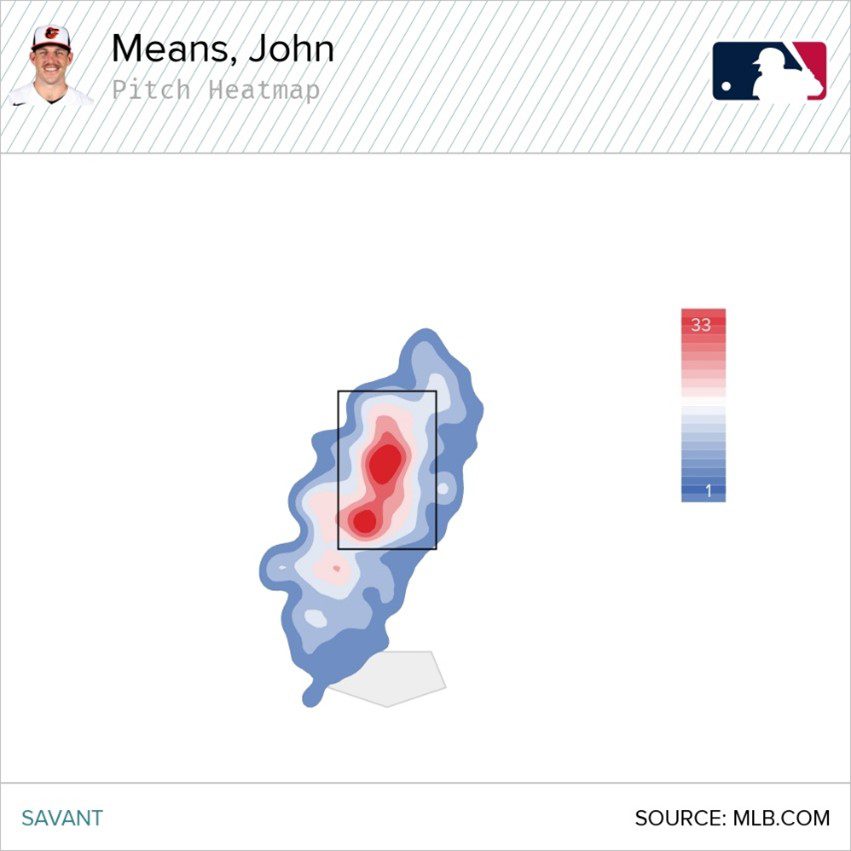
That’s…not ideal.
When you’re throwing a curveball, where do you definitely not want to throw it? Down the middle of the plate. If you want to throw it high, that actually can work out, but down the middle? That’s not great.
He lucked out though, because hitters didn’t make consistent strong contact against his curveball, posting just a .180 wOBA and .076 ISO against the pitch.
And then there’s Means’ slider, which you can see here:
It’s his least-thrown pitch but a decent one from a swing-and-miss perspective, as hitters had a 32.6% chase rate and 16.9% swinging-strike rate, both of which are really solid numbers.
But just like his curveball and his changeup, Means located this pitch in the strike zone a lot for a breaking ball—52.8% of the time (his curveball had a 52.4% zone rate). That’s not necessarily a bad thing, but if you’re getting chases on the pitch pretty consistently (which Means was), I don’t see any reason not to throw it out of the zone a bit.
Means’ slider also was a pretty decent weak contact pitch, posting a .289 wOBA and .058 ISO against (though he only threw it 195 times, so small sample size).
What to expect from John Means in 2022
If you noticed a running theme in this article, it’s my concern with how much Means locates his pitches in the strike zone.
To be clear, I don’t think it’s a bad thing to throw strikes. On the contrary, Means has been excellent at limiting walks his whole career, and I think it’s one of his biggest strengths. But at the same time, he’s not getting all that many strikeouts, never posting a strikeout rate better than 23.9% so far in his career.
And the thing is, I think he’s got a solid approach that can work:
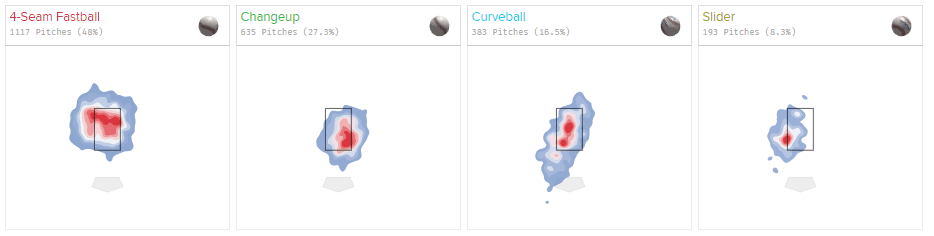
Fastballs high, breakers down is the way to go for a lot of pitchers. It works pretty well. I like that Means is locating his fastballs high in the zone, locating his changeup down and away to righties and utilizing his slider as a backfoot slider. But his curveball, like I said, that’s not great location.
What I would love to see from Means is keeping his fastball up, edging his changeup and slider out of the zone a little bit more while keeping the same location (they’re getting chases out of the zone at a good clip) and more than anything, bringing his curveball down. It doesn’t have to be in the dirt, but down the middle is just a disaster waiting to happen (in fact, what he does in the above curveball GIF is almost exactly what I’d love to see him do more often).
Means has the bare bones of a really solid repertoire. A good fastball, an excellent changeup, and two very workable breaking pitches (that I’d love to see him use more).
He’s also got another thing going for him—over the past three years, look at where home runs given up by Means tend to go:

Left field. And I think you already know what’s happening in left field in Camden Yards—the fence is being moved back. That’s going to help a lot to turn a number of those home runs into fly ball outs (or, bare minimum, doubles instead of home runs).
So what can we expect from Means this year? I’m hopeful he continues to toy with his repertoire and takes a step forward, increasing his strikeouts. But if he keeps pitching the way he did last year, I think we’re due to see a little regression. I’m hopeful the changes to Camden Yards will blunt some of that regression, but I think we could be looking at a guy with an ERA closer to 4.00 than someone in the mid-3s.
That said, Means has shown himself to be a thoughtful pitcher in the past who toys with his repertoire and makes changes, and I guarantee the Orioles analytics department already knows everything I’ve mentioned in this article and infinitely more, so it wouldn’t shock me if Means tries to change things up a bit next year. He’s got the potential to be even better, that’s for sure.

Ben Palmer has lived in Maryland his whole life and currently spends his days working as a health care journalist. He also previously wrote for and was a site expert for the FanSided blog The Baltimore Wire and currently works as managing editor at Pitcher List where he writes about fantasy baseball.