
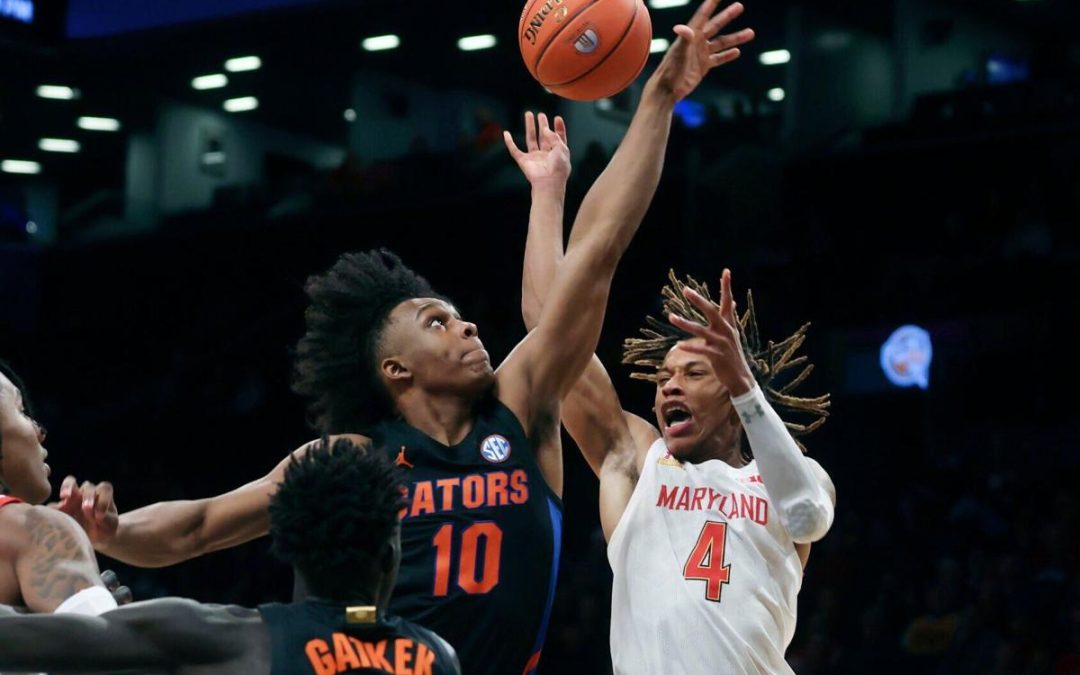
On its fourth try, Maryland men’s basketball was finally able to beat a power conference school.
After home losses to Virginia Tech and Northwestern plus a neutral site defeat against Louisville, the Terps were able to defeat the Florida Gators in Brooklyn on Sunday to get their first victory against someone besides a mid-major.
So, what was different in this game compared to the other three meetings? And what stayed the same, even with a different outcome? Let’s dig in and see what it can mean for the Terps going forward.
Maryland had its best three-point shooting of the season
The Terps arrived in New York knowing it had been a rough season shooting threes. They made under 10 percent of their deep attempts against Virginia Tech and made fewer than 30 percent of their threes against Louisville. The defeat to Northwestern was encouraging, seeing them make 43.5 percent of their threes, but the Terps were still looking for a game where they got hot behind the arc.
And sure enough, the Florida game provided that shooting breakthrough.
Maryland made an impressive 61.5 percent of its threes with an incredibly efficient 8-for-13 day shooting from deep. It was just the sixth time Maryland made at least 60 percent of its threes in the Big Ten era, demonstrating how rare it is to shoot threes that well.

A hot day shooting the ball could also provide confidence boosts for the guard duo of Fatts Russell and Eric Ayala. Russell went 3-for-3 and Ayala went 3-for-5, combining to make 75 percent of their threes. Russell entered the game making 26.1 percent of his threes while Ayala was sitting at 29 percent, so it’s fair to say that both of them definitely needed a good day on their threes.
What makes this three-point shooting performance noteworthy is Maryland wasn’t shooting threes at a noticeably higher or lower rate than the Louisville or Virginia Tech games.
In each of the three games, under 30 percent of Maryland’s field goal attempts were threes. They were more aggressive from deep against Northwestern with 39 percent of their field goal attempts being threes, but it still seems like the blueprint against their toughest teams has been focusing on inside shooting.
Given that they currently rank 252nd out of 358 Division 1 teams for three-point percentage this year, it seems like a strategy that should continue regardless of if they have hot games like Florida or cold games like Virginia Tech.
Maryland had its highest turnover rate of the season
23.5 percent of Maryland’s possessions against the Gators ended with a turnover, the highest percentage they had in a game this year. Fatts Russell was the leading culprit, committing five of Maryland’s 15 turnovers to go along with two assists in a game where he had more success as a scorer than a playmaker.
The turnovers meant that Maryland almost wasted a game where it had an excellent day shooting threes, which would’ve been another frustrating outcome in a season that already seems filled with them.
Maryland had an almost identical 23.3 percent turnover rate against Virginia Tech, which was their season-high for turnover rate entering the Florida game. The average turnover rate across college basketball is currently 19.1 percent, which meant that both Virginia Tech and Florida were games where they were more reckless with the ball than the national average.
The Terps don’t seem like a team that will be enjoying many comfortable wins so there will be plenty of games where every possession will truly matter. As such, trying to have games where the turnover rate is better than the national average would be an important goal going forward.
Qudus Wahab was barely involved on offense
Against Louisville, Virginia Tech and Northwestern, Qudus Wahab averaged 7.3 field goal attempts, 4.7 free throw attempts and 10.7 points. Against the Gators, he had one field goal attempt and two free throw attempts as he finished the game with exactly one point.

What’s especially notable is his lack of offensive involvement did not come from a sudden dip in playing time. He averaged 25.3 minutes in his prior three power conference games and then played 24 minutes against the Gators. He grabbed eight rebounds and blocked a shot so he was hardly anonymous, but his offensive box score was very empty.
Including his two seasons at Georgetown, Wahab has played at least 24 minutes in 29 games and this was the first time and he didn’t have at least five field goal attempts, further demonstrating that Sunday’s game in Brooklyn was an outlier for Wahab’s career.
Of course, Maryland didn’t totally ignore its big men, with Julian Reese attempting five field goals and scoring six points in 19 minutes. In Maryland’s ten games, Sunday was just the third time that Reese had more field goal attempts than Wahab.

It’s possible that the biggest change of the Danny Manning era will be which big man takes more shots going forward, or it could also be just a weird outlier for Wahab’s role on offense. Either way, a starting center with just one field goal attempt in 24 minutes felt especially noteworthy when looking back at this win.

BSL Analyst
Rose Katz is a recent graduate of the University of Maryland’s journalism school, where she worked for The Diamondback as the online managing editor and a sports blogger. As a student, she spent almost all of her time on campus in The Diamondback’s newsroom or at Xfinity Center, Ludwig Field and Maryland Stadium. Rose gained intern experience with the Mid-Atlantic Sports Network (MASN).