
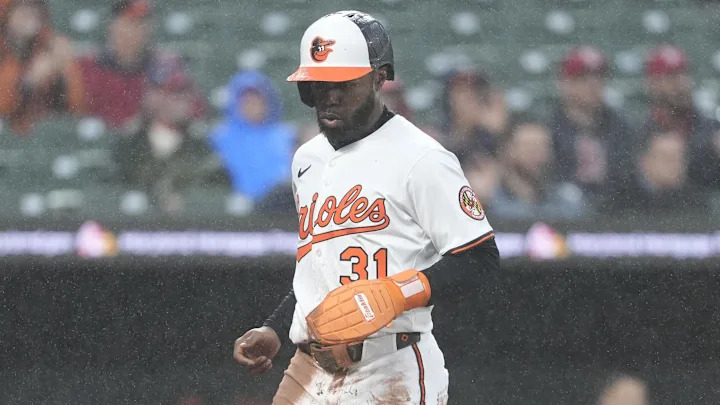
At the start of the 2025 season, when the Baltimore Orioles’ offense was sputtering, Cedric Mullins looked like a beacon of consistency and power. Through March and April, he slashed an impressive .278/.412/.515, tallying six home runs, 17 runs scored, 20 RBI, and five stolen bases.
But since then, the story has changed dramatically. Since May 1, Mullins has slashed a dismal .171/.206/.357 with six home runs, 14 runs, 15 RBI, and three stolen bases.
So what’s going on? Is this just a cold streak fueled by bad luck, or is there a deeper issue at play?
The truth, as is often the case in baseball, lies somewhere in the middle. Mullins’ struggles are partly the result of poor luck, but they also reflect a troubling change in his approach.
Let’s start with the latter. Mullins’ walk rate has cratered from an excellent16.8% in March and April to just 4.4% since May 1. At the same time, his strikeout rate has jumped from 21% to 29.2%. That’s a massive swing in plate discipline, and it’s backed up by the underlying metrics.
His chase rate—the percentage of pitches outside the strike zone that he swings at—has jumped from 22.3% to 31.4%. His swinging-strike rate has also seen an increase from 8.9% to 10.9%. These are clear signs that Mullins is pressing at the plate, expanding the zone, and failing to make consistent contact.
But not all of Mullins’ woes at the plate can be chalked up to poor decision-making—there’s been some pretty bad luck too.
His hard-hit rate, as measured by Statcast, has dipped slightly from 40.3% in March and April to 34.1% since May 1—a decline for sure, but not one that fully explains his drop in production. His groundball rate has only ticked up marginally, from 25.4% to 27.6%, which suggests he’s not rolling over pitches at an alarming rate.
Instead, Mullins is hitting more fly balls—and they’re not leaving the yard. His fly ball rate has increased while his home run-to-fly ball (HR/FB) rate has dropped, meaning more of the fly balls he’s hitting are dying in the outfield.
But where things get really wonky is his infield fly ball rate. In March and April, it sat at a manageable 7.9%, right around league average. But since May 1, it has skyrocketed to 22%, an unsustainable number and one that will almost certainly regress back to the mean.
Then there’s his BABIP. Mullins posted a .318 BABIP in the first two months of the season, which is right around league average, but since May 1, that number has plummeted to .190. That kind of drop is almost always a sign of bad luck, especially when not accompanied by a dramatic change in batted-ball profile.
So yes, Cedric Mullins has been in a deep slump, it’s been painful to watch, but there’s reason for optimism.
Even if he doesn’t fully correct his plate discipline issues, Mullins is unlikely to continue hitting this poorly. His BABIP and infield fly ball rate should regress toward the mean, and that should help lift his numbers back to a more respectable level.
The key, though, will be whether Mullins can pair that with a return to the patient, disciplined approach he showed early in the season. If he can stop chasing pitches out of the zone and start drawing walks again, he could recapture some of the magic from the beginning of the season.

Ben Palmer has lived in Maryland his whole life and currently spends his days working as a health care journalist. He also previously wrote for and was a site expert for the FanSided blog The Baltimore Wire and currently works as managing editor at Pitcher List where he writes about fantasy baseball.