
Recently, I took a look at what did and didn’t work for John Means in 2021 and what can be expected of him in 2022, which led me to think, “why not take a look at the whole rotation?”
As of now, Jordan Lyles, whom the Orioles signed this past offseason, is projected to be in the rotation (and given the state of the Orioles’ pitching staff, why not?) so let’s take a look at who Lyles is as a pitcher and what we can expect from him this season.
What worked (and what didn’t) for Jordan Lyles in 2021
I think it’s important to sort of set expectations for who Jordan Lyles is as a pitcher.
Lyles started off his career in Houston as a starter and never posted an ERA below 5.00 nor a strikeout rate above 16.1%. Then, moving to Colorado, Lyles had two seasons (2014 and 2015) in which he was a starter, posting ERAs of 4.33 and 5.14, respectively, but an MCL injury in 2015 shortened his season to just 10 starts.
After that, Lyles has mainly been used as a reliever (and spot starter) and has bounced around teams ever since. In 2017, he continued with the Rockies, posting a really bad 5.83 ERA in 40 games. Since then, he’s bounced from the Padres to the Brewers to the Pirates then back to the Brewers, and finally landing with the Rangers in 2020 and 2021.
In that time, Lyles has…not been great. In 2017, through 69.2 innings, Lyles posted a godawful 7.75 ERA and in 2020, through 57.2 innings (nine starts), he posted a similarly terrible 7.02 ERA.
As a matter of fact, for his entire career, Lyles has never posted an ERA better than 4.11 nor has he posted a strikeout rate better than 24.4%.
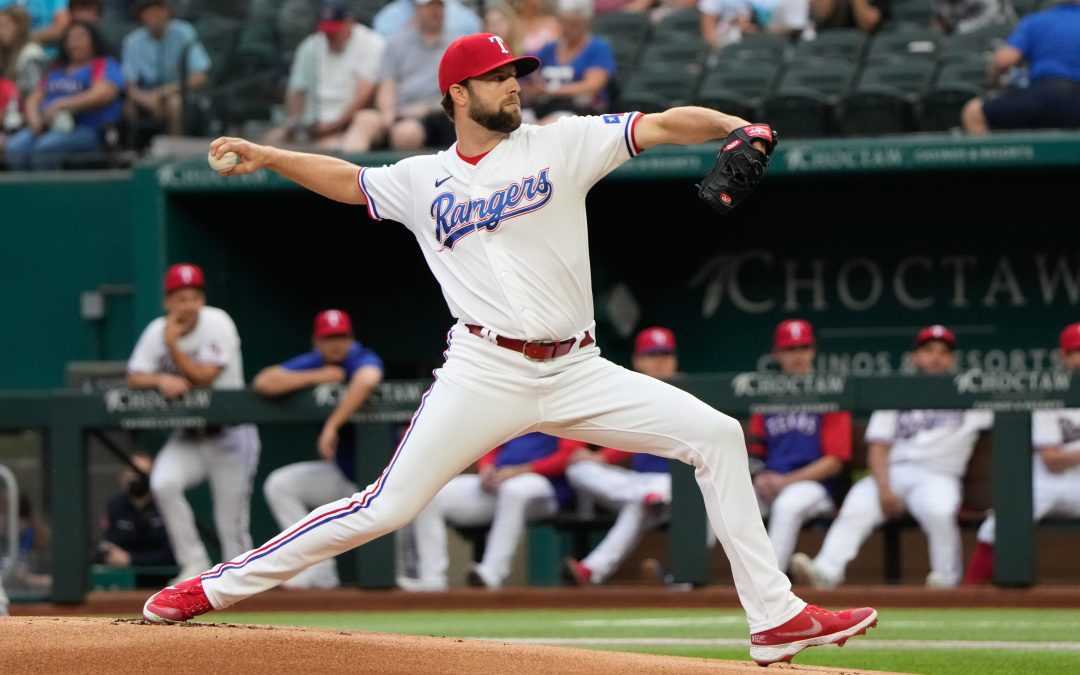
The Rangers put Lyles back in the rotation last year, and through 30 games he pitched to a 5.15 ERA with a 5.34 FIP and 4.70 SIERA, alongside a 1.39 WHIP and 19% strikeout rate. Basically, bad all around.
So is there…anything good about Jordan Lyles as a pitcher?
The answer is actually yes, despite what his career numbers might tell you. His best pitch is this slider:
Lyles sort of switched out his curveball for his slider as his primary breaking pitch and it actually worked pretty well last year, posting a solid 32% chase rate and an equally-solid 14.7% swinging-strike rate. And even if hitters did make contact with it, they generally didn’t make great contact, posting a .299 wOBA against the pitch (though a less-than-stellar .190 ISO against it).
There was one other bright spot—Lyles’ changeup.
Last year, the pitch posted a respectable 10.4% swinging-strike rate and was a good weak-contact pitch, posting a .276 wOBA against and an average .163 ISO against. It was his least-thrown pitch, however, so it’s hard to say what it would’ve looked like had he thrown it more.
But as far as positives go for Jordan Lyles, that’s about it. Lyles’ worst pitch was also, unfortunately, his most-thrown pitch last year—his fastball.
The pitch averaged around 93 MPH and got tattooed, to the tune of a .406 wOBA and .303 ISO against. For context, as I mentioned in Means’ article, if your ISO against is .200, that’s pretty bad. So you can imagine just how awful .303 is.
On the whole, hitters had a .291/.378/.594 line against Lyles’ fastball, and it’s no wonder—take a look at where he located the pitch:

If you throw a mediocre fastball down the heart of the plate all the time, guess what’s going to happen? Bad things, that’s what. And that’s exactly what happened to Lyles.
Then, there was Lyles’ curveball:
As far as a swing-and-miss pitch goes, it was pretty mediocre, posting a 29.3% chase rate and 9.8% swinging-strike rate. Both of those numbers aren’t bad, but they’re also not particularly good, and that’s not what you want from your curveball.
And when hitters made contact? They had a .360 wOBA and .184 ISO against the pitch. So in short, the pitch wasn’t really getting that many chases or swings and misses, and when hitters made contact, they were hitting it hard. Though, for what it’s worth, the xwOBA against the pitch was a more palatable .326, so there’s hope it could be better.
Lyles also threw a sinker:
And the results were similarly not great, but actually better than his fastball. While hitters had a .355 wOBA against the pitch, which is definitely worse than average, they also had just a .127 ISO against it. What that means is, essentially, the pitch was very hittable, but hitters weren’t launching it for extra base hits and home runs.
What to expect from Jordan Lyles in 2022
I’ve not painted exactly a rosy picture of Jordan Lyles, and believe me, I wish I could. But unfortunately, Lyles has been at his very best, an extremely mediocre starting pitcher in the major leagues his whole career, and at his worst, he’s been truly awful.
I do wonder what might happen if he starting utilizing his sinker more than his awful fastball. While the sinker got knocked around, it had better numbers than the fastball and, more importantly, it wasn’t getting launched for extra base hits.
If his sinker continued doing that and it became his primary pitch, that would at least limit the damage. Lyles has a pretty decent strikeout pitch in his slider, and I’m encouraged that he was utilizing it more last year than he has in the past. If his curveball could improve, he could have a decent little combo with the sinker and slider alongside it.
There’s also his changeup—I’m curious what might happen if Lyles started utilizing it more. It’s possible it could maintain its decent weak contact numbers and become a solid secondary pitch, but it’s also very possible that, in throwing it more, it starts getting hit more.
All in all, Jordan Lyles is 31 years old, he’s been in the league for 11 years, I don’t think much is changing with him. He toyed with his pitch mix a bit last year, and that’s certainly encouraging that he’s not just rolling out there throwing the same thing over and over again, but I can’t exactly assume he’s suddenly going to be good for the Orioles this year.
Last year, Lyles posted a 5.15 ERA with a 1.39 WHIP and a 19% strikeout rate. All in all, pretty bad numbers, and that’s basically what I’d expect from him for the Orioles this year. An ERA in the 5.00 range with low strikeout numbers and a below-average WHIP.
I know, that’s discouraging to hear considering we just signed the guy. It would be awesome if he was someone to be excited about, but honestly, Lyles feels like a placeholder. A warm body to pitch for the Orioles while their other pitching prospects gain more experience in the minors.
Lyles is only on a one-year deal, and I’d expect this year to be much like the others—a mediocre one that ends with him moving on to another team next year. But believe me when I say, I would desperately love to be proven wrong.

Ben Palmer has lived in Maryland his whole life and currently spends his days working as a health care journalist. He also previously wrote for and was a site expert for the FanSided blog The Baltimore Wire and currently works as managing editor at Pitcher List where he writes about fantasy baseball.