

Yes, I know he has only pitched 9 innings so the sample size here is small, but hey, those 9 innings were pretty impressive. I’m going to hope I don’t jynx Zimmermann’s next start by writing an article about this, but here we go.
In Zimmermann’s early-season scoreless inning ‘streak’ (I would consider this a streak for an Orioles pitcher), his changeup has jumped out as his most impressive pitch. In an article I wrote a couple months ago, I mentioned that with some development, Zimmernann’s changeup could develop into a John Means-esque out pitch. While it’s certainly way too early to try and substantiate that claim, it has at least started off on the right track.
Let’s do some digging with Statcast.
Back in 2021, Zimmermann relied on a standard 4 pitch mix of 4-seam fastball, changeup, slider, and curveball. The breakdown of his usage of these pitches is as follows:
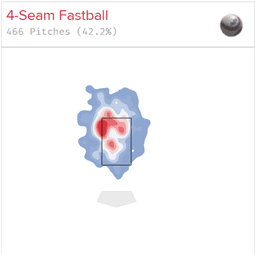
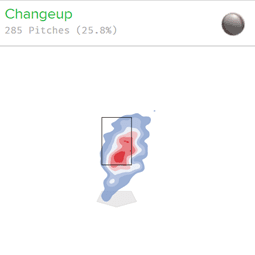
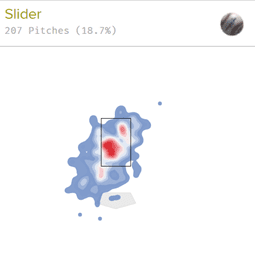
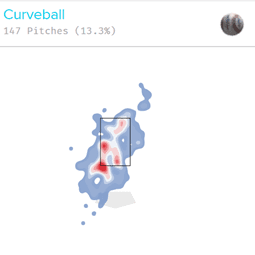
When looking at his pitch usage rate to start this season, one key number jumps out; the usage rate of the changeup has jumped by about 10%. To go along with this, Zimmermann’s Put Away% (the rate of two-strike pitches that result in a strikeout) on his changeup is 43.8%, more than double his 21.2% rate for the same pitch last season. Similarly, the Hard Hit% (exit velocity above 95mph off the bat) of this pitch is down from 43.8% in 2021 to 22.2% in 2022. In short, Zimmermann has had much more success with his changeup to start this season than he had last season.
So the question now becomes what, if anything, is different about Zimmermann’s changeup in comparison to last season besides the fact that he’s just throwing it more? For starters, it’s being tracked at about 1MPH slower than last year and has a higher spin rate (2060 in ‘22 vs 1979 in ‘21). Well, if it’s being thrown slower and is spinning faster it should have more movement. When looking at the vertical movement of his Zimmermann’s changeup compared to the MLB average, it looks like it’s right around average when it comes to vertical break, but is breaking much more than it did in 2020 or 2021.
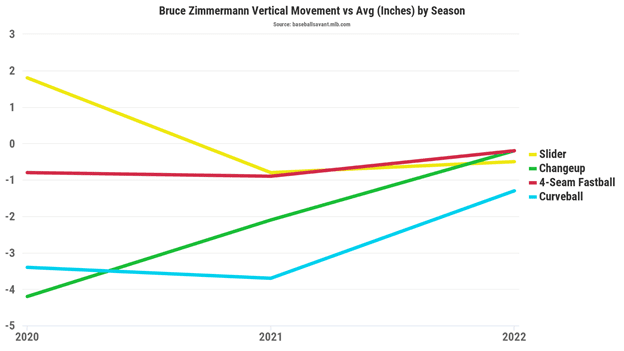
The increased vertical movement is potentially noteworthy, but something even more intriguing to me is the pairing with its horizontal movement.

Zimmermann’s changeup breaks 18.5 inches horizontally; 4.6 inches above the MLB average. In this metric, the movement of a pitch is compared to ‘average’ movement by comparing it to other MLB pitch types within +/- 2MPH and from within +/- 0.5 feet of extension and release (as per baseballsavant.com). This means that in comparison to ‘similar’ pitches, Zimmermann’s changeup is moving horizontally significantly more. The horizontal movement of this pitch is also just shy of 2 inches more than it was in 2021, which is a pretty drastic change.
We can even see some differences from 2021 to 2022 in the axis the ball is spinning on. The left side shows the observed movement by pitch type for ‘21 while the right side shows ‘22.
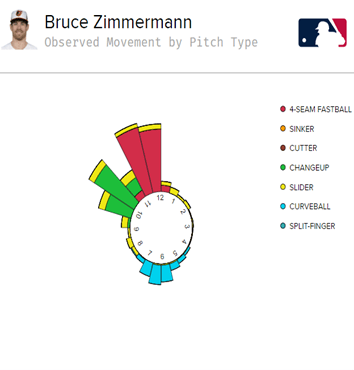

If we focus on just the green bars in these images, which show the spin axes of Zimmermann’s changeup, while not massively different, we see an increase in spin particularly in the green bar just above the ‘9’. This goes right along with what we have seen so far with the increase in horizontal movement of this pitch, i.e., it is spinning more right/left than it is up/down. Maybe this movement direction is something that batters are having just a touch more difficulty adjusting to in comparison to the more traditional changeup movement. This movement direction could prove particularly difficult for right-handed batters to figure out. Coming from a lefty like Zimmermann, the low and away changeup that fades out of the strike zone horizontally can certainly be a viable out-pitch against right-handed batters.
Like I said in the beginning of this article, I understand this breaks all the sample size rules we learned about in statistics, but I think this data is still notable and is something that could be a potential predictor for the future success of this pitch. As we know, the long-term success of a changeup (and really all off-speed pitches for that matter) is mostly based on a pitcher’s ability to locate the fastball, so we could certainly see a performance dip if Zimmermann begins to struggle with his fastball command. As the season goes on, it should be interesting to see if his changeup begins to revert to the Statcast metrics we have seen for this pitch in the past, or if there is truly a material difference here.

As a Baltimore native, Zach is an avid Orioles and Ravens fan. After interning for the Baltimore Orioles, he currently works as a Senior Quantitative Risk Analyst for OneMain Financial and is a part-time graduate student studying Data Science at the University of Michigan.