

Following the Orioles’ not entirely unexpected willingness to let Brian Roberts walk all the way to New York, many fans may be left wondering what to make of the team’s current crop of second basemen. The 40-man roster, as currently constructed, includes possible starters Jemile Weeks, Jonathan Schoop, Michael Almanzar, who is listed as 3B, and Ryan Flaherty. With Schoop still potentially a year away from a full-time Major League gig, Flaherty is the team’s best choice for a full-time second baseman to start 2014. What can fans expect from Ryan Flaherty in the upcoming season?
Discuss this article on the BSL Forums here.

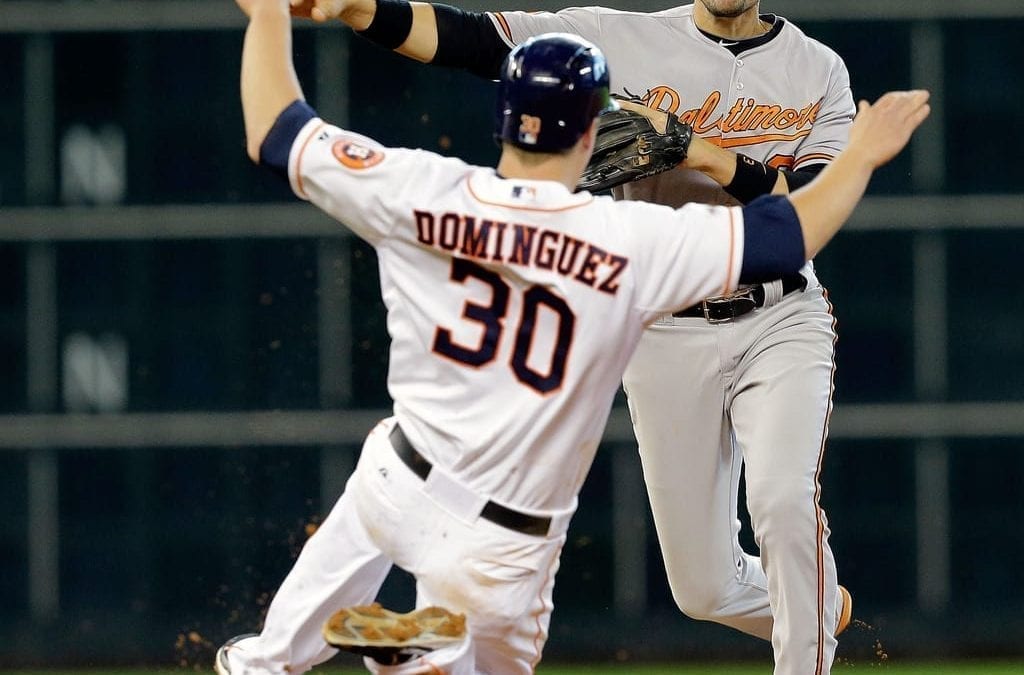
Ryan Flaherty leaps Ian Desmond to turn two.
2013 was Ryan Flaherty’s best year as a professional baseball player, which is more impressive than it sounds. Flaherty, a former Rule 5 draft pick, has only been on a Major League roster for two complete seasons (save for 12 games in the Orioles’ minor league system in 2013), despite already being 27. Across 2012 and 2013, Flaherty has appeared in a total of 162 games, or one full season of baseball. At the Major League level, Flaherty has hit .221/.279/.378, and those figures were weighted positively by an improving performance in 2013. Flaherty’s wOBA in 2013 was .299, which FanGraphs estimates to be poor. While Flaherty has struggled some on offense at the Major League level, his defense has improved. His 2013 campaign saw marked improvements in RngR, UZR, and DPR, and Flaherty was worth 3 defensive runs saved at 2B in 85 games. Flaherty was worth 1.5 fWAR and 1.0 bWAR in 2013. Baseball-Reference breaks WAR into offensive and defensive components, and shows Flaherty as being worth 0.6 oWAR and dWAR each.
There is plenty of reason to believe that Flaherty will improve on his 2013 performance in the upcoming season. If you’re a believer in the 10,000 hours theory, originally proposed by Anders Ericsson and further spread by Malcolm Gladwell in his Outliers, Flaherty may not have accrued the total good practice hours needed to excel in his field. According to the theory, it requires an innate ability and an average of 10,000 hours of thoughtful, dedicated practice with worthwhile feedback to become an expert in a subject. In that case, Flaherty’s background comes into play.
Ryan Flaherty is from Portland, Maine, where only 5 months out of the year have an average high temperature over 60ºF. Where a young athlete from Texas, California, or Florida might have the opportunity to play an outdoor sport like baseball 10 or 12 months out of the year, Ryan Flaherty may have been able to stretch 8 months of good instructional time to work on footwork, holes in his swing, and positioning. If two future Major Leaguers of identical skill from Los Angeles and Portland, ME begin playing organized sports at age six, by the time they’re each 18, the player from warm California will have approximately 24 more months of practice than the player from chilly Maine. I cut it off at 18 because each player would get the same amount of instruction at college and in the minors. Developmentally, the player from the warm-weather climate would be two years ahead of the player from the cold hometown. Even if Flaherty has already reached his 10,000 hours through long professional workdays, he would still be able to make up only so much ground on his counterpart by virtue of missing valuable practice time before college. Under this hypothetical scenario, Flaherty would hit his baseball peak a year or two after the typical player with more practice time: closer to 28 or 29 than 26 or 27.
Of course, you might argue that practice before college and the minor leagues is mediocre instruction at best, and Flaherty isn’t as far behind developmentally as I suggest, but you don’t need to buy into the 10,000 hours theory to have high hopes for Ryan Flaherty. Oliver projects Flaherty to be worth 2.2 WAR in 2014, driven mostly by his defensive ability. Keep in mind that Flaherty came to the Orioles with only a smattering of experience at second base. The Cubs moved Flaherty around the infield, giving him time at short, second, and third. In 2013, the Orioles primarily slotted Flaherty at second, allowing him to settle into a position and learn how to play it well. In return, Flaherty improved on his range factor per game. If given the full-time job at second, Flaherty wouldn’t need to dedicate practice time and mental preparation to third, first, or the outfield, and his defense may improve a little more.

Flaherty swings through a double against the Blue Jays
Ryan Flaherty continues to improve at the plate as well. Flaherty walked 7% of the time in 2013, up from a 3.6% BB% in 2012. That still doesn’t reach the average 10% BB% he posted in AA for the Cubs’ minor league teams, but some drop in walk rate is expected as a player moves up the food chain. More importantly, Flaherty has drastically cut down on his swings outside the strike zone. Per PITCHf/x, the Orioles’ second baseman swung at just 29.2% of pitches outside the zone in 2013, compared to a horrendous 37.4% in 2012. A 29.2% O-Swing% puts Flaherty right in line with league average. To go along with that, Flaherty decreased his O-Contact% From 62.7% to 53.4%, both figures well below the 68% mark considered average. While it’s strange to say, if Flaherty can continue to not make contact with balls outside the zone, he can save himself from hitting weak grounders.
Flaherty’s major league career has also been marked by a below-average BABIP. I’m going to go out on a limb and say that his BABIP can be attributed to a below-average LD%, particularly in 2012, when just 11% of the balls Flaherty put into play were line drives. Flaherty may not be the fastest guy on the team, but he’s not incredibly slow, either. After seeing his LD% jumping to 17% in 2013, still below league average but significantly better than in 2012, we may see Flaherty again improve on the quality of contact he makes at the plate. Just a league-average LD% would boost his BABIP a significant amount.
Flaherty’s spray chart indicates that he’s a significant pull hitter with ground ball tendencies. Indeed, Flaherty put up a 1.37 GB/FB ratio in 2013. Interestingly, his fly balls are pretty well scattered around the field when batting against righties. Getting better at going the opposite way and putting up something close to a league-average LD% would go a long way toward Flaherty’s bat being worth something positive offensively.

Ryan Flaherty spray chart vs. RH via Fangraphs
He only had 23 at-bats against lefties in 2013, so the spray chart is pretty barren and his splits are from too small a sample size to mean much. In fact, Flaherty has only 35 at-bats against lefties in his Major League career.
Flaherty won’t be a game changer, but he fits in well with the team the Orioles have constructed: a boom-or-bust offense with solid defense. His pop at second (or as a utility player) also frees the Orioles up to chase higher OBP players if they elect to trade Wieters or Hardy. Anecdotally, as a fan uninformed with actual baseball talent, Flaherty has seemed to do a better job at the plate when given an extended opportunity. That is, he’s not a great pinch hitter or Sunday substitution, but he seems to do well when given time to settle in.

Ryan Flaherty homers off of Hiroki Kuroda in the 2012 ALDS
I’m a little more bullish on Ryan Flaherty in 2014 than Oliver, as I’m projecting him to make a bigger jump than the algorithm. Oliver is putting Flaherty down for 20 homers in 2014, which is exactly the number I’ve been predicting. I like Flaherty to be worth 2.5 fWAR next season on the strength of an improved LD% and an average around .250. Also unlike Oliver, I think 2014 will be Flaherty’s second best of his career as a starter. If Flaherty gets full-time reps in 2015, I think he could push 3.0 fWAR in that year, as his baseball development catches up to his physical development and he manages to work up to league average in a number of rate statistics. If Schoop continues to improve at the rate he’s going and stays healthy, we may never see Flaherty at his very best. 2014, and the Summer of Flaherty, is upon us.

Patrick was the co-founder of Observational Studies, a blog which focused on the analysis and economics of professional sports. The native of Carroll County graduated with a Bachelor’s degree in Economics from Loyola University Maryland. Patrick works at a regional economic development and marketing firm in Baltimore, and in his free time plays lacrosse.