
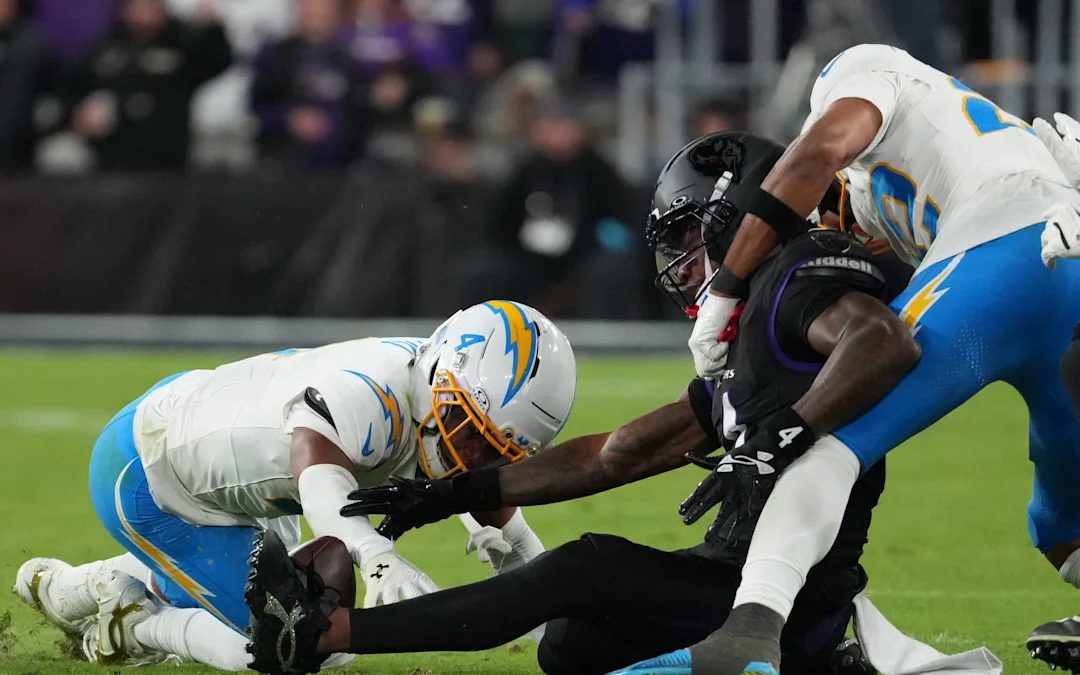
The Chargers beat the Ravens 23-20 on Monday night for their first win of the season. The Ravens are 4-6, have lost five straight, and have lost seven of their last eight home games, per the AP. Jacoby Brissett threw for 340 yards in his first start. The Ravens ran 15 times for 16 yards, and the Chargers ran for 160.
Down three with 2:11 left, Zay Flowers caught a 15-yard pass at the Chargers’ 46, and Tarheeb Still forced a fumble that Elijah Molden recovered. Two plays later, Justin Herbert hit former Raven Charlie Kolar for 11 yards on second-and-9, and the Chargers ran the clock down to 18 seconds before punting.
| 1 | 2 | 3 | 4 | Final | |
|---|---|---|---|---|---|
| Chargers | 10 | 7 | 3 | 3 | 23 |
| Ravens | 0 | 10 | 3 | 7 | 20 |
Carolina is next, Sunday at 1 p.m. at Bank of America Stadium, per Ravens.com. The Panthers are 4-5 and lead the NFC South.
The Chargers Game
At 4-6, the game itself matters less each week. What it showed about the players who’ll be here in 2027 matters more. So this review is short.
How it went. The Ravens opened with three straight three-and-outs, and Herbert’s 22-yard touchdown run on third-and-6 put the Chargers ahead for good. Brissett’s interception at the Chargers’ 43 led to a 13-play touchdown drive that converted twice on fourth down, the second Hampton’s 1-yard run on fourth-and-goal. It was 17-10 at halftime. The Ravens outscored the Chargers 10-6 after it, on two Patterson field goals and Henry’s 1-yard touchdown with 10:23 left, after being outscored by 70 points in second halves through their first seven games. Down three with 4:11 left, they punted on fourth-and-9 from their own 42. The defense forced a three-and-out, and Flowers fumbled on the next possession.
The run game. The Ravens had no rushing yards in the first half and 16 for the game, the third-fewest in team history, per CBS Sports. Henry ran 10 times for 10 yards and two touchdowns, which tied him with LaDainian Tomlinson for the most seasons with 10 or more rushing touchdowns, nine. The Chargers ran for 160, 105 of them by Hampton on 22 carries by our count, and Herbert ran seven times for 51, per the AP. Going in, the Chargers’ defensive line was fourth in run stop win rate in our Week 9 review, and the Ravens were 5.5-point favorites even though ESPN’s Match-Up Predictor gave the Chargers 55.1%.
Brissett. He completed 33 of 49 passes for a season-high 340 yards with an interception and no touchdowns, per Ravens.com. He was sacked twice. The play-by-play marks 10 of his throws as deep, and he completed five of them for 109 yards. Andrews caught all eight passes thrown his way for 82 yards. Lane drew a season-high 11 targets and caught three for 61, and his third-quarter drop would have set up first-and-goal, per Jeff Zrebiec of The Athletic.
The defense. Herbert completed 12 of 18 for 129 yards. It was his first game this season without an interception, and he was sacked only twice, both times by Mike Green. The AP noted that Ravens defenders routinely failed to bring him down when they got pressure. The Chargers converted 2 of 13 third downs by our count but both of their fourth downs. The Ravens forced no turnovers; Humphrey forced a fumble on Hampton’s direct snap, and Hampton recovered it. The Chargers had not scored a first-half touchdown since Week 3, as Bobby Kownack of NFL.com noted, and they scored two.
Everything else. Patterson made field goals from 26 and 36 yards. By our count, the Ravens had six accepted penalties for 45 yards and one false start, and Zion Young’s offside and Green’s roughing the passer both helped Chargers scoring drives. The Ravens lost Vega Ioane (shoulder) and Nnamdi Madubuike (hamstring), per the AP. Chuma Edoga, signed that day, played 33 snaps in Ioane’s place. Hamilton returned to the game in the fourth quarter.
Inactives. Ravens: WR Elijah Sarratt, FS Jaylinn Hawkins, CB Chandler Rivers, G Emery Jones Jr., DT Aeneas Peebles, QB Kedon Slovis (third quarterback). Chargers: OLB Bud Dupree, DL Justin Eboigbe, WR Ladd McConkey, WR Brenen Thompson, CB Isas Waxter, S Kendall Williamson.
Against The Reset
In Resetting The Ravens At 4-5, we set out what the last eight games should show. Here’s the first of them against those markers.
- The bar for Brissett. We said the bar wasn’t 5-3. It was an offense that can throw past 10 yards again, so we could finally evaluate Doyle’s scheme with a functioning quarterback. He cleared it: 340 yards, and five completions on throws the play-by-play marks as deep. Zrebiec wrote that Brissett wasn’t afraid to throw downfield. What the offense couldn’t do was run.
- Fold or fight. The Ravens outscored the Chargers 10-6 after halftime, after being outscored by 70 points in second halves through seven games. But they lost a fifth straight game, to an 0-8 team.
- False starts. One, after a league-high 24 through nine games.
- Hamilton deeper. It happened. Hamilton played a season-high 27 snaps at free safety and 19 in the box, per PFF via Ravens.com. It’s only the second game this season, after Week 5 in Atlanta, in which he played more snaps deep than near the line.
- Lineup changes. Hamilton’s alignment was the real one. Chris Korman of The Banner wrote that the changes Minter touted didn’t come, at least none of substance. Hamilton’s snaps say there was at least one. Otherwise, Vinson’s nine snaps as an extra lineman and Edoga’s 33 after Ioane’s injury were the visible changes.
- Andrews. Last week we said Andrews looked done and tough to watch. Last night he played his best game of the season. It was noted that he had been playing with a broken left hand and this was the most comfortable he’s felt. While last night was encouraging for him, this year’s broken hand doesn’t account for the significant drop in his YPC average last year.
- The kicker. We wrote that the last eight games would be Moody’s four-game audition against Loop’s return. That’s over: Moody went back to the practice squad after the Jacksonville game, and Atlanta signed him. Patterson made both of his field goals.
The Young Players
With seven games left and the 7th seed a long shot, the question for every game is who belongs in 2027. In the reset, we listed the young core as Hamilton, Starks, Green, Ioane, Jurgens, Rosengarten, Flowers, Lane, Zion Young, Cuevas and Hibner. Here’s where the youngest of them stand after Monday.
| Player | Pos. | Drafted | Monday | Through 10 games |
|---|---|---|---|---|
| Mike Green | OLB | 2025, No. 59 | 2 sacks, 2 TFL, 3 QB hits on 45 snaps | Team-leading 5.5 sacks |
| Josh Cuevas | TE | 2026 | 3 catches, 37 yards, all on the drive before halftime | 13 catches, 171 yards |
| Malaki Starks | S | 2025, No. 27 | 4 tackles, a pass defensed; his best PFF grade of the season | 59 tackles, a forced fumble |
| Vega Ioane | G/C | 2026, No. 14 | Left with a shoulder injury | Started at guard and center; MCL sprain earlier |
| Roger Rosengarten | RT | 2024, No. 62 | Started | Third year at right tackle |
| Ja’Kobi Lane | WR | 2026, No. 80 | 3 catches, 61 yards on a season-high 11 targets; a drop | Missed Weeks 2-5 with a fractured wrist |
| Matt Hibner | TE | 2026, No. 133 | No catches | 6 catches, 75 yards |
| Zion Young | OLB | 2026, No. 45 | Offside on the Chargers’ TD drive | No sacks |
| Nate Wiggins | CB | 2024, No. 30 | Back from illness | 4 passes defensed through nine games |
| Ryan Eckley | P | 2026, sixth round | 5 punts, 49.4 average (our count) | 47.6 average through nine games |
| Elijah Sarratt | WR | 2026, No. 115 | Inactive | |
| Chandler Rivers | CB | 2026 | Inactive | |
| Emery Jones Jr. | G | 2025 | Inactive | |
| Adam Randall | RB | 2026 | No carries |
Monday figures are from Ravens.com and our count of the play-by-play. Season figures through nine games are from the reset piece.
Emerging. Mike Green is the clearest case. He played four more snaps than Trey Hendrickson Monday, and his 5.5 sacks lead the team after 3.5 as a rookie, per Ravens.com. He’s the young edge rusher the reset said the Ravens needed. Josh Cuevas earned the offense’s second-best PFF grade Monday, behind Andrews, and between him and Hibner the Ravens may already have Andrews’ successor. Ryan Eckley has been the best of the 2026 Day 3 picks.
Trending up, one game at a time. In the reset, we wrote that Starks “has not impacted games positively enough.” Monday was his best game of the season by PFF’s grade. One game doesn’t change a read, but it’s the kind of game we said we needed to see.
Lacking, or not yet. Zion Young has held up against the run but has no sacks as the 45th pick. Lane is getting the targets, 11 Monday, but caught three and dropped one that would have set up first-and-goal. Wiggins is in his third year on a corner group we graded D+; the Ravens will decide on his fifth-year option this spring.
Not playing. In the reset, we said the last eight games should be about snaps for Young, Lane, Sarratt, Rivers, Hibner, Cuevas and Ioane. Sarratt and Rivers were inactive Monday, Emery Jones Jr. was too, and Randall didn’t get a carry. At 4-6, that should change.
Who to believe in. By our read: Hamilton, Starks, Green, Ioane and Rosengarten on the 2027 core, with Cuevas closing in. Lane and Zion Young are the two high picks who need the last seven games most.
Lamar Jackson: This Season And The Offseason
Does he play again in 2026?
The Ravens said Nov. 13 that Jackson will be out six to 10 weeks. Six weeks from early November lands around Dec. 20th at Pittsburgh. Ten weeks runs past the regular season, which ends against Pittsburgh on Jan. 9th, 10th or 11th, with the date still to be set.
I think the consensus is that he’ll return to game action in 2026 if the Ravens do enough in his absence to warrant it. If they’re out of it, he’ll be shelved.
Monday pushed it toward the second. Minter framed the two games before the bye as the ones that keep the Ravens alive. CBS Sports went further: if the run game doesn’t come back, there’s no reason for Jackson to return at all. Our model gives the Ravens about a 6% chance at the 7th seed with Jackson back Dec. 20th.
Extension or trade
In the reset, our call was an extension in the spring: about five new years at about $66 million a year, taking his 2027 cap hit from $84.34 million to about $49.6 million. We still think that’s the likeliest outcome. Plenty of people don’t, and it’s become hard to believe the Ravens would let him play 2027 on an $84.34 million cap number. If an extension doesn’t happen, a trade is the likely alternative.
The reporting cuts both ways. CBS Sports’ Joel Corry sees a new deal as the most likely outcome; in his view, a trade happens if the Ravens balk at Jackson’s demands and he asks out, or if he tells them he intends to leave in 2028. Ian Rapoport has said he very strongly believes Jackson wants to stay, while Albert Breer reported that Jackson balked at extension talks early this year, per Bleacher Report. ESPN’s Jeremy Fowler reported that some around the league believe Jackson is waiting for next offseason, when the quarterback market could reset. Our colleague Michael Fast asked whether the Ravens should see if Jackson would waive his no-trade clause while his value is high.
The case for a trade. The Ravens find their version of Darnold, Mayfield or Cousins, a veteran who can run the offense for half the price, and put the money into the rest of the roster. Darnold is the strongest example. Seattle signed him to a three-year, $100.5 million deal, about $33.5 million a year, per Spotrac, and he won Super Bowl LX. He’s 28-6 over the last two seasons, per Newsweek. Mayfield is in the last year of his deal, and Tampa Bay has reportedly put extension talks off until after the season, per All Seahawks (SI). A trade would also bring back draft capital and end the bet on a quarterback who turns 30 in January and has missed four or more games in four of the last six seasons. His playoff record is part of that case too: the Ravens are 3-5 in playoff games he’s started, and he has averaged 1.38 turnovers a game in the postseason, per CBS Sports.
The case for an extension. When he’s played, he’s played like an MVP candidate: 10.1 yards a pass in his four full games this year. Without him this season, the Ravens are 1-4 with three different starters. Darnold is the exception, not the rule: Seattle was his fifth team. And the cap math works against a trade in 2027. Using the CBS Sports figures from the reset, a trade before June 1 leaves $74.81 million in dead money and saves only $9.53 million. A trade after June 1 frees $52 million in 2027 but leaves $42.47 million dead in 2028, and the Ravens would carry the full $84.34 million through the draft and the start of free agency. By our reading, the Ravens can’t get both 2027 draft picks and real 2027 cap room out of the same trade. He also holds the no-trade clause, so he has a say in where he goes, which limits the return. The cap is rising fast enough that $66 million a year would be about 20% of a $327 million cap, and less each year after.
Where we land. An extension is still our call, and everything points to it needing to happen in March at the latest for the Ravens to have real flexibility. A trade can’t give them both 2027 picks and 2027 cap room, and playing it out means an $84.34 million cap number. After March, every option gets worse.
DeCosta
In the reset, we reviewed three offseasons and found the draft a strength, the trenches the weakness, the roster old where it’s expensive, and the cap spent forward. Two months later, the trenches are still where the season is being lost.
What’s happened since
- The deadline went the way we argued. DeCosta added Brissett for a 2027 fourth and a 2028 seventh, getting a 2027 fifth back, and center Ryan Neuzil from Atlanta for Andrew Vorhees and a 2028 sixth, per NFL.com. Henry, Andrews, Smith, Humphrey, Bateman and Campbell all stayed. No buying, no selling of the 2027 core.
- The line keeps costing games. Monday the Ravens ran for 16 yards and allowed 160. Jeff Zrebiec wrote that they get dominated in the trenches pretty much every week. Part of that is Jackson’s absence: without him, defenses don’t have to account for the quarterback in the run game, as CBS Sports pointed out. But the line was built thin. In October, DeCosta sent a 2028 second and a 2027 fifth to Philadelphia for Cam Jurgens. Fast cited PFF ranking Jurgens last among guards.
- The money hasn’t matched the results. Citing Yahoo Sports’ June figures, BSL Ravens Analyst Mike Fast had the Ravens second in defensive spending, about $187.4 million, and 28th on the offensive line, about $37.6 million. Monday that defense allowed 160 rushing yards to the league’s lowest-scoring offense. Brian Wacker of The Baltimore Sun wrote that the roster isn’t close to living up to its price tag.
- The kicker. The Ravens didn’t put Moody on the 53-man roster when Loop went on injured reserve Nov. 3rd, and Atlanta signed him a week later. It’s a small thing, but on a team with no margin, it was avoidable.
- The draft is still the strength. Green, Starks, Cuevas and Eckley are the evidence from Monday (see the young players above). Zion Young and Lane, the two highest picks after Ioane, are the open questions.
The 2027 decisions that grade him next
These are the same numbers we published in the reset, from Over The Cap and CBS Sports:
| Player | 2027 cap number | The decision |
|---|---|---|
| Jackson | $84.34 million | Extension, trade, or play it out (see above) |
| Smith | $32.7 million | A trade or release saves $20.0 million |
| Henry | $16.289 million | A release after June 1 saves $12.0 million; before June 1, $1.482 million |
| Andrews | $14.7 million | A trade saves $3.5 million; a release costs $1.5 million |
| Stanley | $24.0 million | Final year of his deal, at 33 |
| Humphrey | $11.9 million | Dead money either way; the contract voids |
| Hendrickson | $18.0 million | $29 million guaranteed; the decision year is 2028 |
Andrews’ Monday night may have raised his trade value. Wiggins’ fifth-year option is also due this spring.
In the reset, I wrote that I don’t see any scenario where DeCosta’s job is in jeopardy.
The Path To A 7 Seed
At 4-6, with Jackson back Dec. 20th at Pittsburgh, the Ravens get the 7th seed in about 6% of our simulations, using the rankings and projections from our Week 10 review. After the game, Minter told reporters the Ravens have “a two-game stretch before our bye to stay alive,” per the AP.
The Ravens are the AFC’s 10th seed, two games behind Cleveland for the 7th, and the Browns have already beaten them. Most of the coverage after the game last night called the season over, including Zrebiec, Korman and Zachary Pereles of CBS Sports. The model doesn’t disagree much: about one run in 16.
| Jackson back | Games with Jackson | 7th seed | 7th seed, every tie lost |
|---|---|---|---|
| Dec. 20th at Pittsburgh | 4 | About 6% | About 3% |
| Dec. 27th vs. Cleveland | 3 | About 5% | About 2.5% |
| Dec. 31st at Cincinnati | 2 | About 4% | About 2% |
The 7th seed won 9 or 10 games in about seven of 10 runs, and 9 most often. From 4-6, that means 5-2 or better the rest of the way. The model’s most common finish is 7-10.
The method is the same as the reset’s. Each remaining Ravens game rates both teams by their place in the power rankings from our Week 10 review, with the Ravens at their pre-injury place, 14th, and adds home field. The Ravens lose 6 points in every game without Jackson. Every other AFC team plays out its season at the pace of that piece’s win projections.
Game by game, without Jackson / with him:
| Game | Without Jackson | With Jackson |
|---|---|---|
| Nov. 22nd at Carolina | About 33% | About 50% |
| Nov. 29th at Houston | About 30% | About 47% |
| Dec. 13th vs. Tampa Bay | About 40% | About 58% |
| Dec. 20th at Pittsburgh | About 23% | About 39% |
| Dec. 27th vs. Cleveland | About 39% | About 57% |
| Dec. 31st at Cincinnati | About 18% | About 32% |
| Week 18 vs. Pittsburgh | About 34% | About 51% |
The model treats every team’s games as independent of each other’s, which they aren’t, and it doesn’t know about injuries beyond Jackson. ESPN Analytics gave the Ravens about a 3.5% chance to make the playoffs before this game, per ESPN. Ours is more generous than that.
Next: At Carolina
Sunday, Nov. 22nd, 1 p.m. ET, Bank of America Stadium. Carolina is a 2.5-point favorite at DraftKings, with a total of 44.5. As of Tuesday, ESPN’s Match-Up Predictor gives Carolina a 68.7% chance to win, a number that will likely move before Sunday. Our model has the Ravens at about 33% without Jackson.
The Panthers at 4-5
Carolina beat New Orleans 20-17 on Sunday to take the NFC South lead, a division it won at 8-9 last year, per the AP. Chuba Hubbard ran 27 times for 92 yards and two touchdowns and caught five passes for 80. Ryan Fitzgerald won it with a 54-yard field goal as time expired, after a 30-yard pass interference on the Saints set Carolina up at the New Orleans 36. Carolina was flagged a franchise-record 17 times for 152 yards. Bryce Young was 17 of 30 for 200 yards without a turnover.
The week before, Carolina lost 26-21 at Denver. Young threw for 276 yards and three touchdowns, but Carolina was missing its top four corners and both starting safeties and was called for five pass interferences, per our Week 9 review.
Denver won that game at the end. With 1:24 left, Nik Bonitto beat left tackle Rasheed Walker to the outside, strip-sacked Young and recovered the fumble. Earlier, at the Denver 1, Sean Payton’s challenge turned an incompletion into Devon Key’s interception. Carolina was also without Taylor Moton and Damien Lewis on the line, and two practice-squad call-ups were flagged for the five interferences, per the AP.
Dave Canales is the Head Coach.
Offense
Young has completed 203 of 338 (60.1%) for 2,397 yards, 16 touchdowns and six interceptions, and has been sacked 29 times, per ESPN. Hubbard has 711 yards on 161 carries, 4.4 a carry, and seven rushing touchdowns, plus 31 catches. Tetairoa McMillan leads the receivers with 49 catches for 660 yards; Jalen Coker has 393 and Darren Waller 323 with four touchdowns. Carolina scores 24.3 points a game.
Our offensive line rankings have Carolina 25th: 49% pass block win rate (21st), 70% run block win rate (31st) and a 7.8% sack rate. Jonathon Brooks (groin) and lineman Brady Christensen (hamstring) were not activated off injured reserve last week, per the AP.
Defense
Carolina has 15 sacks and six interceptions. Jaelan Phillips leads with 3.5 sacks and Princely Umanmielen has three. Devin Lloyd leads the team with 63 tackles and three interceptions, one returned for a touchdown. Mike Jackson (groin) was not activated off injured reserve.
Our defensive line rankings have Carolina 27th: 16th in pass rush win rate (50%) and 14th in run stop (30%). It allows 4.4 yards a carry, 0.3 more than its opponents average, and its sack rate is 4.6%. Its defensive DVOA is 22nd.
Special teams
Fitzgerald is 15 of 17 on field goals and 5 of 5 from 50 or more, but 18 of 23 on extra points. Sam Martin averages 46.6 yards a punt.
Our numbers
Carolina is 19th in our power rankings and 17th in DVOA. In our Week 10 review, we moved its projection up to 9-8, which would win the NFC South and make it the NFC’s fourth seed. The Ravens are 25th in the power rankings, projected 6-11.
Things To Watch
- Henry against Carolina’s run defense. Carolina’s defensive line is 27th on our list and 14th in run stop win rate, and it allows 4.4 yards a carry. Carolina allows 124.0 rushing yards a game, 22nd in the league, per CBS Sports. Henry ran 10 times for 10 yards Monday and is at 3.1 a carry over the losing streak.
- Hubbard against the Ravens’ front. The Chargers ran for 160 yards Monday, Madubuike left with a hamstring injury, and our rankings dropped the Ravens’ defensive line from 11th to 16th. Hubbard had 172 yards from scrimmage in New Orleans, 80 of them on five catches.
- Carolina’s pass rush against the Ravens’ line. Carolina is 16th in pass rush win rate, with a 4.6% sack rate. The Ravens’ line fell to 22nd on our list from 19th, with a 7.8% sack rate, and Ioane left Monday with a shoulder injury. Brissett was sacked twice.
- Penalties, both ways. Carolina just set a franchise record with 17. The Ravens had six accepted penalties Monday by our count, and only one false start.
- Carolina’s secondary. It was without its top four corners and both starting safeties at Denver. Brissett threw 10 deep passes Monday. If Carolina’s secondary is still depleted, that’s where the Ravens can attack.
- Turnovers. The Ravens lost two Monday and forced none. Brissett’s interception set up a Chargers touchdown, and Flowers’ fumble ended their last chance.
- Fitzgerald’s extra points. He’s 5 of 5 from 50 or more but 18 of 23 on extra points. With Carolina favored by 2.5, a missed point could matter.
- The young players’ snaps. Whether Sarratt, Rivers and Randall get on the field, and whether Zion Young and Lane do more with the snaps they’re getting. With Ioane hurt, the line may need Edoga again.
Takeaways
- The line lost it. The Chargers outrushed the Ravens 160-16, and the Chargers’ defensive line was fourth in run stop win rate going in. With Henry held to 10 yards, every drive depended on Brissett.
- Brissett gave the Ravens a passing game. 33 of 49 for 340 yards with five deep completions, after Fagnano threw for 60 against Jacksonville. But he threw no touchdowns, and the Ravens scored two touchdowns in four red-zone trips.
- Herbert beat them with his legs. He ran for 51 yards and the opening touchdown, and Ravens defenders often failed to bring him down when they got pressure. The Ravens held the Chargers to 2 of 13 on third down, but couldn’t stop either of their fourth-down tries.
- Minus-two in turnovers, in a three-point game. The interception became seven Chargers points, and the fumble ended the Ravens’ last drive at the Chargers’ 46.

Owner
Chris Stoner founded Baltimore Sports and Life in 2009. He has appeared as a radio guest with 1090 WBAL, 105.7 The Fan, CBS 1300, Q1370, WOYK 1350, WKAV 1400, and WNST 1570. He has also been interviewed by The Baltimore Sun, Baltimore Business Journal, and PressBox (TV). As Owner, his responsibilities include serving as the Managing Editor, Publicist, & Sales Director.