
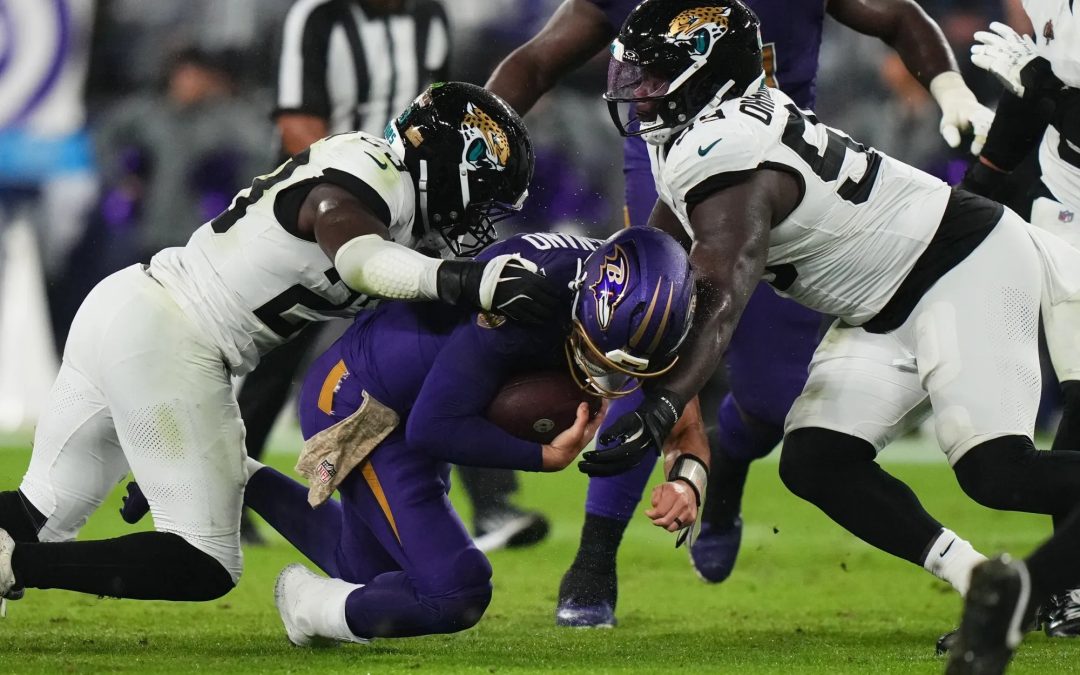
Jacksonville beat the Ravens 33-10 on Thursday night. The Ravens are 4-5 and have lost four straight. They are the first Ravens team to lose three straight games by 20 or more, and the first held under 14 points in four straight, per Ravens.com.
| 1 | 2 | 3 | 4 | Final | |
|---|---|---|---|---|---|
| Jaguars | 10 | 7 | 3 | 13 | 33 |
| Ravens | 3 | 0 | 0 | 7 | 10 |
The plan was the one the roster allowed. The Ravens snapped the ball directly to Derrick Henry 10 times, and Jacksonville was ready for it: “We practiced Wildcat a ton,” Liam Coen said, per AP. Joe Fagnano went 10 of 18 for 60 yards with two second-half interceptions. His longest completion was 14 yards, and he threw only one pass 10 or more yards downfield.
It was 10-3 until Trevor Lawrence hit Parker Washington for a 50-yard touchdown with 58 seconds left in the half. Jacksonville’s only other touchdown drive was the opening 77 yards. By our count from the play-by-play, 16 of its 33 points came after Ravens turnovers: field goals after both interceptions and after a fourth-and-1 aborted snap at the Jacksonville 41, and Chris Rodriguez Jr.’s touchdown after LaJohntay Wester’s kickoff-return fumble, which Jacksonville won on a challenge.
Justice Hill’s 65-yard run with 7:26 left was the Ravens’ first touchdown after halftime since Week 5. Jake Moody made a 53-yarder in his debut. Henry ran 17 times for 57 yards and passed Jerome Bettis and LaDainian Tomlinson for seventh on the career rushing list.
The Ravens had no sacks, four more false starts and a league-high 24 for the season. Kyle Hamilton left in the third quarter with a hip injury and did not return; Minter had no update. Nate Wiggins was inactive with an illness.
The Ravens were playing a rookie third-string quarterback against one of the better teams in the league. Losing was of course the expectation. My hope was to run, run and run again, keep it close and possibly be in-position to steal something with a turnover or a special-teams play. That was more of a pipe-dream, vs. anything realistic.
There are eight games left. Jackson is on injured reserve, Tyler Huntley is out for the season, and Jacoby Brissett is expected to start against the Chargers after an 11-day break. The rest of this piece is a reset: the coaching staff, the roster DeCosta built, Jackson’s future, what’s left of the playoff path, and the trade deadline on Tuesday.
Minter And The Staff
The staff has lost four straight since the overtime win in Atlanta, and most of the reasons trace to injuries it didn’t cause. But several problems showed up while Jackson or a healthy backup was playing, and those are on the coaches.
The realistic ask
This was a first-year Head Coach, a Defensive Coordinator who calls his own defense, and a 30-year-old Offensive Coordinator calling plays for the first time. Declan Doyle came from Chicago; Anthony Weaver returned from Miami as defensive coordinator, per WMAR. Minter was third in CBS Sports’ preseason poll of defensive playcallers, behind Mike Macdonald and Steve Spagnuolo.
The roster they inherited went 8-9 in 2025, with 30 sacks, more than only two teams, and the 31st-ranked pass defense. Outside, the expectations were still high (see the DeCosta section below). In our season preview, we had them fifth overall to begin the year, finishing 11-6, under the DraftKings total of 11.5. The question we asked of them was how much of the last two seasons was actually coaching.
The realistic ask, then: with a healthy Jackson, win the AFC North or come close, and fix the pass rush and pass defense that sank 2025.
My belief was if Jackson could suit-up for 15 games, the Ravens would be amongst the top teams in the AFC.
The adversity
- Quarterback. Jackson has played 14 full quarters. Brissett will be the fourth quarterback to throw a pass this season, tying a franchise record. With Jackson starting, the Ravens are 3-2, including the one-snap game in Buffalo. They are 1-2 with Huntley and 0-1 with Fagnano. Zay Flowers missed the Saints game with a hamstring, Ja’Kobi Lane spent Weeks 2-5 on injured reserve with a fractured wrist, and Durham Smythe, the best blocking tight end, was lost to an Achilles injury against Tennessee.
- Center and the line. Jovaughn Gwyn (ankle) and Ethan Pocic (knee) were both hurt in Rio, and by Week 4 Gwyn, Pocic and Danny Pinter were all on injured reserve. Rookie guard Vega Ioane played center until Cam Jurgens arrived, then hurt his knee in Jurgens’ first game. Ronnie Stanley missed Rio with a toe injury, and Andrew Vorhees started at right guard for the first time since college. That’s six different starting line combinations, per ESPN.
- Defense. Tavius Robinson (torn pectoral) is out for the season. Trey Hendrickson played in a cast on a broken finger, then missed two games after finger surgery. Nnamdi Madubuike missed the first two games; Rio was his first game in more than a year. Marlon Humphrey (calf) and Teddye Buchanan (knee) missed time. Hamilton left Thursday, and Wiggins missed it.
- The schedule. Buffalo, then Jacksonville four days later, with a rookie making his first start on four days’ rest.
Where they’ve fallen short
Second halves. Through seven games, the Ravens were plus-65 in first halves and minus-70 in second halves. They led in Cleveland and against Cincinnati and lost both, the 10th time since 2022 they blew a double-digit second-half lead, per @BenjaminSolak. Both of those were Huntley starts. Jackson was playing in Week 2, when New Orleans outscored the Ravens 15-0 in the fourth quarter to erase a 17-9 lead, and in Rio, where Dallas retook the lead in the fourth before Loop’s 56-yarder won it. After the Saints game I wrote that seeing the same fourth-quarter storyline continue in Minter’s home debut was a bit deflating.
Pre-snap penalties. The 24 false starts lead the league, per Ravens.com. Minter called them “unacceptable” Thursday and called it a question of “ownership of players and coaches.” Stanley and Andrews had back-to-back false starts on one second-quarter drive. That’s discipline and operation, and it doesn’t depend on who plays quarterback.
Short yardage. Through the Cincinnati game, Henry had converted 2 of 10 carries with 1 or 2 yards to go over three games.
The defense Minter calls. It is 14th in FTN’s defensive DVOA, and our defensive line rankings dropped it from seventh to 12th this week. It had no takeaways in its first three losses. Cincinnati scored touchdowns on five straight second-half possessions, and Buffalo on three of four. Thursday it had no sacks of Lawrence. Of everything here, this is the part that most directly answers the preseason question, because it’s Minter’s own unit. Third downs have been the leak: New Orleans converted 8 of 15 at an average of about eight yards to go, and Atlanta 9 of 17, including all four that needed 10 or more. My view all season has been that this defense is too passive, too comfortable in big, soft zones. There’s too much talent, and too much of the cap, on that side of the ball not to ask it to attack more.
Decisions. Tied with New Orleans in the fourth quarter, the Ravens threw deep on third-and-1 instead of making the Saints stop Henry, and a lost challenge on a 3-yard completion cost a timeout they needed at the end. In Rio, Minter went for fourth-and-1 at his own 30 in the first quarter, and it cost seven points. In Atlanta, the Ravens chose to receive in overtime, which surprised me. Down 14-13 on the first play of the fourth quarter in Cincinnati, they went for it on fourth-and-2 at the 12 instead of kicking for the lead with a backup quarterback. In Buffalo, Doyle had Fagnano throwing almost immediately after he entered. [CHECK: our count of Fagnano’s first plays in Buffalo from the play-by-play] Thursday’s Wildcat plan was creative, and Jacksonville had prepared for it.
The other side
The Ravens started 4-1, two of those wins with Huntley. The offense was producing with Jackson: 10.1 yards a pass in his four full games. And the defense kept the last two games within reach into the second half; Thursday, Jacksonville had two touchdown drives longer than 32 yards.
After Atlanta I wrote that Doyle continued to impress. His short-yardage adjustment against Tennessee and the Cuevas trick play in Cleveland are what a first-year playcaller needs to show. After Cleveland I also wrote that I didn’t think the staff had Huntley in a great position to succeed. In our Buffalo review, I wrote that Minter calling the defense is supposed to be his strength. At-least his on-field strength.
DeCosta’s Roster
Entering this season, the people who grade rosters for a living thought DeCosta had built one of the two or three best in football. Nine games in, the record is 4-5. Most of the gap is Jackson’s health, but the roster was also built older and thinner up front than those grades suggested.
What outsiders thought in August
From our season preview:
| Source | View of the 2026 Ravens |
|---|---|
| Mike Clay, ESPN | Second-best roster in football; 11.5 projected wins, third in the league; defense fourth; best interior defensive line and best safety group in the league; receivers, tight ends and corners each a 5 of 10 |
| DraftKings | 11.5 wins |
| NFL.com | Sixth in preseason power rankings |
| Sharp Football | Eighth; fifth-easiest schedule |
| Mike Sando, The Athletic | Jackson down from Tier 1 to Tier 2 |
| BSL | Fifth; 11-6, AFC North champions, AFC No. 2 seed; Under 11.5 |
The 2025 roster had been billed as the league’s best too, per Ravens.com, and went 8-9.
Three offseasons
2024. DeCosta signed Derrick Henry for two years and $16 million and extended Justin Madubuike for four years and $98 million after tagging him. He let Patrick Queen (Pittsburgh), Geno Stone (Cincinnati), Jadeveon Clowney (Carolina), Kevin Zeitler (Detroit) and John Simpson (the Jets) leave, and traded Morgan Moses to the Jets. That was three line starters gone in one offseason. The draft opened with Nate Wiggins at No. 30 and Roger Rosengarten at No. 62, then Adisa Isaac, Devontez Walker, T.J. Tampa and Rasheen Ali. The Ravens won the AFC North and lost in the divisional round at Buffalo.
2025. He re-signed Ronnie Stanley for three years and $60 million and extended Kyle Hamilton (four years, $100.4 million), Henry (two years, $30 million) and Rashod Bateman. The free-agent adds were short and cheap: DeAndre Hopkins, Jaire Alexander, Chidobe Awuzie, Cooper Rush. He declined Tyler Linderbaum’s fifth-year option. The draft brought Malaki Starks at No. 27, Mike Green at No. 59, Emery Jones Jr., Teddye Buchanan, Carson Vinson, Tyler Loop, LaJohntay Wester and Aeneas Peebles. During the season he traded Odafe Oweh to the Chargers for Alohi Gilman, and added Dre’Mont Jones from Tennessee for a conditional fifth. The Ravens started 1-5, finished 8-9 and missed the playoffs; the defense had 30 sacks after 54 the year before.
2026. The Ravens fired John Harbaugh after 18 seasons and hired Jesse Minter after interviewing 16 candidates, per Pro Football Rumors. Then March went sideways:
- Linderbaum left for Las Vegas on a three-year deal worth up to $81 million.
- Maxx Crosby. The Ravens agreed to send their 2026 and 2027 first-round picks to the Raiders, then backed out after his physical, citing his knee, which needed meniscus surgery. DeCosta said he was “gutted,” per NFL.com. The No. 14 pick they kept became Vega Ioane.
- Trey Hendrickson signed for four years and $112 million at 31, coming off core muscle surgery and four sacks in seven games.
- Jackson’s extension didn’t happen, so the Ravens restructured him for $39.96 million in room, which is where the $84.34 million 2027 cap number comes from.
- Also gone: Isaiah Likely, Charlie Kolar, Patrick Ricard, Daniel Faalele, Keaton Mitchell, Gilman, Dre’Mont Jones and punter Jordan Stout, per SI. Added: Jaylinn Hawkins, Simpson again, Durham Smythe; Awuzie re-signed. Likely followed Harbaugh to the Giants. As I wrote after Atlanta, the Ravens extended Andrews when they couldn’t get Likely locked in, and it feels like they should have told Likely he was the lead option.
The draft: Ioane at No. 14, Zion Young at 45, Ja’Kobi Lane at 80, Elijah Sarratt at 115, Matt Hibner at 133, then Chandler Rivers, Josh Cuevas, Adam Randall, Ryan Eckley. In October, DeCosta sent a 2028 second and a 2027 fifth to Philadelphia for Cam Jurgens and a 2027 seventh.
What the three years add up to
The draft has been the strength. Of the last three classes, Ioane, Starks, Rosengarten, Wiggins, Green and Tampa are starters or regulars, and Eckley is the punter. Green and Robinson are tied for the team lead with 3.5 sacks. Hibner, Cuevas and Lane are getting real snaps as rookies. Day 3 has supplied the kicker, punter, returners and two tight ends.
The trenches have been the weakness. The 2024 line exodus, Linderbaum’s departure and the center carousel since have left the offensive line 22nd in our rankings. The pass rush has been bought rather than built: Hendrickson at 31, Calais Campbell at 40, Dre’Mont Jones for half a season. Pro Football Rumors called getting stronger in the trenches the top priority after 2025.
The roster is old where it is expensive. Hendrickson is 31, Humphrey 30, Andrews 31, Henry 32, Stanley 32 and Campbell 40, per The Ringer, which put the blame on DeCosta’s roster management more bluntly than anyone: “bad roster management.” That’s one outlet’s view; Clay’s August grades said the opposite.
The cap has been spent forward. The Ravens are tight this year, about $1.9 million in room, and carry the league’s highest 2027 commitments, $366.74 million per NFLPA data via CBS Sports. Over The Cap has them about $46 million over a $327 million cap. The Jackson restructure and the void years were the price of keeping 2026 intact.
The Minter hire is too early to grade. He came with the credentials the job asked for: two Harbaugh coaching trees, a national title at Michigan and a top-six defense by EPA with the Chargers, per Chargers.com. The staff section above covers what nine games have shown.
Unit Grades
Two grades for each unit. Performance is what it has done through nine games. Talent is what’s in the room for the rest of this year and into 2027. Both are our grades, and both account for the context: three quarterbacks, six line combinations and the injuries above. Season stats are from the team stats sheet; line numbers are from our rankings.
| Unit | Performance | Talent | The short version |
|---|---|---|---|
| Quarterback | C- | A when healthy, D behind him | Jackson elite on the field, the depth chart below him the problem |
| Running back | C+ | B- | Henry at 3.9 a carry against loaded boxes; Hill the spark |
| Receivers | C+ | C+ | Flowers productive with every quarterback; little behind Bateman |
| Tight ends | C- | C- | Andrews’ decline continued; two rookies getting snaps |
| Offensive line | D+ | C+ | Hard to grade through the churn; Rosengarten and Ioane the bright spots |
| Interior defensive line | C | B | Best in the league on paper in August; Madubuike’s comeback is the swing |
| Edge | C- | C+ | 17 team sacks in nine games; Green the one rising |
| Linebackers | B- | B- | Smith still the defense’s most reliable player |
| Cornerbacks | D+ | C | The weak spot we flagged in August |
| Safeties | B- | A- | Hamilton’s hip now the biggest question on defense |
| Special teams | C+ | B | Loop’s misses, return fumbles; Eckley a find |
Offense
Quarterback. Jackson has a 118.4 rating and 10.0 yards a pass in his five games. Tyler Huntley was a functional backup: 95.5, 6.6 a pass, and 11 sacks in five games. Joe Fagnano has a 28.9 rating with no touchdowns and three interceptions. The performance grade is mostly a grade on availability and depth, and the depth was always one injury from this.
Running back. Henry has 689 yards on 175 carries, 3.9 a carry, with eight touchdowns. He is the one player defenses have been able to load up against since Week 4, and his short-yardage conversions fell to 2 of 10 over the three games through Cincinnati. Justice Hill is at 7.3 a carry on 33. Henry turns 33 in January; his contract is a 2027 question.
Receivers. Zay Flowers has 43 catches for 614 yards, 14.3 a catch, with three different starters throwing to him, then had no catches in Buffalo. Bateman has 294 yards. Flowers missed the Saints game with a hamstring, and Lane spent Weeks 2-5 on injured reserve with a fractured wrist; he had four catches, three on third down, in his first game back. Walker and Sarratt haven’t separated yet. After Atlanta I wrote that my preseason take on Flowers as a high-end No. 2 was bad. And it was. He’s been excellent this year, and if Jackson had stayed healthy his numbers would be even better. Clay graded the group a 5 in August, and that holds.
Tight ends. Mark Andrews has 31 catches for 237 yards, 7.6 a catch, plus a lost fumble and false starts. He averaged 12.1 yards a catch for his career and 8.8 last year, and in Atlanta had a dropped touchdown, a lost fumble and a dropped two-point try. Durham Smythe, the best blocker in the room, was lost to an Achilles injury against Tennessee. Josh Cuevas (10 for 134) and Matt Hibner (six for 75) are rookies getting real snaps, which counts toward the talent grade. Cuevas and Hibner both look promising. Andrews is tough to watch at this point.
Offensive line. The line has allowed 23 sacks, is 22nd in our rankings (47% pass block win rate, 21st; 73% run block, 19th) and is responsible for most of the league-high 24 false starts. Ronnie Stanley has several of those.
It’s also the hardest unit to grade fairly. Gwyn, Pocic and Pinter were all on injured reserve by Week 4, Ioane moved from guard to center, and Carson Vinson started at left tackle in Rio with Stanley out. That’s six line combinations. Roger Rosengarten has played right tackle next to Andrew Vorhees, Emery Jones Jr. and Ioane at right guard, and has had to adjust to each. Vorhees hadn’t played right guard since his sophomore year at USC, and Jones made his first career start in Atlanta. Ioane was playing at a high level at guard and center before the MCL sprain, and Jurgens arrived midseason. Stanley is 32 and on a deal through 2027, with a $24.0 million cap number next season.
Defense
Interior defensive line. Clay called it the league’s best in August. Nnamdi Madubuike has one sack in seven games after his neck injury; he didn’t take 11-on-11 reps in camp and missed the first two games. Travis Jones has six tackles for loss and no sacks, and Calais Campbell has one sack at 40. The run defense held up: 3.8 yards a carry allowed and a 30% run stop win rate, 12th. The pass rush from the middle hasn’t.
Edge. The defense has 17 sacks in nine games. Mike Green and Tavius Robinson lead the team with 3.5 each, and Robinson is out for the season. Trey Hendrickson has two in seven games at $28 million a year, first playing in a cast on a broken finger, then missing two games after finger surgery. Zion Young has held up against the run but has no sacks.
Linebackers. Roquan Smith has 74 tackles, two sacks, two forced fumbles and an interception. Trenton Simpson has 57 tackles and an interception. Teddye Buchanan, back from his ACL, recovered Thursday’s fumble.
Cornerbacks. Corners were the concern in our preview, because Minter’s scheme asks them to cover without help. Marlon Humphrey has nine passes defensed and no interceptions, and played only 56% of the snaps in Buffalo. Nate Wiggins has four passes defensed in his third year and missed Thursday. Chris Olave beat Wiggins in Week 2, and Wiggins’ interference set Dallas up at the 2 in Rio. Tee Higgins’ 148 yards and Washington’s 50-yard touchdown were both against this group.
Safeties. Kyle Hamilton has 60 tackles, nine for loss, and an interception. Malaki Starks has 55 tackles and a forced fumble, including Thursday’s. Starks has not impacted games positively enough. Jaylinn Hawkins has played six of nine games. Hamilton bails the Ravens out repeatedly; he needs teammates to show up more consistently around him. Assuming / hoping Hamilton is back for the Chargers game, Minter might need to look at what the Ravens Defense did two years ago. At that point a struggling Ravens Defense pulled Hamilton deeper into coverage, vs. consistently keeping him at the LOS, and the defense improved. It might also keep Hamilton healthier.
Special teams
Tyler Loop was 13 of 17, perfect from 50 and beyond and 2 of 5 from 40 to 49, before going on injured reserve. Jake Moody made a 53-yarder in his debut. Ryan Eckley averages 47.6 yards a punt, 42.3 net, with 18 inside the 20, as a sixth-round rookie. Kick returns average 26.0 yards, but Rasheen Ali muffed one in Buffalo and Wester’s fumble Thursday led to a touchdown.
Lamar Jackson
Jackson will have surgery on his right thumb and is on injured reserve, so he will miss at least the Chargers, Carolina and Houston. His contract runs through 2027 at an $84.34 million cap number, and he holds most of the leverage on what comes next.
The injury history
This season he started the first four games, then a diving defender’s shoulder landed on the inside of his left ankle on Oct. 4 against Tennessee, per Ravens.com. The high ankle sprain cost him Atlanta, Cleveland and Cincinnati. He came back in Buffalo and lasted one snap: his right hand hit Greg Rousseau on the follow-through, per CBS Sports.
Minter said Jackson will have surgery and go on injured reserve, and that the injury is potentially season-ending, per NBC Sports. With the Week 13 bye, the earliest he can return is Dec. 13 against Tampa Bay, and the surgery makes later more likely, per Yahoo Sports. Ian Rapoport (@RapSheet) said he is likely out for the season. The team has not given a diagnosis. Speaking generally, without having examined him, UofL Health hand surgeon Rodrigo Moreno said surgery for a ligament injury usually means six to 10 weeks of recovery, per [UofL Health](https://uoflhealth.org/news/lamar-jackson-thumb-2026/).
Here is the table from our Bengals review, with this season added:
| Season | Starts | Games missed | Season result |
|---|---|---|---|
| 2019 | 15 | Week 17, rested | Clinched home-field advantage; lost in the divisional round |
| 2020 | 15 | One game, COVID-19 | Won a wild-card game; lost in the divisional round at Buffalo |
| 2021 | 12 | One game, illness; final four, ankle injury against Cleveland | The Ravens finished 8-9 |
| 2022 | 12 | Final five and the wild-card game, PCL sprain at Denver | 10-7, sixth seed; lost the wild-card game in Cincinnati |
| 2023 | 16 | Week 18, rested | No. 1 seed; lost the AFC Championship Game |
| 2024 | 17 | None | Second straight AFC North title; lost in the divisional round to Buffalo |
| 2025 | 13 | Three games, hamstring; one game, back contusion | The Ravens finished 8-9 |
| 2026 | 5 | Three games, high ankle sprain; Buffalo after one snap and at least four more, right thumb | 4-5 after last night. |
That is four seasons out of the last six with four or more games missed. If he doesn’t play again this year, he will have appeared in 18 of a possible 34 regular-season games over 2025 and 2026.. In 2023 and 2024 he missed one, a rest game.
When he was on the field, he was playing as well as he ever has. In his four full games he completed 68 of 96 passes for 967 yards, six touchdowns and one interception, a 119.6 rating, per CBS Sports. Both the completion rate and the 10.1 yards a pass would be career highs.
Where the contract stands
Jackson signed a five-year, $260 million extension in 2023, at $52 million a year with a $72.5 million signing bonus, per ESPN. Owner Steve Bisciotti wanted a new deal before free agency in March. It didn’t happen, so the Ravens restructured the contract, clearing $39.96 million in 2026 cap room. His 2026 salary is now $1.3 million, with the rest in a $49.5 million bonus prorated through a voiding 2030 year, per The Banner, citing Spotrac.
The bill comes next year. His 2027 cap number is $84.34 million, the second highest in the league behind Patrick Mahomes. He also has a no-trade clause, and the Ravens can’t franchise or transition tag him when the deal ends after 2027.
The talks are not where the Ravens wanted them. The Ravens tried to negotiate an extension after Minter was hired, and Jackson balked, Albert Breer of SI.com reported, per Bleacher Report. Rapoport said he believes strongly that Jackson wants to stay in Baltimore long term, and that an extension is the top priority this offseason, per Ravens.com. In May, Jackson said he loves the organization and the city.
Without an extension, these are the paths, all per CBS Sports:
| Path | 2027 cap | 2028 cap | The catch |
|---|---|---|---|
| Play out 2027 as is | $84.34 million | $42.47 million in dead money | No tag; he can walk as a free agent |
| Trade before June 1 | $74.81 million in dead money, saving $9.53 million | Nothing | Needs his approval |
| Trade, or release, after June 1 | $32.34 million in dead money, freeing $52 million | $42.47 million in dead money | Carry $84.34 million until June 2; a release brings no compensatory pick |
| Restructure again | Up to $37.4 million cleared | As much as $79.9 million in dead money if he leaves | Pushes the problem into 2028 |
What an extension would likely look like
Bisciotti said in January that he hoped to “plug a new number into the same contract,” per The Banner. That points to the 2023 structure: five years, a record signing bonus and guarantees, with a higher average.
The number has moved since 2023. Mahomes reworked his deal in June to average $63.09 million, and Dak Prescott is at $60 million, per SI. Joe Burrow and Matthew Stafford are among those at $55 million. Jackson’s $52 million ranked 10th among quarterbacks in March, per ESPN. Kansas City reworked Mahomes coming off a torn ACL and LCL, a worse injury than any Jackson has had, as CBS Sports’ Joel Corry pointed out.
So the reasonable starting point is at or above Mahomes. What matters for the Ravens is what share of the cap that takes, and the cap keeps moving.
The cap was $208.2 million in 2022 and is $301.2 million this year, up about 45%. The 2027 cap should land between $322.5 million and $327.5 million, per CBS Sports; Over The Cap uses $327 million and Spotrac runs as high as $352 million. Estimates past that have it at about $348 million to $355 million in 2028, $370 million to $375 million in 2029, about $400 million in 2030 and $420 million or more in 2031, driven by media-rights escalators.
By our arithmetic, his 2023 deal took 23.1% of that year’s $224.8 million cap. At $65 million a year, a new deal would be 19.9% of a $327 million cap; at $70 million, 21.4%. Mahomes’ average is 20.9% of this year’s cap. On those estimates, a $66 million average would be about 19% of the 2028 cap, 18% in 2029, 16.5% in 2030 and under 16% by 2031.
The other side of it is age and wear. He turns 30 in January. He has taken 1,234 hits since 2018, more than any other quarterback, per ESPN in March. Corry’s read is that none of his injuries are career-threatening, and the thumb was a freak play. Breer’s read is that Jackson holds a lot of the cards, and that he can reach an unfettered free agency in 2028 by doing nothing.
My previous take would have leaned toward being scared of an extension, with some of his injury history and his age. But given how much the cap has grown over the past five years, and the projections for the next five, that concern has been minimized.
What we think happens
We think Jackson signs an extension in the spring, around five new years at about $66 million a year. Neither side can live with the alternative.
For the Ravens, $84.34 million in 2027 makes building a roster around him close to impossible. Jeff Zrebiec called it untenable. Another restructure only moves the problem into 2028, when as much as $79.9 million could be dead money if he leaves, per CBS Sports. For Jackson, playing out the year means going into free agency at 31, after two straight seasons with significant time missed. Breer is right that he holds the cards. But the safest way to cash them is a record deal now, not a market bet in 2028. He said in May that he loves Baltimore. When asked if becoming the highest-paid player sounded good, he said, “It sounds good,” per ESPN.
The number would have to clear Mahomes. That’s $63.09 million a year by Spotrac’s math and $64 million by Over The Cap’s. We have him at about $66 million, roughly $330 million over five new years, with a signing bonus near Dak Prescott’s record $80 million. The 2023 deal took 27 months. This one won’t have that long, so it could still drift past the March deadline Bisciotti wants, the way the last one went to April. All of this is our projection, not a report.
What it would do to 2027, by our arithmetic:
| Plays it out | Extension (our projection) | |
|---|---|---|
| Jackson’s 2027 cap hit | $84.34 million | About $49.6 million |
| Breakdown | $52 million in salary and bonus, plus $32.34 million of old bonus money | The same $32.34 million, plus $16 million of the new bonus, plus a $1.3 million salary |
| Ravens vs. a $327 million cap (Over The Cap’s commitments) | About $46 million over | About $11 million over |
| Same, NFLPA commitments via CBS Sports | About $38 million over | About $4 million over |
The extension clears about $35 million in 2027 by turning his $52 million salary and bonus into a bonus spread over five years. It doesn’t get the Ravens under the cap by itself. Add a Roquan Smith trade or release, which saves $20.0 million in 2027 per our Over The Cap numbers, and they would sit roughly $9 million to $16 million under before the draft class and free agency. Smith isn’t the only path; Andrews, Henry and Campbell are the other candidates. Some combination is needed.
The bill moves to later years. The old void-year money doesn’t disappear; it lands in 2028 through 2030 as real years, starting at about $18 million in 2028. Add the new bonus and a rising salary, and Jackson’s 2028 cap hit would be somewhere in the $70 million range. That’s why the cap growth matters. At $66 million, the average is about 20% of a $327 million cap, below the 23.1% his 2023 deal took of that year’s cap. On the estimates above, his roughly $70 million 2028 hit would be about 20% of the cap, and the $66 million average falls to about 16.5% by 2030.
The Path To A 7 Seed
At 4-5, with Brissett starting and Jackson out until at least Dec. 13th, the Ravens get the 7th seed in about 3% to 8% of our simulations, depending on when Jackson returns. Last week, assuming Jackson back sooner, it was about 10% to 11%.
| Jackson back | Games with Jackson | 7th seed | 7th seed, every tie lost |
|---|---|---|---|
| Dec. 13th vs. Tampa Bay (earliest) | 5 | About 8% | About 5% |
| Dec. 31st at Cincinnati | 2 | About 5% | About 3% |
| Out for the season | 0 | About 3% | About 2% |
The method is the same as last week’s. Each remaining game rates both teams by their place in our Nov. 3rd power rankings, with the Ravens at their pre-injury place, 14th, and adds home field. The Ravens lose 6 points in every game without Jackson, how far the line moved when he was ruled out against Cincinnati. Every other AFC team plays out its season at the pace of our Nov. 3 win projections. We ran the rest of the season 200,000 times.
The 7th seed won 9 or 10 games in about eight of every 10 runs. From 4-5, that means 5-3 or 6-2 the rest of the way. The model’s most common finish is 8-9 if Jackson is back Dec. 13th, and 7-10 if he isn’t back at all.
The 6-point adjustment treats Brissett as a healthy backup, about where Huntley was, and the model doesn’t know about Hamilton’s hip. It also treats every other team’s games as independent of each other’s, which they aren’t.
Game by game, without Jackson, the Ravens are favored only against the Chargers, at about 61%. The two Pittsburgh games and the trip to Cincinnati are the hardest, at about 22% to 32%.
The Sunday Week 9 games aren’t in yet. Pittsburgh is on bye; Cincinnati, Cleveland, New England, Las Vegas and Houston all play.
As I said last week, there’s no pressure and zero expectations. I hate feeling like the season is over on Nov. 6th. The path is to beat the Chargers with Brissett coming off the mini-bye, keep fighting week to week, and hope Jackson’s thumb progresses better than expected. If he’s back for Cincinnati on Dec. 31st, that’s two games with him, at most.
The Trade Deadline
The deadline is Tuesday, Nov. 10th, at 4 p.m. ET. The Ravens have already made the move they had to make, and clearly the rest of the week should be about 2027, not about chasing a minimal playoff chance.
Brissett
The Cardinals are finalizing the trade, expected this weekend, per Adam Schefter and Ian Rapoport via ESPN. Compensation hasn’t been reported. Arizona converted $2.7 million of his remaining $5.4 million salary into a bonus before the deal, and because it wasn’t done before Thursday, Baltimore owes him a $2.43 million base salary, per ESPN, plus possible incentives. He reunites with quarterbacks coach Israel Woolfork, who coached him in Arizona last season and in Cleveland in 2022.
Two things don’t fit yet. Spotrac’s figures, via Cardinals On SI, had Baltimore taking on about $650,000 in salary; ESPN’s $2.43 million is the later report and the one we’re using. And $2.43 million is more than the roughly $1.9 million in room Over The Cap showed for the Ravens last week. Placing Jackson, Huntley and Loop on injured reserve doesn’t clear their salaries, so something else has to move.
Brissett is 33, 23-50 as a starter, and was third on Arizona’s depth chart a week ago. The trade gives the Ravens “a better chance of stabilizing the season than saving it,” per ESPN’s Jamison Hensley. That’s the right price for that.
What else is on the table
| Proposal | Who | The case |
|---|---|---|
| Sell Calais Campbell, Henry or Humphrey | ESPN | All three are possible 2027 cap casualties, so get something now |
| Sell Bateman | Jeremy Fowler, ESPN | Several teams need receivers, and he isn’t a focal point here |
| Henry to the Giants | Mike Florio, PFT | John Harbaugh’s history with him; a $1 million roster bonus is due in March |
| Buy Chargers CB Donte Jackson for a 2027 seventh | Ben Solak, ESPN | A familiar corner for Minter, in the last year of his deal |
The first is from ESPN’s deadline survey; the rest are via Ravens.com. Hensley’s own read is that it wouldn’t be surprising if the Ravens stood pat.
Our published numbers still decide most of these. Only Roquan Smith frees meaningful 2027 space whenever he’s moved. Humphrey frees none: his contract voids after this season, and his $11.9 million 2027 charge is dead money either way. Andrews is the one where a trade beats a release, saving $3.5 million instead of costing $1.5 million, per Over The Cap. Henry is the new name, and his contract makes a deadline trade about the pick, not the cap. He counts $16.289 million in 2027: an $11 million salary, a $1 million roster bonus due in March and $4.289 million in bonus proration, with none of it guaranteed. Moving him before June 1 leaves $14.807 million in dead money and saves only $1.482 million; a release after June 1 saves $12.0 million, per Over The Cap.
How we’d handle it
- Don’t buy. Donte Jackson costs almost nothing, but neither does it change a 3% to 8% shot at the 7th seed. A seventh-round pick is fine; anything more isn’t.
- Sell only where the trade beats March. Andrews fits; the trade saves money a release wouldn’t. A veteran with no 2027 value to the Ravens, for a real pick, fits.
- Don’t sell the 2027 core for late picks. Smith, Hamilton, Starks, Green and the young linemen are the roster Jackson comes back to.
- Henry is the hard one. He is 32, the offense with Brissett runs through him, and he is the player most likely to bring back a real pick. Moving him would read as the white flag. Keeping him means paying for a season the model says is mostly gone.
Last week I said Smith, Humphrey, Andrews and Bateman were the only realistic names, and that even those were unlikely. I also don’t want to see this team become one of those playing out the string.
If the Ravens feel there is any chance of Jackson returning, I can’t see them moving Henry. If they’re convinced Jackson’s season is done, then moving Henry becomes something more to consider.
What’s Next: The Chargers
The Chargers come to M&T Bank Stadium on Monday, Nov. 16th, at 8:15 p.m. ET on ESPN, Minter against the team he left in January. They are 0-7, 32nd in our rankings and last in FTN’s DVOA, and they host Houston on Sunday as 4.5-point underdogs.
- Their offense has gone 27 straight drives without a touchdown, behind our 30th-ranked offensive line. Justin Herbert has thrown an interception in all seven games.
- Their defense is still Minter’s built unit: our seventh-ranked defensive line, fourth in run stop win rate. That’s the matchup Brissett and Henry walk into.
- The model gives the Ravens about 61%, the only game left where it has them favored without Jackson.
We’ll do the full preview, with the line, injuries and ESPN’s number, next week.
The Questions
Fourteen questions, six about the rest of this season and eight about the offseason and 2027, with our thoughts on each.
The rest of 2026
1. What’s a realistic bar for Brissett? He is 23-50 as a starter and lost 16 of his last 19 starts, per ESPN. The bar isn’t 5-3. It’s an offense that can throw past 10 yards again, so we can finally evaluate Doyle’s scheme with a functioning quarterback.
2. Should Jackson come back if the season is gone by December? If he’s medically cleared and the Ravens are alive, yes. If they’re out of it by mid-December, then maybe there’s not enough to gain by further risking his health.
3. Who has to do more? Hendrickson, with two sacks in seven games at $28 million a year. Madubuike, a year removed from the neck injury. Stanley and Andrews, for the false starts as much as the play. Humphrey, in a scheme that asks its corners to win alone. At this point Andrews looks done, so asking him to do more probably isn’t realistic. Humphrey might still be able to help a team, but he can’t be asked to defend on an Island. Those days are done. The Ravens need Stanley to be at-least league average at LT. Huge issue if he’s not at that level. I’d like to see Travis Jones finish strong.
4. What should the last eight games be used for? Snaps for the players who will be here in 2027: Zion Young, Lane, Sarratt, Chandler Rivers, Hibner and Cuevas, and Ioane at whichever spot he projects to. And Moody’s four-game audition against Loop’s return.
5. Does the team fold or fight? Thursday, the defense held Jacksonville to two touchdown drives longer than 32 yards, and the offense gave away 16 points. A team that has quit doesn’t play that way on defense. We’ll find out more against the Chargers and in Pittsburgh.
6. Should Minter keep calling the defense? Eight more games is a fair test with the roster healthier on that side.
The offseason and 2027
7. Are the right people in the right chairs? Minter’s first year has been wrecked by the quarterback injuries, and one year like this shouldn’t settle a head coach. Doyle had Jackson at 10.1 yards a pass before the ankle. Ravens fans aren’t happy with Minter or DeCosta right now, I don’t think either is going anywhere anytime soon. This isn’t an organization that makes change for the sake of change. Before Minter, the Ravens only had 3 previous Head Coaches. I think a short-run for Minter would be 5 years. DeCosta has been with the Ravens forever, and was groomed for the GM spot for years under Ozzie Newsome. He’s closing in on a decade at the helm, and the Ravens haven’t won a Super Bowl; and now have several unfulfilling years. There is worry that the Ravens won’t have taken advantage of Jackson’s absolute prime. He’s still had several historically strong regular season teams, and I believe the complete backing of Ownership. I don’t see any scenario where his job is in jeopardy.
8. What’s the Jackson plan? We think it’s an extension in the spring: around five new years at about $66 million a year, clearing Mahomes. The alternative, an $84.34 million cap number with no tag and no trade without his approval, works for neither side. Breer reports Jackson balked last spring; Rapoport believes he wants to stay. The risk is timing. The 2023 deal ran into April, and every week past March limits what DeCosta can do in free agency. See the Jackson section.
9. What are the cap questions? Even with the extension we project, Jackson’s 2027 cap hit is about $49.6 million by our arithmetic, and the Ravens are still about $4 million to $11 million over a $327 million cap before filling the roster. The extension is step one, not the whole answer. Step two is a choice:
- Smith, at $32.7 million: a trade or release saves $20.0 million.
- Andrews, at $14.7 million: a trade saves $3.5 million, while a release costs $1.5 million.
- Henry, at $16.289 million: a release after June 1 saves $12.0 million, but a move before then saves only $1.482 million, per Over The Cap. Or Campbell.
Humphrey’s $11.9 million is dead money either way. The extension also moves about $18 million of old bonus money into 2028, so 2028 gets tighter as 2027 loosens. Two big numbers aren’t really options. Hendrickson counts $18.0 million in 2027, and $29 million of his 2027 money is guaranteed, so cutting him before June 1 would cost more cap than it saves, per Over The Cap. His decision year is 2028, at a $35.5 million cap number. Stanley’s final year carries a $24.0 million cap number at 33.
10. What does the roster need? Line depth, particularly a tackle plan (see below). Young edge rushers behind Green. A corner. A dependable WR opposite of Flowers, or Lane breaking out. A tight end to follow Andrews, unless Cuevas and Hibner are it. And a backup quarterback who can win games: Jackson has now missed significant time in four of the last six seasons. And if they trade Henry, they’ll need a RB.
11. Who protects Jackson’s blind side after Stanley? With Jurgens at center and Ioane at guard, the interior has its core. The tackles are the next decision. Stanley is 32 and turns 33 in March, with his share of the false starts and a $24.0 million cap number in 2027, the last year of his deal. Rosengarten is in his third year at right tackle, and Carson Vinson’s only start at left tackle came in Rio. Whether the next lineman is a tackle, and whether he comes in the first round, follows from that.
12. Who needs to be replaced? The cap answers part of this. If the extension still leaves the Ravens over, Smith or Andrews is the likeliest move, and moving Smith means replacing the defense’s most reliable player. Beyond that, Calais Campbell turns 41 next season, Humphrey’s contract voids, Stanley turns 33 in March, and Henry turns 33 in January. Not all of them go, but more than one has to.
13. Was Hendrickson the right fallback for Crosby? Four years and $112 million for a 31-year-old coming off surgery, after a deal for a younger rusher fell through on a physical. Two sacks in seven games so far. His $60 million in full guarantees, including a $20 million signing bonus, runs through 2027, so 2028, at a $35.5 million cap number, is when the Ravens could get out, per Over The Cap. I think it was the right call, there just hasn’t been quite enough production. He has generally brought pressure, even if the sacks aren’t there. Do also have to factor in the injury he’s playing through.
14. How much of the last two seasons was coaching? That was our preseason question. With the quarterback injuries, 2026 can’t answer it cleanly. Blown second-half leads were a problem under Harbaugh’s last staffs too, 10 double-digit leads lost since 2022, and they’ve continued under Minter’s. That points at the roster at least as much as the coaches.
Overall Thoughts
The Ravens are 4-5, have lost four straight, and are down to their fourth quarterback. Their chance at the 7th seed is somewhere between about 3% and 8%. This season was built on Jackson being available, and he has played 14 full quarters. Nothing that has happened since Oct. 4th is a fair test of the team DeCosta built or the staff Minter hired.
That cuts both ways. It means 2026 can’t condemn them. It also means it can’t clear them. Some problems were showing before the injuries piled up: fourth-quarter leads lost with Jackson on the field, a defense that gave up long third downs in September, and false starts no matter who was at quarterback. The last eight games are about seeing whether those get fixed, and finding out which young players are part of 2027.
Can 2027 be a Super Bowl year?
We think it can, but only if several things go right, and most of them are decisions, not luck.
- Jackson is signed early. An extension around $66 million a year by March, not April. That turns an $84.34 million problem into about $49.6 million and lets DeCosta work free agency with the number known. When Jackson has played, he has played like an MVP candidate: 10.1 yards a pass this year.
- The cap math gets finished. Even with the extension, the Ravens are about $4 million to $11 million over. One real veteran move, most likely Smith or Andrews, gets them under; Henry only helps after June 1. Hendrickson’s guarantees take him off the table until 2028, and Stanley’s $24.0 million final year is the other number to watch. More than that buys them a free agent who matters.
- The trenches get fixed on purpose. Jurgens and Ioane are the interior. The next priorities are a tackle plan for life after Stanley, and edge rushers young enough to grow with Green. This is where three years of roster building has come up short.
- The corners improve. Minter’s scheme asks its corners to cover without help. Clay graded the group a 5 in August, and it has played like one. Hamilton, Starks and Smith can’t cover for that every week.
- The defense finds an identity. Year 2 under Minter should look different from big, soft zones and long third downs allowed.
- The backup can win. Jackson has missed significant time in four of the last six seasons. A Ravens Super Bowl season would take Jackson staying on the field, and playing like an MVP when available. But you need a backup you believe can win multiple games.
- The operation gets clean. A league-high 24 false starts and repeated fourth-quarter collapses are coaching problems the staff can fix with or without new players.
The young core is better than the record. Hamilton, Starks, Green, Ioane, Jurgens, Rosengarten, Flowers, Lane, Young, Cuevas and Hibner are all under contract. The question is whether enough of it is ready to carry a roster that would otherwise lean on Henry, Campbell, Hendrickson and Stanley, who will be 33, 41, 32 and 33 next season.
The AFC won’t wait. Buffalo, Jacksonville, Denver, Kansas City, Cincinnati and New England all have their quarterbacks in place.
For now, there are zero expectations. Show up and fight for eight more weeks here in ’26, find out who’s part of 2027, and get Jackson signed.

Owner
Chris Stoner founded Baltimore Sports and Life in 2009. He has appeared as a radio guest with 1090 WBAL, 105.7 The Fan, CBS 1300, Q1370, WOYK 1350, WKAV 1400, and WNST 1570. He has also been interviewed by The Baltimore Sun, Baltimore Business Journal, and PressBox (TV). As Owner, his responsibilities include serving as the Managing Editor, Publicist, & Sales Director.