
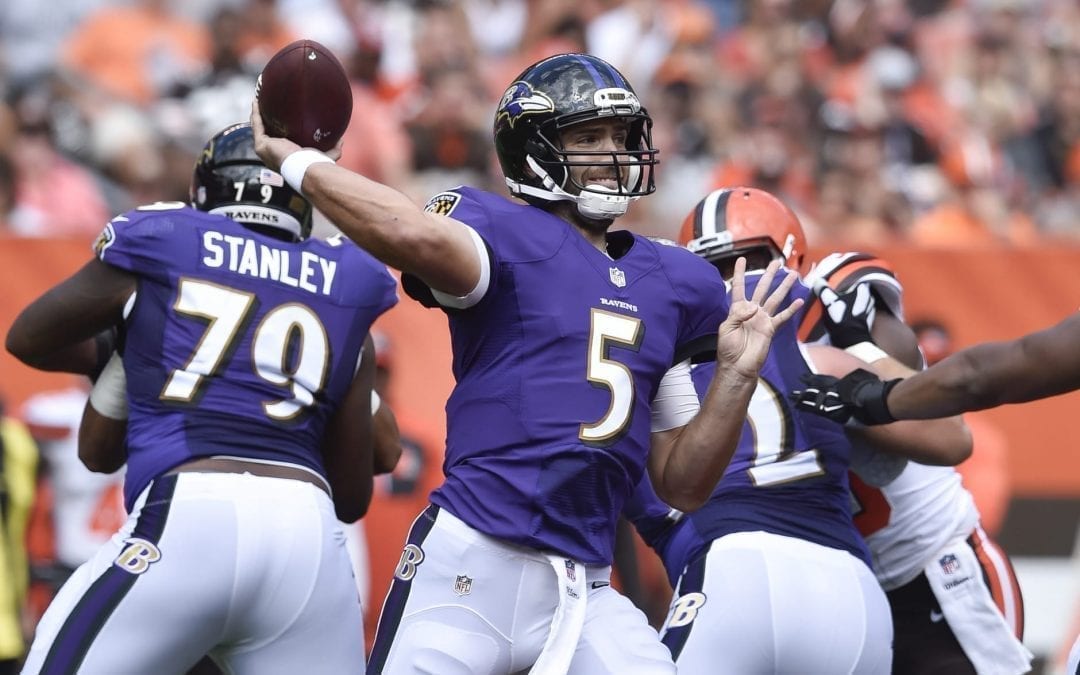
Few teams entered 2016 with more variables, questions, and potential for success and disaster in equal measures than the Baltimore Ravens. So it’s no surprise that the expectations for the the team ran the gamut from playoff contender to NFL cellar dweller. Through two weeks, the Ravens have somehow managed to embolden each side of the divide, posting a 2-0 record while playing some of the ugliest football in the league thus far. While pinning down any team through two weeks can prove difficult, making sense of Baltimore’s start represents a challenge all its own.
Neither of the Ravens’ two games make a clear case for the quality of the team. On the one hand, they never trailing during their Week 1 win over the Buffalo Bills, though they managed only 11 offensive points against a defense ranked among the league’s worst over the past 12 months. Quarterback Joe Flacco and his surgically reconstructed knee performed admirably in the tilt, averaging nearly 8 yards per attempt and avoiding costly mistakes and turnovers. Still, the offensive line allowed the Bills to knock down Flacco nine times, including four sacks for 33 total yards lost. That same line struggled to carve out running lanes, leading to Baltimore’s running backs producing just 3.3 yards per rush.
And Week 2 only further confused the matter. In the first quarter, the Ravens yielded 20 points to the lowly Cleveland Browns, a team already without preferred starting quarterback Robert Griffin III. Over two-thirds of that damage came from Corey Coleman, a rookie receiver still learning the basic tenants of Hue Jackson’s offense after playing three seasons in Baylor’s spread attack. But while a three-possession deficit normally dooms even the most talented squads, Baltimore managed to battle back, scoring 25 unanswered points and playing shutdown defense in the game’s final minutes.
(Discuss this article on the BSL board)
All of which paints the picture of a team capable of bouts of brilliance interspersed between periods of decidedly poor on-field performance, and that reality cuts both ways.
On the positive end, the Ravens have found ways to generate points with the likes of 37-year-old wideout Steve Smith Sr., the somehow-functioning remains of Dennis Pitta, and, at least as currently constituted, an unremarkable backfield group. Flacco does not appear physically limited despite suffering a major knee injury less than nine months ago. The defense has generated regular pressure without the services of Elvis Dumervil, still the second-best pass rusher on the roster.
Yet at the same time, the Ravens lacks any trump card, a player or schematic nuance that force opponents to reconfigure their entire approach in anticipation of the showdown. Their roster features no Antonio Brown- or Von Miller-like figure, someone capable of creating mismatches anytime they step on the field. Likewise, the coaching staff has no go-to strategy on either side of the ball to force a positive result such as the New England Patriots’ complimentary route concepts or the Seattle Seahawks’ press coverage. Without any semblance of one or more of these elements, Baltimore can expect their inconsistencies to persist.
While that may seem a dour diagnosis, the Ravens do possess some wildcards with the potential to alter their fortunes this season.
Rookie tailback Kenneth Dixon, the team’s fourth-round pick this past April, entered the NFL as the most decorated runner in Louisiana Tech program history. He fell just 83 yards short of posting four consecutive 1,000-yard campaigns, an unrivaled accomplishment among his peers in the 2016 draft class. A knee injury has kept him on the sidelines since the preseason. However, once he returns in a few weeks, Dixon’s combination of quickness and power could fast propel him to the top of the depth chart. Those traits, along with his receiving skills make him a potentially dangerous weapon in Marc Trestman’s offense.
Fellow rookie Chris Moore could offer a similar shot in the arm for the passing game. His two catches for 22 yards have left little mark through the first two weeks. Yet, like many first-year wideouts, his play could dramatically increase later in the year as he gains stronger footing in the offense. With legitimate deep speed and ball-tracking skills, a refined Moore could break games catching bombs from Flacco.
But those developments, should they even occur, remain weeks or even months away. Until then, the Ravens must operate within their current limitations, likely keeping them in pole position for the status of most-befuddling team in the NFL.

Jason B. Hirschhorn is an award-winning sports journalist and Pro Football Writers of America member. He has bylines at NFL.com, SB Nation, Sports Illustrated, and other outlets.