
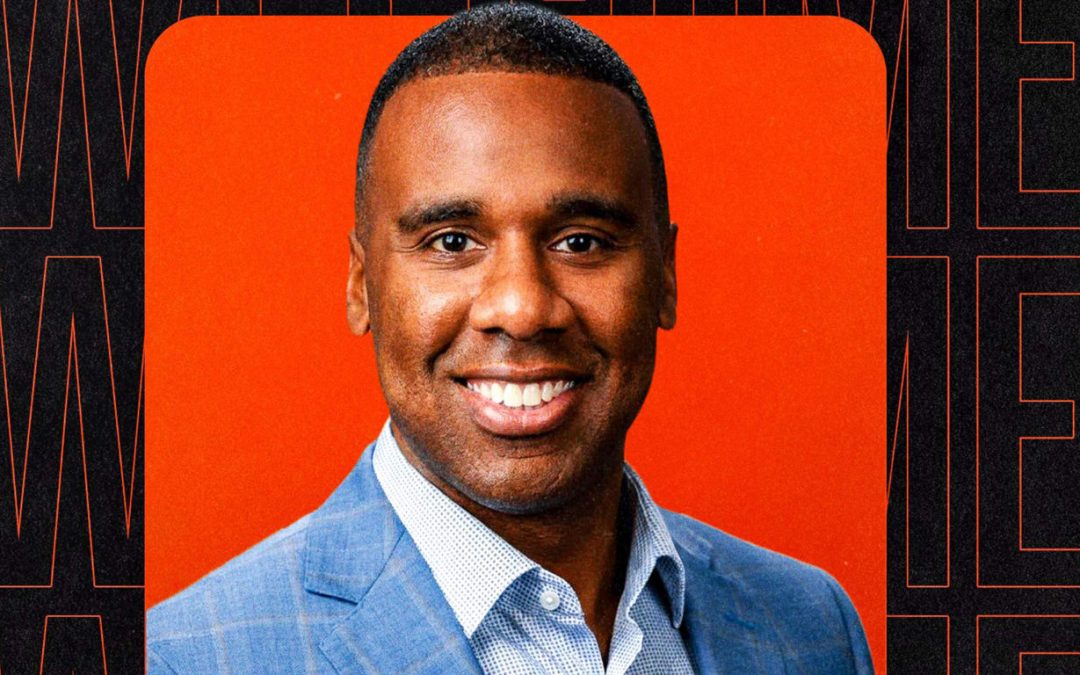
The Orioles named Jared Banner their General Manager on Monday. He’ll be introduced at Camden Yards a week from Tuesday, on October 27th.
Banner is 41, a Brooklyn native, and he has spent 18 seasons in baseball operations. He was the Cubs’ Assistant General Manager, a job he’d held since 2024 after running their Player Development department from late 2021 through 2023 and arriving in Chicago as Vice President of Special Projects in December 2020.
Before that, two years with the Mets as Executive Director of Player Development. Before that, eleven years with the Red Sox – a fellow in 2007 who became a Player Development Assistant, then Amateur Scouting Coordinator, then Assistant Director of Player Personnel, then Vice President of Player Personnel, overseeing professional scouting in Japan, Korea, Taiwan and Mexico. Boston won the World Series in 2007, 2013 and 2018. He was there for all three.
He played four years of outfield at Amherst, captained the team in 2007, and got into the game because his college coach knew Ben Cherington, who had played for the same coach eleven years earlier.
That’s a real resume. But the more interesting thing about Monday’s announcement is the job description.
Read The Title Carefully
From the Orioles’ statement, Banner will “lead the organization’s player development, coaching and performance efforts, while also partnering with Elias on strategy, staffing, and talent acquisition.”
Player development. Coaching. Performance. Those are his. Strategy and acquisition he shares.
Now put that next to the rest of what’s happened in that building over the last six weeks.
Matt Blood is gone. The Vice President of Player and Staff Development, a longtime and well-regarded executive, mutually parted ways with the organization in September.
Sig Mejdal has been moved. Elias’s first hire after leaving Houston, the Assistant General Manager who built the analytics department, is no longer overseeing it. He’ll now oversee “the research of emerging technologies and innovative practices across baseball operations,” which is a real job and also not the job he had.
And now a General Manager has been hired whose primary portfolio is player development.
Mike Elias has looked at an organization that went 79-82 after finishing last in 2025, and he has concluded that the thing that broke is the machine that was supposed to turn prospects into major leaguers.
He’s right.
The Evidence Was On The Field All Year
Baltimore hit the ball harder than the league average in 2026. Team exit velocity of 89.9 mph against an MLB mark of 88.8. A hard-hit rate of 42.6% against 38.6%. A barrel rate of 8.7% against 7.7%.
Their expected wOBA was .323. Their actual wOBA was .313.
They hit it harder than almost anybody and scored less than they should have. Meanwhile Colton Cowser, Coby Mayo, Samuel Basallo, Jackson Holliday and Dylan Beavers – four first-round picks and the best catching prospect in baseball – produced exactly zero seasons of a 110 wRC+ between them.
At some point that stops being five separate coincidences and starts being an organizational result.
The Orioles had the No. 1 farm system in baseball four years running through the 2023 preseason. Eight Top 100 prospects that spring. Six were position players. Gunnar Henderson became a star. Jordan Westburg became a very good player when healthy. Joey Ortiz is in Milwaukee. The rest are 24 to 26 years old and still being described in terms of what they might become.
The rebuilding playbook worked right up until the part where the players were supposed to turn into a winning team. That’s the gap Banner has been hired to close, and the Orioles are telling you so in the press release.
And there’s a more specific version of the mandate, which came out of our playoff preview and is worth putting in front of him on day one.
Of those eight Top 100 prospects in 2023, only two were pitchers: Grayson Rodriguez and DL Hall. Both have been traded. Hall threw a 1.91 ERA out of Milwaukee’s bullpen this year. Tyler Wells had a 1.50 ERA for Tampa Bay after the deadline. Cedric Mullins started in center for the Rays because of his glove, and Adley Rutschman was the best defensive catcher in the field.
Every team that earned a bye got there by keeping runs off the board, and they did it with arms they grew. Cleveland’s 2023 Top 100 group had Gavin Williams, Tanner Bibee and Daniel Espino; the Guardians turned that into a 109 ERA+. Milwaukee took Jacob Misiorowski in the second round in 2022 and he posted a 1.80 ERA this year.
Baltimore’s system is back to No. 7, and for the first time in this era three of its four Top 100 prospects are pitchers: Anthony Eyanson, Joseph Dzierwa and Caden Hunter.
That’s the job. Not “improve player development” in the abstract. Turn those three into Orioles starters rather than trade chips, and don’t repeat what happened with Rodriguez and Hall.
What He Actually Brings
Two things, and the second one is less obvious than the first.
The Player Development background is the headline. He ran the Mets’ farm system and the Cubs’ farm system, and he came up inside a Red Sox organization that was an early adopter of things that are now standard. Jon Meoli wrote this week about interviewing Xander Bogaerts in Frederick years ago and being told the kid had to finish his vision training first – a crude laptop program where a dot crossed a strike zone and hitters had a fraction of a second to react. That was Boston in the early 2010s, pushing at the edges while traditional coaches ran everything else.
Banner’s own description of the work is worth reading, because it isn’t what you’d expect from an analytics hire: “I don’t think you want to move to any one side. I think we do try to stay grounded in the evidence, but at the end of the day, they’re human beings. There needs to be a human touch, a care, a belief in each other and a culture created.”
He’s also said, in a long Executive Access Q&A with MLB.com, that 2021 was the year he stopped believing he could just look at a player and know. That’s a useful instinct in a front office that’s been accused of the opposite problem.
But the credential that actually matters is Pete Crow-Armstrong, and it isn’t for the reason you’d assume.
Banner is credited with the Cubs’ acquisition of Crow-Armstrong from the Mets in the 2021 Javier Báez deal, and Crow-Armstrong is the likely National League MVP. Fine. Plenty of executives have a trade on their ledger.
The relevant part is what happened next. Crow-Armstrong arrived in Chicago as a prospect and got better — through the exact player development department Banner was running in 2022 and 2023. A kid came in with a grade on him and left as the best player in his league.
That is precisely the thing Baltimore has not been able to do. The Orioles have been excellent at acquiring prospects and have spent two seasons watching them arrive at 24 and 25 and hover. If you’re looking for the single data point that justifies this hire, it isn’t the Báez trade. It’s that one of the best players in baseball was developed on his watch.
Now the part that complicates it. During Banner’s time in Chicago, the Cubs did something Baltimore has never done: they spent their system. Fifteen players traded away who now appear on other organizations’ Top 30 lists, a farm ranking that fell from eighth to 28th in eighteen months, and a playoff berth at the end of it.
I’ve argued all fall that the criticism of Elias is no longer about talent evaluation but about conviction – an executive who accumulates and doesn’t convert. So on its face, hiring from an organization that converted is exactly right.
Except, as we laid out in our 2026 MLB Playoff Preview, the Cubs got swept out of the Wild Card round. The Yankees fell from 13th to 27th in the system rankings. Houston has ranked 29th on five straight lists, spent $246 million, and went 81-81. San Diego is 30th. Those teams made October and arrived there without cushion.
The four clubs that got first-round byes – the Rays, Guardians, Brewers and Dodgers – had the four best average farm rankings in the entire field. Three of them did it on bottom-four payrolls: Cleveland at $70 million, Tampa Bay at $90 million, Milwaukee at $125 million.
So Baltimore has hired a development executive from a team that won by trading its development. Which model came with him is the question, and the answer probably depends less on Banner than on the man he reports to.
What It Says About Elias
Elias was promoted to President of Baseball Operations before the 2025 season, quietly, with no announcement. He’s been carrying both titles ever since, and he said in September that he wanted help:
“We have a small operation. It has been. I’ve seen in some metrics it’s like 29th in the league in terms of size in baseball operations… And there’s parts of our baseball operation that I think I could use some different voices and ideas in more than others.”
Then the tell: “I don’t know that I want to get into it here on the stage, but you’ll probably be able to see as these hires come in where we’re looking for some impact.”
We can see. He told us where to look and then looked there.
I wrote a piece on August 3rd under the headline “Yeah, Time For Elias To Go.” I took the headline back in “The Winter Ahead” and said the critique of the process still stood.
Ownership has now given its own answer, and it’s neither of mine. They didn’t fire him and they didn’t simply back him. They made his department bigger and handed a third of it to somebody else.
I’d note two things about that. The first is that it’s genuinely to Elias’s credit. Handing the Player Development department to an outside hire with his own resume and his own constituency is not the move of a man protecting his territory. He identified the weakness as his own and gave it away.
The second is that it’s a hedge, and everybody involved knows it. Elias has had eight years. The farm is loaded again, the books are the cleanest in the sport, and the team has finished under .500 twice in a row after an AL East title in 2023. If 2027 goes badly, there is now an experienced, well-regarded executive sitting one chair over who was a finalist for the A’s top job this month and who interviewed for other lead roles.
That’s not a prediction. It’s just how front offices work. You could argue that Elias is placing a potential scapegoat in-front of him, but I don’t think that argument has a lot of merit.
If things don’t improve for the O’s in ’27, Banner won’t be out the door before Elias.
What It Says About Rubenstein
David Rubenstein and Michael Arougheti authorized a franchise-record $170 million payroll last winter – 16th in baseball, ahead of Milwaukee, Tampa Bay, the White Sox and Cleveland, three of which earned first-round byes this month – and got a losing season out of it.
Their response was not to fire the President of Baseball Operations. It was to make his department bigger.
Elias said the owners “are looking to build” and have been “very supportive.” Meoli’s point this week is the right one: Banner’s job isn’t only development, it’s capital allocation. The Red Sox teams he came up in didn’t just carry high payrolls, they pressed advantages wherever the rules let them — most famously by blowing past everyone on draft bonuses before the pool system existed.
That specific lever is gone. But the question of where else to deploy Rubenstein’s money, beyond the major league roster, is exactly the kind of thing a 29th-ranked baseball operations department has never been able to ask.
What It Means For The Two Offseason Plans
We laid out two versions of this winter a few weeks ago. Option 1 runs the group back — re-sign Rogers, add a catcher who plays, find Mayo at-bats in right field. Option 2 is the wholesale one – Rogers walks, Holliday and Beavers go out in a package for a controllable arm, Varsho in center, Basallo catching 110 games.
The Banner hire doesn’t pick between them. But it bears on both.
Go back to the “Best Case, Worst Case, Likely” exercise. Basallo at 3.0-3.5 wins. Cowser at 2.5-3.0. Westburg at 2.5-3.0. Holliday at 2.0-2.5. Mayo at 1.5-2.0. Beavers at 1.0-1.5. Add Alonso and a Henderson bounce-back and the position group lands somewhere in the low twenties, which I called sufficient rather than good.
Every one of those likely cases is a development assumption. The best cases – Basallo as a 5-win All-Star catcher, Cowser as a 4.5-win center fielder – are the difference between 87 wins and 92. I wrote at the time that you can’t build a 95 win team by waiting for four of them to hit their ceiling simultaneously.
Banner’s actual job is to make that less true.
Which creates one real tension with Option 2. That plan trades Holliday and Beavers. You could reasonably argue the Orioles just hired the person whose entire brief is figuring out why those two haven’t developed fully, and that selling both in his first winter is the organization answering a question before its new answer-finder has unpacked.
I don’t think that should stop a good trade. But if Baltimore is going to move young position players in December, somebody should at least ask the new guy first.
Does This Put Seiya Suzuki In Play?
It’s an obvious immediate question.
Suzuki is a free agent after five years with the Cubs, which means Banner was in that building for every one of them. And it isn’t only the Chicago overlap. Banner’s last two years in Boston, 2017 and 2018, were spent overseeing professional scouting in Japan, Korea, Taiwan and Mexico – which is to say he was working that market while Suzuki was establishing himself with Hiroshima. He scouted the player before the Cubs signed him and then watched him for five seasons from inside the front office.
That’s an unusual amount of proprietary information about one free agent.
Suzuki is coming off of a 4.6 fWAR season, and he’s an exceptional fielder.
Both of our offseason plans said every available dollar goes to run prevention and none of it goes to more offense. Suzuki is the rare player who doesn’t force that choice – he’s a run-prevention signing that happens to carry a 134 wRC+.
He’s also right-handed, which addresses the structural hole in both plans. Cowser bats left-handed and struggles against lefties. Beavers bats left-handed. Basallo bats left-handed. Henderson bats left-handed. In Option 2, Varsho bats left-handed too. CBS made the point this fall that there are shockingly few quality right-handed hitters in the game right now. The Orioles need one badly.
Where he’d play is clean. Put Suzuki in left, keep Cowser in center, leave Mayo in right. That swaps out Beavers and his -9 Outs Above Average for one of the best corner-outfield gloves in the sport and a middle-of-the-order bat, and it does it without disturbing the Mayo-to-right-field plan which I think will get consideration from the O’s.
A 134 wRC+ with Gold Glove defense in a corner is a $25-28 million a year player, even at 32. And the qualifying offer figure for this winter came in at $23.15 million. Suzuki will get one, is expected to reject it, and whoever signs him forfeits a pick.
Our Option 1 budget was $66 million total: Mize at $18M, Rogers at $21M, Jeffers at $19M, Robert at $6M, a depth outfielder at $2M. Suzuki at $26 million costs you roughly the catcher and the fourth outfielder. For a team whose catching spot donated a lineup slot twice a week last season, that’s a genuinely hard trade, and I’d probably still take Jeffers.
Which means Suzuki is a $200-million-payroll conversation. He’s not an alternative to one item on the list. He’s an argument for the list getting longer.
Now, does Banner’s presence change the odds? At the margin maybe.
What the connection buys is the stuff you can’t scout – makeup, work habits, how he responds to coaching, medical history that never makes a report. In the room, when somebody asks whether the age 33 and age 34 years are going to hold up, Baltimore now has a first-hand voice instead of a folder. That’s worth something real.
What it doesn’t buy is a discount. Banner’s portfolio is player development, coaching and performance; he partners on acquisition. Elias runs acquisition. Familiarity has never once won a bidding war.
And it cuts both ways, which people forget. Banner may know exactly why the Cubs let him walk to free agency instead of extending him. The most valuable thing that relationship produces might be Banner telling Elias not to.
My read: Suzuki is a legitimate fit on the merits and would make the Orioles meaningfully better. Whether Banner knows him is close to irrelevant to whether they sign him. Whether David Rubenstein will go past $200 million is the only question that matters.
The Caution
This is a process hire. It does not add a win in 2027.
The actual list is still sitting there, and it’s still Elias’s to execute. The Orioles need a starting pitcher at the top of the rotation – and as we worked through in the playoff preview, a team that’s 60% to win a given game still takes a best-of-three only about 65% of the time. You’d need something like a best-of-75 to be 80% sure the better club advances. An ace is the closest thing to cheating those odds, because he pitches twice in a short series. Baltimore’s four most-used starters finished between 3.56 and 4.12. That’s innings, not an edge.
They also need to decide what to do about Trevor Rogers before the December 1st lockout. They need a catcher who can take 50 to 70 starts without being an automatic out. They need outfield defense. They need to settle on Gunnar Henderson, who has two years of control left.
None of that gets easier because a General Manager was hired in October. Front Office moves are the most applaudable thing an organization can do in an offseason, because nobody can tell you for two or three years whether they worked.
But this one is aimed at the right target. The Orioles did not get worse because they ran out of talent. They got worse because the talent stopped getting better, and they have just spent six weeks restructuring the department responsible for that.
One last note worth recording. With Houston’s firing of Dana Brown, Jared Banner is the only Black General Manager in Major League Baseball. He’s talked publicly about wanting young African Americans to follow the path he took – keep learning, keep meeting people, keep growing the network. He’ll have a platform here to do something about it.
Welcome to Baltimore. The work starts immediately, and the hard part isn’t the part he was hired to fix.

Owner
Chris Stoner founded Baltimore Sports and Life in 2009. He has appeared as a radio guest with 1090 WBAL, 105.7 The Fan, CBS 1300, Q1370, WOYK 1350, WKAV 1400, and WNST 1570. He has also been interviewed by The Baltimore Sun, Baltimore Business Journal, and PressBox (TV). As Owner, his responsibilities include serving as the Managing Editor, Publicist, & Sales Director.