
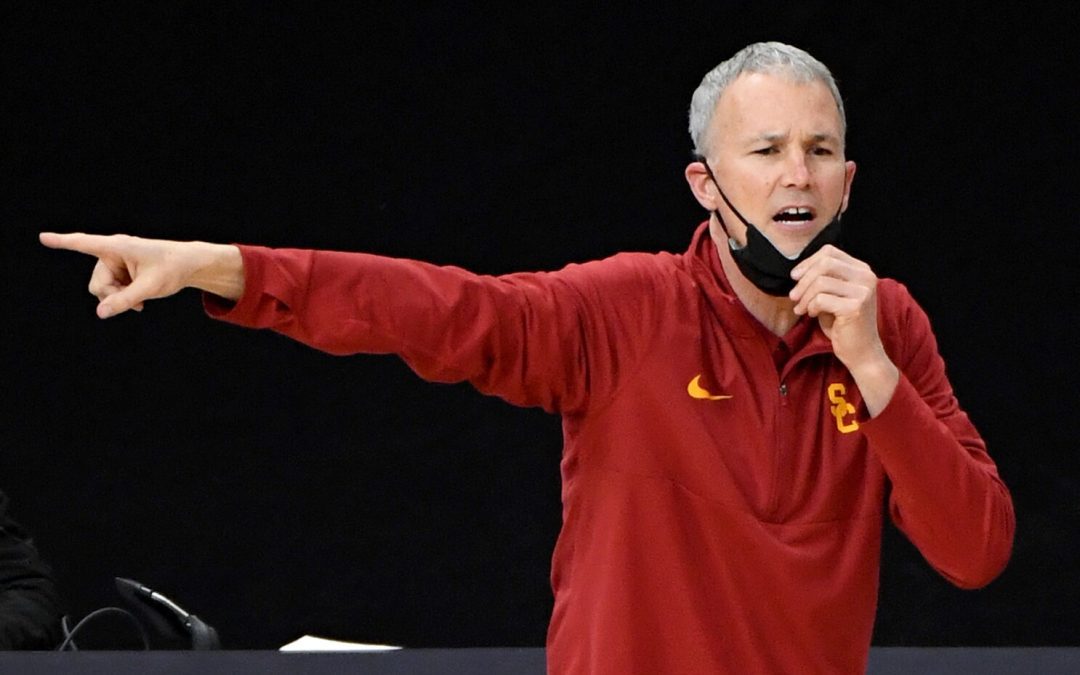
After looking at Seton Hall’s Kevin Willard as a candidate for the new head coach of the Maryland men’s basketball team last week, we’re going to continue examining candidates with USC’s Andy Enfield.
Enfield made his name at Florida Gulf Coast, but has been coaching the Trojans since 2013-14 and reached his first NCAA tournament with USC during the 2015-16 season. Just like the Willard article, I’ll just be focusing on what Enfield accomplished, starting with his first NCAA tournament season with the Trojans.
He is also a notable candidate for the Maryland job because of some local ties. He grew up in Pennsylvania, played for Johns Hopkins and went to Maryland for grad school, earning an MBA in College Park.
Let’s take a closer look at another candidate for the Maryland head coach job.
How they play
From 2015-16 to 2018-19, USC was an offense-first team based on Kenpom’s adjusted efficiency. Across those four seasons, they averaged a ranking of 46th for offense and 94th for defense. However, 2019-20 saw a very drastic shift, with the Trojans suddenly having a top 20 defense and an offense that ranked outside the top 100. Since then, USC’s rankings for offensive and defensive efficiency have been very balanced.

USC’s vastly improved defensive efficiency in the last three seasons can best be explained by a defense that became elite at defending two-pointers. USC has been in the top ten for opposing two-point percentage three straight seasons, demonstrating a remarkable ability to stop inside shots. In the prior four seasons, USC was in the top 100 for opposing two-point percentage three times but never ranked higher than 84th in that timeframe.
This improved defensive efficiency has also come with very little reliance on creating opposing turnovers. USC’s last three seasons have not seen them rank in the top 200 for opposing turnover percentage. Additionally, this year’s defense has been especially poor at creating turnovers, ranking 340th out of 348 teams in the country for opposing turnover percentage.
When looking at USC’s offense, a curious trend that’s spanned four straight seasons stands out: they’re bad at free throws. From 2018-19 to this season, the Trojans have ranked in the 300s for free throw percentage. Once a player gets to the free throw line, I don’t think there’s much a coach can do in terms of in-game instruction or strategy, but it’s still a very puzzling thing to see happening repeatedly with different rosters.
If you’re looking for a positive on offense for USC, they’ve been very solid at avoiding turnovers, a common weakness for Mark Turgeon teams. In five of their last seven seasons, they’ve been in the top 100 for lowest offensive turnover percentage, with three of those seasons being in the top 30. Meanwhile, the last six full seasons under Turgeon saw the Terps rank in the top 100 for lowest offensive turnover percentage just twice.

As for the tempo, USC has been somewhat inconsistent for that part of their offense. Out of the last seven seasons, two have seen the Trojans rank in the top 100 for Kenpom, while three other seasons have resulted in a tempo that ranked 200th or lower. Tempo looks to be a flexible part of Enfield’s coaching style and adapting from season-to-season sounds like a good coaching approach to me.
NCAA tournament results
I’m going to focus on USC for the rest of this article, but we can’t discuss Enfield in the NCAA tournament without mentioning Florida Gulf Coast.
In 2012-13, Enfield was the architect of one of the most legendary Cinderallas in tournament history, turning FGCU into Dunk City as the #15 seed Eagles upset #2 seed Georgetown and #7 seed San Diego State on their way to a magical Sweet Sixteen run.
Meanwhile at USC, Enfield reached the Elite Eight during last year’s tournament and did so in style. As the #6 seed, USC won their first three tournament games by double digits, including a remarkable 34-point blowout win against #3 seed Kansas. The Trojans then ran into #1 overall seed Gonzaga, who comfortably dispatched USC 85-66 to reach the Final Four.
Maryland never reached an Elite Eight with Turgeon and last advanced that far when they won the 2002 national title, so it’s safe to say an Elite Eight in College Park would be met with incredible enthusiasm.
USC’s Elite Eight is especially notable given that Enfield didn’t produce a ton of tournament success prior to last year at his current job. The Trojans were eliminated in their first game as a #8 seed in 2015-16 and then improved on that result by making the round of 32 as a #11 seed before being eliminated by #3 seed Baylor the following season. USC then missed the 2017-18 and 2018-19 tournaments and was a projected #9 seed by BracketMatrix.com for the 2019-20 tournament that was canceled.
Turgeon never missed the NCAA tournament in back-to-back seasons once Maryland moved to the Big Ten, so if you want a coach that is able to consistently get his team to the dance, Enfield might not be your guy. However, if you’re willing to sit through a couple lean years knowing an Elite Eight run is the ceiling, then I’d imagine Enfield’s tournament history is very enticing.
Conference tournament results
USC’s recent results in the conference tournament with Enfield have felt boringly neutral.
They are 6-5 in the Pac-12 tournament since 2015-16, having never won the tournament with only one appearance in the title game. While USC has never won the conference tournament, they’re also never gone winless in their last five appearances.
Avoiding a winless conference tournament isn’t exactly a glamorous outcome for a head coach, but it’s something Turgeon failed to do for three straight seasons, so Enfield would still be an upgrade if he made it five straight tournaments getting at least one win.
The one year USC reached the conference title game, they ran into a future #1 pick. Deandre Ayton dominated the Trojans with 32 points and 18 rebounds as Arizona denied Enfield a conference tournament title with a comfortable 75-61 victory.
Interestingly enough, USC did not make the NCAA tournament after making a run to the conference title game that season. The 2017-18 squad was 12-6 in Pac-12 play, but failed to produce any notable wins in out-of-conference play and had an ugly loss at home to a Princeton team that finished 5-9 against Ivy League schools.
Performance against ranked teams
In recent years, USC simply hasn’t had many regular season games against ranked schools.
From 2015-16 to now, the Trojans have played a true road game against a ranked team just eight times. In that same time frame, Maryland has played 18 true road games against top 25 schools and even mid-majors like Savannah State or Arkansas-Pine Bluff have found themselves playing more than eight games against ranked teams on the road.
In those eight true road games, USC is currently winless. They’ve lost to a ranked Arizona team four different times, with the other four losses scattered between Colorado, Oregon and UCLA. Two of USC’s losses have been by five points or fewer, but four of them have also been by double digits. They’ve suffered a 23-point loss to #21 Oregon in December 2016 and also got destroyed by Lonzo Ball’s UCLA squad in a 102-70 blowout during February 2017.
Even when USC has been at home, their performance against ranked schools does not look like a team that can regularly deliver key wins. They’re 3-6 since 2015-16 in home games with ranked schools. However, two of those three wins have been against top ten schools, including a marathon win over #7 Arizona that needed four overtimes.
The Trojans are also 1-1 against ranked schools on a neutral court in the regular season, with a win over #20 Wichita State and a loss against #23 Xavier as part of a Thanksgiving weekend tournament from 2015.
USC’s lack of chances against ranked opponents isn’t really their fault and is instead just the outcome of the Pac-12 being one of the weaker power conferences, at least when it comes to having schools ranked. In the same time frame that USC played eight true road games, Arizona, Oregon and UCLA all played nine. Enfield’s record against ranked schools isn’t great, but it’s also a much smaller sample than coaches in other conferences.
Enfield is also currently looking at three more chances to play a ranked school this year. The Trojans still have two meetings with #9 UCLA on their schedule and will also be visiting #3 Arizona. A 2-1 record in that stretch would certainly make Enfield more appealing and a 3-0 performance would be incredibly impressive.

BSL Analyst
Rose Katz is a recent graduate of the University of Maryland’s journalism school, where she worked for The Diamondback as the online managing editor and a sports blogger. As a student, she spent almost all of her time on campus in The Diamondback’s newsroom or at Xfinity Center, Ludwig Field and Maryland Stadium. Rose gained intern experience with the Mid-Atlantic Sports Network (MASN).