
If you have been anxiously waiting for the next installment of our Baltimore Orioles depth chart preview series featuring the 2022 starting rotation, buckle up.
My fellow On The Verge co-hosts have covered the partially set but intriguing infield situation and the strongest and deepest unit of the roster in the outfield, which I encourage you to check out, if you haven’t.
As for the pitching staff, more specifically the starting rotation, there are plenty of question marks and very few firm answers, but by the end of the season, one rotation spot should be held by the top pitching prospect in all of baseball. Could a second Top 100 prospect and arm residing just outside of the Top 100 take up the other two spots? More on that later.
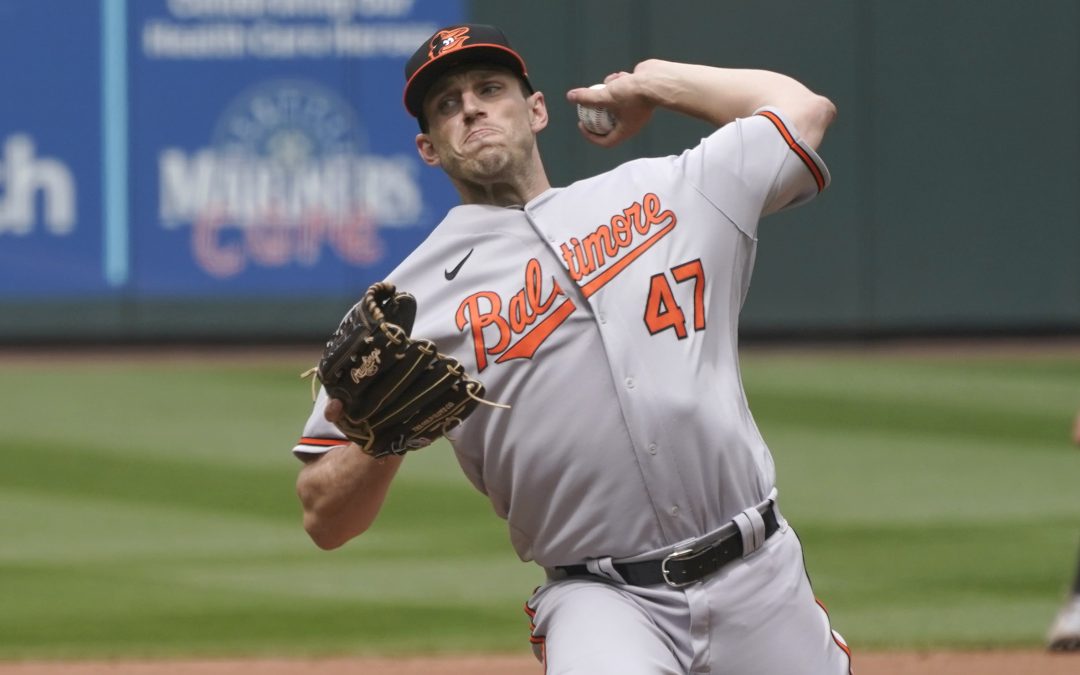
We know that LHP John Means is going to sit atop the starting rotation, once again. Means rebounded from a tumultuous 2020 season, posting a 3.62 ERA, 1.03 WHIP, and a 134/26 K/BB mark across 146.2 IP. His high-quality change is still his bread-and-butter pitch and his curveball has continuously improved to be a viable second out-pitch. He isn’t an ace, but has proven that he can be an effective major league starter. The only question is whether or not the Orioles decide to hold onto Means and keep him around for when the organization turns the corner, or do they continue to stockpile the farm system by shopping him in 2022? The farm system is in a pretty good place, with the first overall pick in the 2022 MLB draft, and largest draft pool, upcoming, so unless another team comes in with a huge overpay, Means should be safe.
The only other proven veteran in the mix is recently acquired RHP Jordan Lyles. I wrote my thoughts on the signing and one or two interesting notes I found already, but he should be fine, as long as more help is on the way. If he can at least pair with Means to work deep into games, Lyles will provide added value by helping out the bullpen. Lyles went at least six innings in 18 of his 32 outings last season, allowing three or fewer runs in 12 of those outings.
Once the lockout is over and the free agent frenzy before spring training begins, another veteran arm or two could very well be signed to help. Fellow BSL Analyst Stephen Loftus went over a few names he likes on short-term deals earlier this offseason. If one or two of these names can provide some early-season stability before being flipped at the deadline, I’d be happy.
One of the biggest disappointments of 2021 was the failure of any young pitcher to take a real step forward. There won’t be any shortage of young options in 2022, with the hopes that at least one or two take command of a rotation role.
LHP Bruce Zimmermann continues to show promise, but injuries wiped out a big chunk of his 2021 campaign. His slider and changeup (32% combined usage) are highly effective pitches, but opponents slugged .711 against his fastball, which produced minimal swing-and-miss. If that can be cleaned up and he can stay healthy, there’s a viable rotation piece here.
Other internal options for the rotation will include LHP Keegan Akin, RHP Michael Baumann, LHP Alexander Wells, LHP Zac Lowther, RHP Dean Kremer, and RHP Kyle Bradish.
Akin showed promise as a possible back-end option in 2020, but was hit hard in spring training, didn’t make the Opening Day roster, sliced his finger at home and missed a few weeks of the 2021 season with COVID. When he was on the mound, the strikeouts dipped, the walks remained an issue, and his ERA ballooned. If there’s a positive to extract from last season, it’s the way Akin ended the year after finally moving past the injuries and health issues. Over his final six starts, Akin tossed 31.1 innings with a 4.05 ERA, throwing his only two Quality Starts of the year and limiting opponents to just one run in three of those six appearances. Unfortunately, an abductor strain ended his season prematurely, but he’s expected to be a full go, whenever spring training finally starts. He’s perhaps best suited for a bullpen role, where his sneaky fastball can play up even more, along with his changeup that plays well against righties and lefties.
Michael Baumann got his first taste of the major leagues and while he didn’t blow anyone away, it’s pretty difficult to have any hard takeaway from that first cup of coffee. Baumann got a late start to the 2021 season after slowly coming back from a 2020 Alt Site injury and it took him a long time to get right in Bowie. His outings were up and down and the velo seemed to bounce around a bit, but his ups and downs can likely be attributed to continuing to mentally get over his injury instead of physically. He was effective in a very brief Triple-A stint and showed flashes of 2019 “Big Mike”, a powerful righty with a dominant fastball and high-quality slider who can work deep into games and get stronger as he progresses in outings.
Alexander Wells saw some MLB action last year and had flashes of success, but the control artist finished with an ERA of 6.75 across 42.2 IP with just a 13% strikeout rate and 6.4% swinging-strike rate. He’s a fly-ball pitcher who relies more on a strong defense behind him to make plays, but can pick his spots and has shown a great deal of success at all levels of the minor leagues. Maybe the new left field dimensions help, but Wells will have his work cut out for him to stick in the rotation.
Zac Lowther was completely mismanaged by the Orioles and never given an opportunity to pitch on any sort of schedule in 2021, both at the major league and Triple-A levels. He’s earned an opportunity to work in a regular role and see if he can stick in the rotation, but I’ve said for a long time that I think he can carve out a long, successful career out of the bullpen with his high-spin curveball and fastball that can run away from righties and ride in on lefties, he just needs a routine to develop feel for it all in the big leagues.
Of all the young arms who have MLB experience, Dean Kremer may have the highest ceiling, but he’s coming off a disastrous 2021 season at all levels. Nathan Ruiz of The Baltimore Sun gave his thoughts on Kremer on a recent episode of On The Verge, noting a heavy reliance on his fastball and big drop in his curveball usage, arguably Kremer’s best pitch. A hard reset this offseason and entering spring with a clear mind could go a long way in a rebound for the former MiLB strikeout king. The ongoing lockout isn’t doing Kremer any favors, so it’s likely he starts the year in Triple-A where he can regain his confidence before getting another opportunity in the big leagues.
Orioles fans can also expect to see a few notable prospects make their debuts in 2022, including the top overall pitching prospect in all of baseball, Grayson Rodriguez. Rodriguez largely breezed his way through High-A and Double-A competition last season, ending the year as the only qualified full-season minor league starting pitcher with a strikeout north of 40%. He averages 97 mph with his fastball and topped out at 101 mph, is armed with four plus-pitches, and produced a 37% or higher whiff rate with all four of his pitches. Some evaluators (well, just one) isn’t a big believer in the development of his changeup, but literally every other national evaluator has rained down high praise on the offspeed offering. It’s worth it to take a minute and re-read the recently released FanGraphs Top 45 Orioles prospects list and soak in what was said about Rodriguez and Rutschman. Even as someone who watched every single pitch from Rodriguez last season, I don’t think I’ve fully grasped just how elite Rodriguez could become.
Kyle Bradish received at least one Top 100 vote in Baseball America’s latest ranking, deservedly so after he ended 2021 as one of the more dominant arms in all of minor league baseball. Despite only one season of pro ball under his belt (back in 2019), the Orioles felt confident in promoting Bradish to Triple-A after just three starts with Bowie. There were ups and downs, as is expected with every single player in baseball, and Bradish has been open this offseason about specific troubles, but he certainly lived up to the hype that surrounded him entering 2021. Now on the 40-man roster, Bradish will start back in Triple-A to get work in, but he shouldn’t be there long.
The last big name to look out for in 2022 is DL Hall. Hall started just seven games last season before being shut down and didn’t pick up a baseball again until December, but he’s already back on the mound throwing an easy 95 mph and should be ready to go when the season begins. The big question is how will the Orioles limit his innings as he works back to full form? After what we saw in terms of innings last year for prospects, I imagine the Orioles work Hall back pretty cautiously. However, even with just seven starts on his resume in 2021, Hall is already being discussed as the heir to the top pitching prospect in baseball throne after the graduation of Grayson Rodriguez. Look throughout the majors and minor leagues and you won’t find but one or two lefties in the game with the stuff Hall has. There’s a small chance he makes the majors in 2022, but even if he doesn’t, he will surely be in line to begin 2023 in Baltimore’s rotation.
Major league pitching has been a disaster recently in Baltimore, and the inability of young arms to establish themselves was rough to watch last season. I imagine a lot of fans would enter 2022 with a bit more optimism about the overall season and pitching prospect depth if at least one arm would have really popped, but here we are.
I’ll leave on this note, though. We know John Means can man a rotation spot. Can Grayson Rodriguez or DL Hall man a second spot? Can just ONE arm among a loaded group consisting of Bradish, Drew Rom, Baumann, Kyle Brnovich, Zach Peek, Jean Pinto, Raul Rangel, Moises Chace, Garrett Stallings, Brandon Young, Carlos Tavera, and oh yeah, Carter Baumler, take a third spot? I like the odds. Use the surplus of bats in this system to trade for an established veteran and go out and sign one big free agent arm in the next year or two and there’s your starting rotation worthy of competing.
Here’s to hoping 2022 is a season of progress and good health.

Orioles Analyst
A former high school teacher and coach in the mountains of Virginia, Nick Stevens has been writing about the Baltimore Orioles and their minor league system for five years. When he isn’t at a minor league stadium, he’s enjoying a Wizards game or supporting his alma mater, James Madison University. Co-Host of The Verge.